
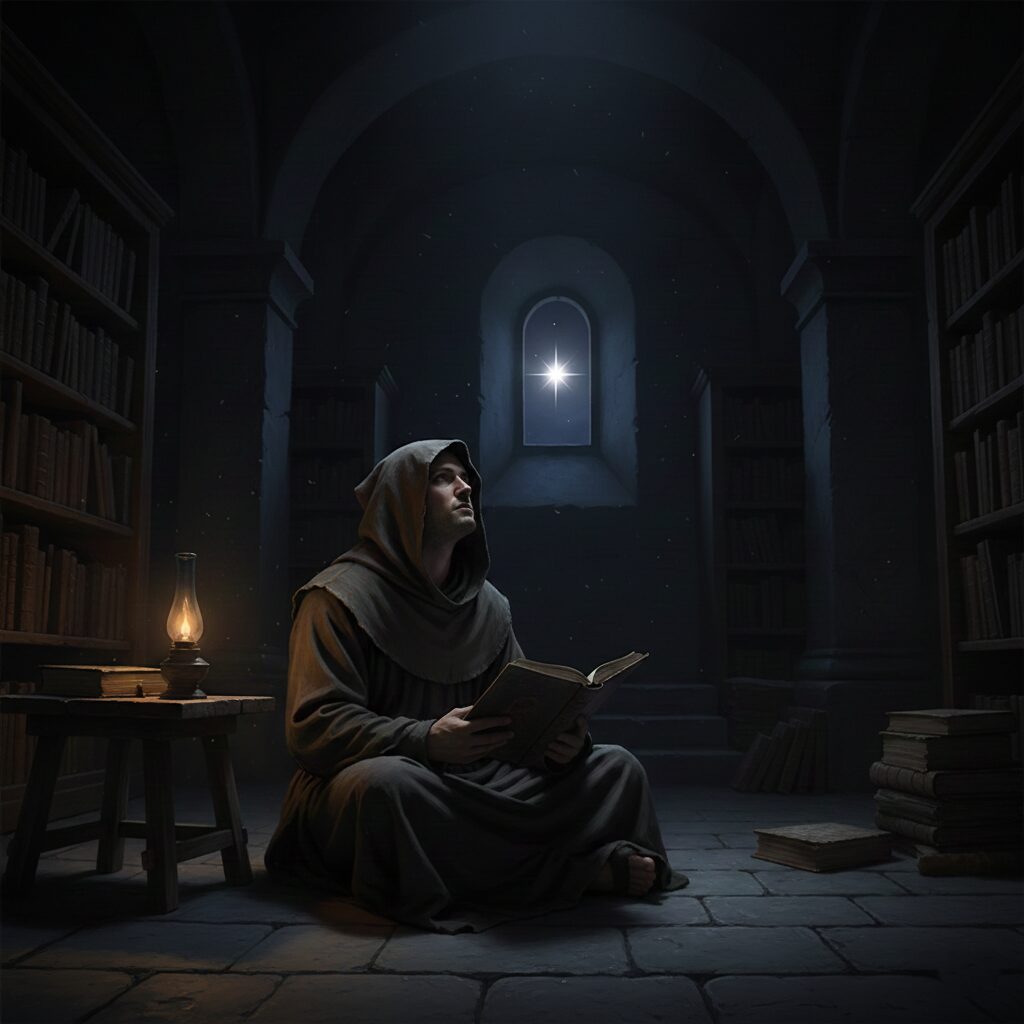
Advent begins as the year dies. The days shorten, darkness encroaches, and nature enters its dormancy. The Church invites us into this darkness not with dread but with expectation, asking us to wait for the coming Light. For St John of the Cross, the great Carmelite mystic and Doctor of the Church, this seasonal darkness mirrors the interior journey every soul must make toward union with God. His teachings on the dark night offer unexpected wisdom for embracing Advent as a time for spiritual transformation. Our culture resists darkness. We flood our nights with artificial light, fill silence with noise, and distract ourselves from discomfort with endless entertainment. Advent’s invitation to darkness — that is, to fasting, simplicity, waiting, and quiet — runs counter to everything our world teaches. Yet John insists that darkness is a divine gift, the very path God chooses to lead us into deeper union with Himself.
In The Ascent of Mount Carmel, John writes of the necessity of darkness for spiritual progress. The soul cannot reach union with God while clinging to created things, even spiritual consolations. God must wean us from our attachments, our false securities, our comfortable ideas about how the spiritual life should feel. This weaning happens in darkness — the darkness of faith that sees nothing, the darkness of hope that possesses nothing, the darkness of love that feels nothing. The shortening days, the Advent wreath’s progression through weeks of purple candles, the readings filled with prophetic longing and apocalyptic urgency all conspire to lead us into this fruitful darkness where transformation happens.
We live in times that feel especially dark — times marked by division, violence, uncertainty, and loss. For many, Advent arrives not as poetic metaphor but as lived reality: the darkness of grief, depression, doubt, or despair. John of the Cross does not minimise this darkness; rather, he insists that even here – especially here – God is at work. He has not withdrawn; rather, He draws near in a way our faculties cannot register. “The more the soul is in darkness with respect to all its faculties and attachments, the nearer it approaches to God,” he writes. This is faith’s supreme test: to believe in divine love when we feel nothing, to trust in divine presence when we perceive only absence, to hope in divine light when we see only darkness. For those enduring difficult Advents — perhaps facing the first Christmas after loss, wrestling with health crises, or struggling with fractured relationships – John’s teaching offers consolation. The darkness you experience is not evidence of God’s absence but of His transforming presence. He is purifying your love, deepening your faith, preparing you for a union more intimate than you could imagine. The call is to naked faith; that is, faith stripped of feeling, of consolation, of everything but sheer trust in God’s goodness. “In the beginning of the spiritual life it is good to give to the senses pleasure in holy things,” John acknowledges, “but later… the soul must walk in faith.” Advent’s darkness invites us to this mature faith, to believe not because we feel or see but simply because God is faithful.
The Advent liturgy repeatedly echoes Isaiah’s cry: “Prepare the way of the Lord, make straight his paths.” We are to prepare for Christ’s coming by making space for Him. But how? By decorating our homes, buying gifts, attending parties? These have their place, but John of the Cross points to a more fundamental preparation: emptying. In his famous sketch of Mount Carmel, John inscribed the path to God’s dwelling with a single word repeated: “Nada” – nothing. “To come to possess all, desire the possession of nothing. To come to be all, desire to be nothing.” Advent is preparation for the possession of the All – Christ becoming incarnate in our heart. John counsels us to dispossess ourselves of our desperate attempts to fill ourselves with anything other than God. Advent asks: What must be emptied from your life to make room for Christ? Perhaps it is the frantic activity that leaves no space for silence. Perhaps it is the grudges and resentments that clog your heart. Perhaps it is the attachment to outcomes, the need to control how God comes to you. Perhaps it is the very spiritual experiences you cherish; those moments of consolation you replay mentally, trying to recreate them rather than moving forward into new encounters with God.
John teaches that this emptying is not loss but gain. We empty ourselves of the finite to receive the Infinite, release our grip on shadows to grasp the Substance, let go of our small satisfactions to make room for boundless Joy. The dark night strips away everything that is not God so that God alone might fill us.
In John’s poetry, especially the Romances, we encounter a mystic enraptured by the beauty of God’s condescension. These poems meditate on the Trinity’s eternal dialogue about the Incarnation, imagining the Father, Son, and Spirit discussing how to win humanity back to love. The Romances reveal that Advent’s waiting is mutual. We are not alone in our longing; God Himself yearns for union with us. The Son eagerly volunteers to take on human flesh, to enter our darkness, to become vulnerable and small. “I will go and tell the world, spreading the word of Your beauty and of my love,” declares the Son to the Father. This transforms our understanding of Advent’s darkness. We do not wait alone in the dark; God descends into darkness with us, seeking us even as we seek Him. The Christ child we await is the God who cries – who experiences human limitation, who knows what it means to be cold, hungry, dependent, fragile. Our darkness does not repel Him; it attracts Him. He comes precisely because we dwell in shadow and need His light.
If you find yourself drawn to explore this deeper dimension of Advent, we invite you to join us for a retreat at the Carmelite Priory, Boars Hill, Oxford, from December 12-14. Titled ‘The God Who Cries,’ this retreat will immerse participants in the Romances of St John of the Cross, exploring the mystery of divine love that empties itself to fill us, that descends into darkness to become our Light. Together, we will prepare for Christmas by contemplating the God who longs for us even more than we long for Him; the God who chose to enter our night, crying as infants cry, vulnerable as we are vulnerable, Emmanuel: God-with-us in the darkness until eternal dawn.
Learn more about the retreat “The God Who Cries” here.