
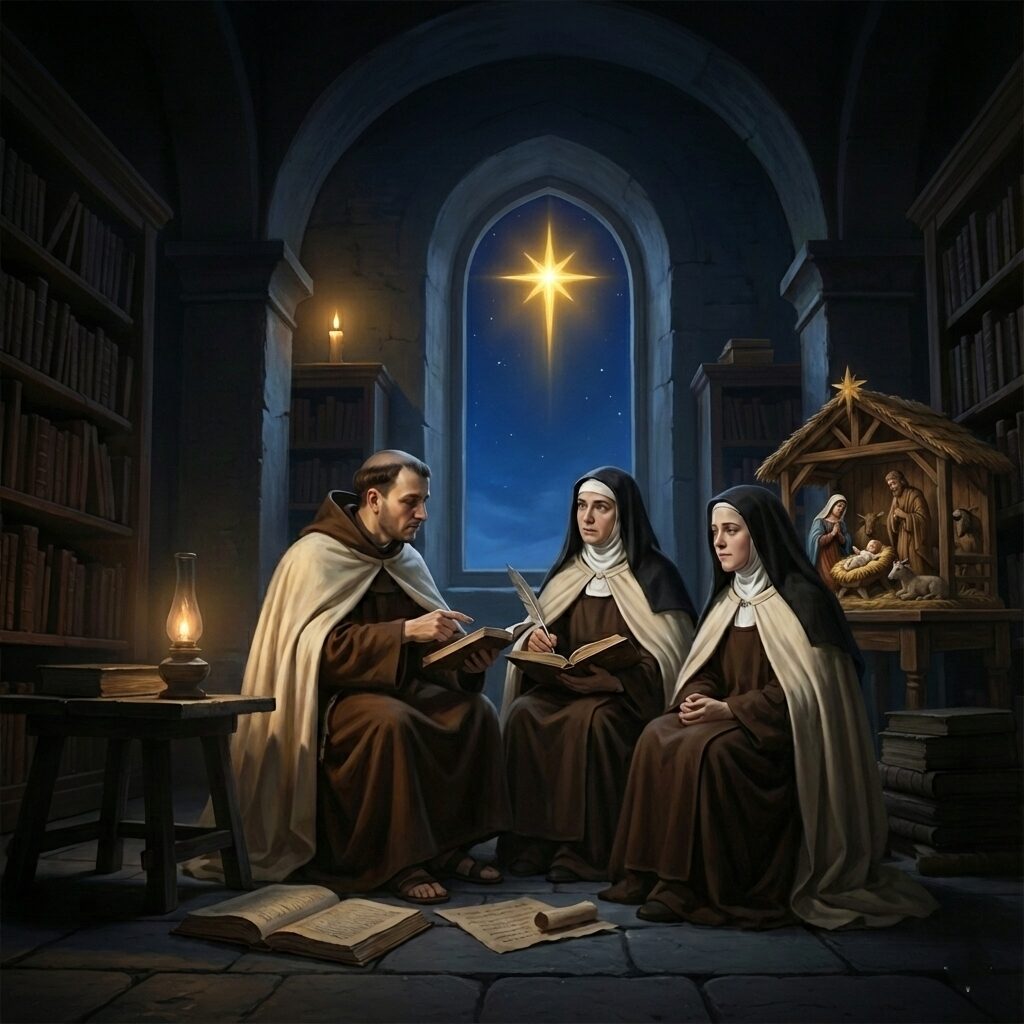
Christmas comes to us through song. Carols fill the air from Advent through Epiphany, proclaiming joy, peace, and the wonder of Incarnation. Yet beneath the jubilant melodies lies a deeper mystery that the Carmelite poet-mystics understood: Christmas is ultimately silent. The Word becomes speechless flesh. The Creator cries helplessly as a newborn. Omnipotence swaddles itself in weakness. This paradox — infinite God as a little child — finds its truest expression in poetry that hovers between sound and silence, between saying and unsaying, between declaration and wonder.
John of the Cross: The Romance of Divine Descent
The Romances of St John of the Cross offer perhaps the most theologically rich and tender meditation on the Incarnation in all Christian literature. Writing in ballad form, John imagines the etdernal conversation within the Trinity about humanity’s redemption.
In these verses, we overhear the Father speaking to the Son about creating humanity:
A bride who will love you
Is what I want to give you, My Son,
One who deserves you
And who at your side
Could eat bread at our table
The same as I.
When sin enters, the Father grieves:
I see that if I desire to give him
Someone who to him is equal,
I can find her only
In the likeness of your beauty.
The Son’s response captures the heart of Christmas:
Then I shall go and seek my bride
And take upon myself
Her weariness and labours
In which she suffers so.
Here is the sweetness of the Christmas mystery: divine love choosing poverty, divine strength embracing weakness, divine glory hidden in a stable’s obscurity. John’s poetry helps us see that the crying infant in the manger is the eternal Word saying “yes” to the Father’s plan from all eternity.
What makes John’s Christmas poetry so powerful is its focus. He doesn’t describe the stable scene, the shepherds, or angels. Instead, he takes us behind the event to the divine love that necessitated it. His silence about details invites our contemplation. Christmas happens first in eternity, in the Trinity’s loving dialogue, before it unfolds in Bethlehem’s straw.
Teresa of Ávila: Befriending the Christ Child
St Teresa’s approach to Christmas poetry is more intimate, more domestic. Her poems and letters reveal a woman who cultivated deep personal friendship with the Christ child. For her, the Incarnation wasn’t merely doctrine to affirm but relationship to enter.
In her poem Vertiendo está sangre (‘He is shedding blood’), Teresa contemplates the infant Jesus and sees already the passion foreshadowed:
I prithee tell me why
The Infant thus they wound,
For He is innocent,
No guile in Him is found
— Aye, for He comes to die,
To save from ills our earth.
She cannot gaze at the baby without seeing the man on the cross. Christmas and Calvary intertwine; the same love that empties itself into a manger will pour itself out on a cross. The swaddling clothes prefigure burial shrouds.
Yet Teresa’s poetry also radiates joy. She writes of the Christ child with maternal tenderness, encouraging her sisters to hold Him in their hearts, to rock Him, to warm Him.
If he is cold
I will warm him
And a thousand kisses on his feet
I will place.
This is Christmas mysticism — personal encounter with a particular baby who can be held, kissed, warmed.
Teresa teaches us that Carmelite Christmas spirituality is ultimately relational. The infant doesn’t represent an idea; He is a person seeking our love. Silent night becomes the silence of contemplation, of gazing at the child with love too deep for words, of offering ourselves as warmth against winter’s cold.
Thérèse of Lisieux: The Little Way to Bethlehem
The Little Flower found in the Christmas mystery the key to her ‘little way.’ The infant Jesus embodied what she most longed to teach: that littleness, weakness, and hiddenness are not obstacles to holiness but its very path.
In her poetry, Thérèse addresses the Christ child with intimate familiarity:
O Jesus, my beloved
Why this swaddling, these tears?
Ah! You reduce yourself to nothing
To attract my heart.
She recognizes that God becomes small precisely to draw us close, that He cries to teach us that our own weakness is no barrier to His love.
One of her most moving Christmas poems, Jésus seul (‘Jesus Alone’), contemplates the poverty of the stable:
Neither angels nor seraphim
Would sleep in such a place.
Yet this very poverty attracts her:
O Jesus! I want to live and to die
For love of you in lowliness.
Christmas reveals that God’s way is downward, that glory hides in obscurity, that the path to greatness runs through littleness.
Thérèse’s Christmas poetry invites us to embrace our own poverty. The child in the manger doesn’t demand that we be great, accomplished, spiritually advanced. He asks only that we come as we are — small, needy, dependent — and allow Him to love us. Silent night becomes the silence of trust, of resting like a child in the Father’s arms.
The Silence That Speaks
The Carmelite poets teach us that Christmas’s deepest truths are revealed in silence. Their verses don’t so much explain the Incarnation as invoke it, creating space for wonder and contemplation. They write with restraint because the mystery exceeds language.
This Christmas, perhaps we need Carmelite poetry more than ever. In a season of commercial noise, endless music, and frantic activity, these verses invite us into silence, the silence of presence too deep for words. They teach us to contemplate the Incarnation as John did, to befriend the child as Teresa did, to embrace littleness as Thérèse did. ‘Silent night, holy night. All is calm, all is bright.’ But the deepest brightness shines in silence, and the profoundest calm settles over those who learn simply to behold the wonder: the Word made flesh, dwelling among us, full of grace and truth.
If you feel inspired to delve deeper into the teaching and spirituality of any of the Carmelite mystics, and would like to see the offerings of our publications, please visit our bookstore here.
There is also a Lecture series being organised on the spiritual journeys of six Carmelite saints. For more information, please click here.