
V/ My eyes are turned to you, O Lord.
R/ You are the joy and gladness of my youth.
V/ Grant me the Wisdom that sits by your throne.
R/ That I may dwell as a child in your presence.
Let us pray. Lord, in your loving design, you have drawn me here to encounter you in your Word and, in you, to find myself. Empower me by your Wisdom, that this meditation may be a font of transformation and freedom, bearing fruit for my salvation and that of the whole Church. Amen
THE TRANSFORMING GAZE
By Candida Kirkpatrick, OCDS
The Solemnity of Mary, The Holy Mother of God, Theotokos
Numbers 6:22-27; Psalm 66(67):2-8; Galatians 4:4-7; Luke 2:16-21
31st December 2025
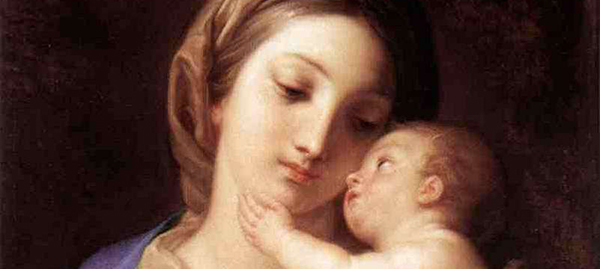
As we cross the threshold of a new year, the Liturgy ushers us into the embrace of Mama Mary, Mother of God. We join her as she beholds her Son, inviting the shepherds to encounter the promised Messiah face-to-face. In this theo-drama of the Incarnation, the Divine Face of the Infant Jesus is revealed, inspiring the Virgin to ‘ponder all things in her heart’ and the shepherds to glorify God. To behold another’s face is to enter the depths of their mystery—the very essence of their personhood.
The yearning to see God face-to-face permeates salvation history. The Priestly Blessing in the Book of Numbers—‘The Lord make his face to shine upon you… and give you peace’—articulates the human heart’s cry to be known and understood by the Creator. It is the realisation that seeing God’s Face initiates a reciprocal covenant relationship.
This relational gaze reaches its zenith at the Nativity. As the Immaculata, Mary possesses the capacity to receive the fullness of the Christ Child’s contemplative gaze. Their locked eyes establish Mary as the mirror reflecting Divine Love to humanity. As the Carmelite mystic St Elizabeth of the Trinity observed, Our Lady was ‘so transparent… yet she is but the “mirror” of the Sun of Justice.’
Modern neuroscience harmonises with this mystical insight. Secure attachment is formed through ‘mirror neurons’ stimulated by mutual gazing. This biological interfacing fosters trust and empathy; indeed, spouses often experience ‘appearance convergence’ through years of attentive looking. We are biologically hardwired for this divine mimicry.
St Pope John Paul II placed this spirituality at the centre of the new millennium. In Novo Millennio Ineunte, he asked: ‘Is it not the Church’s task… to make the Face of Christ shine also before the generations of the new millennium?’ Later, in Rosarium Virginis Mariae, he defined the Christian programme: ‘To contemplate the Face of Christ, and to contemplate it with Mary.’ He coined the term ‘Eucharistic Face of Christ’, urging Adoration as the means of transformation. We truly become what we gaze upon.
How, then, shall we live this year? If we intentionally gaze upon the Holy Face, we enter the sacred humanity that draws us into communion. If we put down our devices to truly look at our neighbour, we honour their dignity. As Theotokos, Mary teaches us to love with authenticity. May she, the Speculum Iustitiae (Mirror of Justice), assist us in reflecting Christ’s Holy Face to the world.
Prayer:
At the threshold of this New Year, we entrust our eyes to your care O Mother Mary. You who first received the gaze of the Incarnate Word, through your intercession, may we truly become what we behold. Grant us the grace to put down all that distracts, that we may see the “Eucharistic Face” in the breaking of the bread and the “Hidden Face” in the poor and the lonely.
Ponder Questions:
1. Do you allow the Infant Christ’s gaze in the unassuming posture of goodwill for all alike and in all things?
2. To whom in your life this year are you called to be a “mirror of the Sun of Justice,” reflecting their dignity back to them through your attentive presence?
3. If “we become what we gaze upon,” how might you intentionally shift your “gaze time” from the flickering shadows of digital devices to the “Eucharistic Face of Christ” in the coming year?
Practice for the week:
Each morning this week, before engaging with any screen or task, spend three minutes in “sacred looking.” Place a crucifix or an icon of the Theotokos before you. Do not seek to “study” the image or say many words. Allow your eyes to rest upon the Face of Christ and His Mother. Ask for the grace to carry this contemplative gaze into every encounter you have with people throughout the day.
Phrase to remember:
To contemplate the Face of Christ, and to contemplate it with Mary, – St Pope John Paul II, Rosarium Virginis Mariae, 3.