
V/ My eyes are turned to you, O Lord.
R/ You are the joy and gladness of my youth.
V/ Grant me the Wisdom that sits by your throne.
R/ That I may dwell as a child in your presence.
Let us pray. Lord, in your loving design, you have drawn me here to encounter you in your Word and, in you, to find myself. Empower me by your Wisdom, that this meditation may be a font of transformation and freedom, bearing fruit for my salvation and that of the whole Church. Amen
WISE MEN STILL SEEK HIM
The Solemnity of the Epiphany
Isaiah 60:1-6; Psalm 71; Ephesians 3:2-6; Matthew 2:1-12
4th January 2026
We recognise that the pilgrimage of these Eastern sages is the perennial journey of the soul. The Epiphany is not merely a narration of past events; it is the ongoing drama of the human heart’s orientation toward its Creator. Our Creator manifests as an infant, vested in the cloak of our humanity. Creative wisdom takes on a concrete existence and has become the light of all who seek real life.
Wise men still seek Him because true wisdom is the recognition that our deepest desire is not for more information, but for an Encounter. We seek Him because we know that our wisdom is not a fortress to be defended, but a road to be travelled.
This road was travelled by the Magi, who were men of “sparks” and “dreams,” possessing the highest natural wisdom of their age. Yet, they were truly wise precisely because they knew their wisdom was incomplete. In our Carmelite tradition, St. John of the Cross teaches in the Ascent of Mount Carmel that all natural lights must eventually give way to the “dark night” of faith. The Magi did not allow their sparks of insight to lead them to pride; instead, they followed the star not as masters of the universe, but as beggars for the Truth.
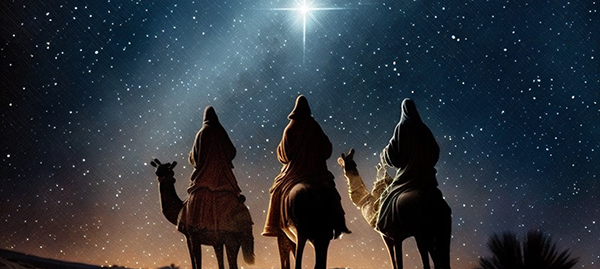
As St. John Chrysostom noted, this star was no ordinary celestial body; it was a miraculous guide comparable to the pillar of cloud in the desert, leading them from north to south. Yet, nature could only lead them to Judea; it could not tell them “Where.” For that, they needed the Scriptures. The star signals that the Logos has become tangible, inviting our reason to wander in wonder, leading to an obedience of faith.
However, in the Gospel, we encounter the terrifying counter-posture of Herod. He possesses the scribes and the scrolls; he knows where Christ is to be born, but he lacks the openness to tread wisdom’s footstep.
“When King Herod heard this, he was perturbed and so was the whole of Jerusalem” (Matt 2:3).
We must admit there is a “Herod” in each of us: the part that clings to the throne of our own plans, stagnant, deceptive and comfortable with the status quo. The Epiphany teaches us that Christ’s rule is not a competition; He comes not to take away our humanity, but to restore it.
In contrast to Herod’s paralysis, the truly wise move. Their journey mirrors the interior ascent described in St. Teresa of Avila’s Interior Castle. Teresa insists that the most important thing is to know Who dwells in our centre: “The King dwells in the centre of this castle.”
When the Magi fall to their knees, the “Nothing” (nada) meets the “Everything” (todo). Their gifts mirror the path of union: Gold is the surrender of the will; Frankincense, the ascent of prayer; and Myrrh, the acceptance of the Cross. These virtues anchor the theological disposition of charity, hope, and faith as the inner collaboration with the divine guidance.
Finally, the Gospel notes they returned “by a different way” (Matt 2:12). They emerged empowered, carrying the Light within. Today, the star leads to the Scriptures, and the Scriptures conduct us to a bended knee. There, in the Eucharist, we find the same King who sat on Mary’s lap. Wise men still seek Him, for they know that in the centre of our being, the logic of Love awaits.
Prayer:
Lord Jesus, Divine Child and King of the Nations, You led the Magi by the light of a star to the humble interiority of the stable. Lead us now from the outer courts of our distractions to the quiet centre of our souls where You abide. Pacify the “Herod” within us—the parts that fear to lose control— and grant us the courage to bow before You in true freedom. May we offer You the gold of our will, the incense of our prayer, and the myrrh of our daily crosses. Having met You in this Eucharist, send us back to our lives by a different way, transformed by the light of Your face. Amen.
Ponder Questions:
1. Where in my life am I settling for mere “sparks” of intellectual knowledge or worldly success, when my soul is actually thirsty for the “fire” of a personal encounter with God?
2. Is there a situation, a relationship, or a plan I am tightly gripping out of fear or pride? How does the “Herod” in my heart react when Jesus asks to be King of that specific area?
3. What is one specific way I can approach life—at home or work—that shows I have truly encountered the Lord?
Practice from insight:
Identify one specific worry or plan that you are currently trying to micromanage (the “Herod” tendency). In a quiet moment of prayer, visualise yourself placing that specific worry into the hands of the Child Jesus as a gift of “Frankincense.” Consciously say, “I surrender my control over this matter in the Myrrh of my daily challenges as a refiner of my Gold to will; You are my King.”
Phrase quote:
“Wise men still seek Him”