
V/ My eyes are turned to you, O Lord.
R/ You are the joy and gladness of my youth.
V/ Grant me the Wisdom that sits by your throne.
R/ That I may dwell as a child in your presence.
Let us pray
Lord, during this Lent, I commit myself to You and ask that You take over my life. Remove distractions and fill me with Your spirit of love for my failings. Strengthen my resolve with Your power as I engage in prayer, fasting, and charity. Nurture my love for Your Word and keep me attuned to Your voice. Amen.
FROM THE WELL TO THE WEDDING: SEEKING THE WATER OF LIFE
Rev. Fr. Emeka K. Agboeze, OCD
Third Sunday Of Lent, Yr A
Exodus 17:3-7; Psalm 94(95): 1-2, 6-9; Romans 5:1-2,5-8; John 4:5-42
Biological and emotional appetites, when pursued in a disordered manner, impede our progress towards our ultimate spiritual goal – union with God. That is why St Paul warns of the tension between the flesh and the spirit (Gal. 5:17). In the first reading, the people of Israel were on a spiritual pilgrimage to a land appointed to them by God. Though a physical territory, its purpose was spiritual, as there they were to live as God’s people, in covenantal union with God. But then their biological need for water soon gave rise to works of the flesh: wrath and sedition (Gal. 5:19-20), stirring tension between flesh and spirit. This is also the story of the Samaritan woman in the Gospel. She sought to meet her emotional need for love in a disordered way: through unstable amorous relationships.
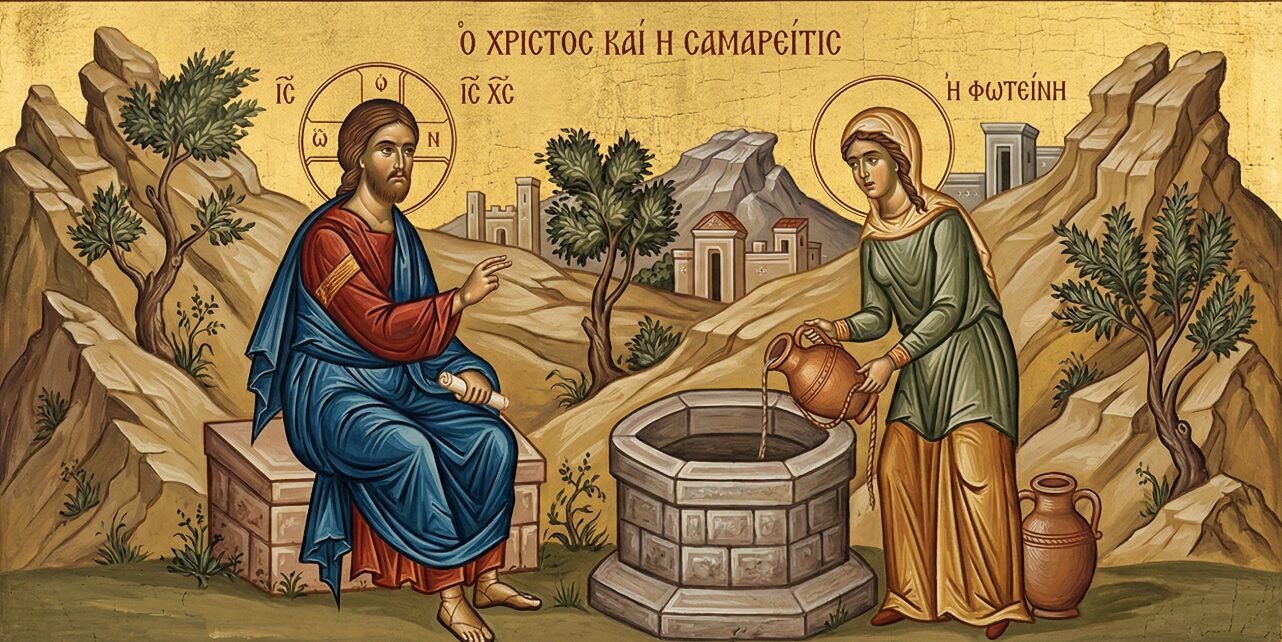
Both the Israelites and the Samaritan woman experienced a double thirst, corresponding to human nature as body and soul. Israel’s thirst for water is only bodily; their deeper thirst is the reason for their journey. They thirst for the land flowing with milk and honey (Dt. 26:9). The Samaritan woman also had a physical thirst, which brought her to the well. But her inner thirst was for true love. While it is legitimate to quench physical thirst physically, this solution is only temporary: ‘whoever drinks this water will thirst again’. Israel would thirst again even though they drank miraculous water, just as they still died even after they ate manna from heaven (Jn. 6:49). The Gospel, therefore, distinguishes between water from above and water from below. The water from below, found in the well and in the rock, responds to a natural need. But the water that Christ gives meets our spiritual need; it gives eternal life. Christ himself fulfils in the soul, while hanging on the Cross, what Jacob’s well and the rock in the desert sought to achieve in the body. He is the true rock that gives water (1 Cor. 10:4); and just as Moses struck the rock in the desert, a soldier struck his side on the Cross to give us this water of life (Jn. 19:34).
Both the Israelites and the Samaritan woman were in settings that suggest deeper union. The desert was the place of covenant, God’s marriage with Israel (Hos. 2:14), just as the well was a privileged place for encounters leading to marriage – Isaac, Jacob, and Moses all met their wives at the well (Gen. 24:15-16; 29:1-10; Ex. 2:16-21). This is why, I would say, the disciples were surprised. They were not surprised that Christ spoke to a woman – they had seen him do so several times. They were surprised that he spoke to a woman at the well, a setting for wooing. The thirst of this woman meets Christ’s thirst. Although she had been married several times, she was not truly married – Jesus affirms as true her claim of having no husband. Now the true Bridegroom (Jn. 3:29; Mt. 9:15) is with her, and she can truly marry and experience real, life-changing love.
This is the spiritual marriage to which our soul earnestly aspires, and it remains restless until it is attained. This holy restlessness is captured by St John of the Cross in the Spiritual Canticle, where the soul restlessly runs after the Bridegroom. It pines, feeling wounded and abandoned by the Beloved. This restlessness creates a daring resoluteness and holy indifference in the searching soul, which is no longer afraid to ‘go over the mountains and strands’, insisting: ‘I will gather no flowers, I will fear no wild beasts; and I will pass by the mighty and the frontiers.’ The only thing that the soul truly desires is union with God, and that is the true goal of our existence. We must give up all other desires, seek to resolve the tension created by these desires, and dispose ourselves for union with God. The Lenten season fosters this disposition as we practise self-denial and open ourselves to God’s love. Let us plead like the Samaritan woman: ‘Give me this water that I may never be thirsty again.’
Prayer
Lord Jesus, You are the True Bridegroom and the Rock struck for our salvation. We confess that we often linger at the wells of this world, seeking to fill eternal voids with temporary things. Grant us the grace of holy restlessness, that we may not be satisfied until we find our rest in You. As we journey through this Lenten desert, strip away our disordered desires and give us a taste of the Living Water, that we may live in covenantal union with You forever. Amen.
Ponder Questions
1. Is God truly my only desire, or do I see him just as one among many?
2. To what extent have I prepared myself through self-denial to welcome him as the true Bridegroom of my soul?
3. Where do my physical needs lead me? Do I allow them to lead me away from God?
Practice for the Week: “The Five-Minute Fast of the Heart”
The Samaritan woman left her water jar behind to run toward Christ. This week, practice intentional detachment from your “water from below” (those biological or emotional appetites that feel urgent but are disordered).
The Action: Identify one specific thing you reflexively turn to for comfort or validation (e.g., mindless scrolling, stress-eating, or seeking constant approval).
The Pause: When you feel the “thirst” for that thing, pause for five minutes before indulging it.
The Internal Shift: During those five minutes, acknowledge the deeper spiritual thirst beneath the surface. Say internally: “Lord, this is a thirst only You can quench.” Use that time to offer your restlessness to Him, asking for the “water from above.”
Phrase to Memory
“You have made us for yourself, O Lord, and our heart is restless until it rests in you.” — St Augustine