
V/ My eyes are turned to you, O Lord.
R/ You are the joy and gladness of my youth.
V/ Grant me the Wisdom that sits by your throne.
R/ That I may dwell as a child in your presence.
Let us pray
O Lord, as we draw closer to the mysteries of Your Passion, grant us the grace of true repentance. Soften our hearts, that we may see where we have wandered from You, and give us the courage to return to the light of Your friendship. We ask this through Christ our Lord. Amen.
BETRAYING THE FELLOWSHIP WE SHARE
By Fr Emeka Agboeze, OCD
Tuesday of Holy Week
Isaiah 49:1-6; Psalm 70(71): 1-6, 15, 17; John 13:21-38
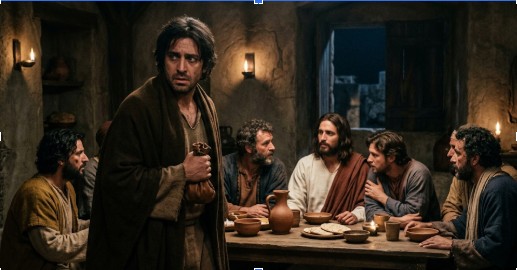
“I tell you most solemnly, one of you will betray me.” ‘One of you’, says Jesus; not one of them, not an outsider, but one of the people closest to him, with whom he shared his most intimate thoughts. He left his biological family to be with them; they are his new family. And this is the saddest thing about betrayal: it never comes from one’s enemies. Jesus stresses this: “It is the one to whom I give the piece of bread that I shall dip in the dish.” This betrayer shares the same table with him. He is an intimate friend, a family member.
If this first betrayal concerns Judas, the second one clearly concerns Peter: “I tell you most solemnly, before the cock crows you will have disowned me three times.” Jesus predicts the two betrayals with a solemn declaration: “I tell you most solemnly.” This signals the seriousness of the sin of betrayal; it is a sacrilege, for both Judas and Peter sinned against love, divine love. While Judas was after material profit, Peter sought self-preservation. Both acted selfishly. Furthermore, the source of this selfishness can be deduced: darkness. One who lives in darkness is easily prone to all kinds of shameful deeds (cf. Eph. 5:11-12). Judas’ choice to leave the company and go out into the night shows his preference: “Night had fallen,” reports the Evangelist, when Judas left the company. The darkness within him has now attained its external expression. Peter was not different. “Before the cock crows” is an expression which refers to the night. The cock-crow signals the dawn of a new day. He denied Christ in the night and did so three times. If ‘three’ connotes completeness, then Peter’s denial was total – a very shameful act, considering the amount of trust Christ had reposed in him. The following Davidic prophecy applies both to Judas and to Peter: “Even my bosom friend, in whom I trusted, who ate my bread, has lifted his heel against me” (Ps. 41:9).
Yet this could be a friendly indictment to us as well. We belong to the family of Christ, to the Church which is his body (cf. Eph. 1:23). What could be more intimate than being his body, one with him? Yet, as Pope Benedict XVI notes, this betrayal or “breach of friendship extends into the sacramental community of the Church, where people continue to take ‘his bread’ and to betray him.” But we must react like Peter, who did not remain in the night. When the cock crowed, he entered the dawn, in a sense, he woke from sleep, according to St Ambrose, having hitherto given himself to the spiritual slumber of the night. Christ is the cock which crows in our night and invites us into the day. He calls us to “cast away the deeds of darkness and put on the armour of light” (Rm. 13:12). Even if we have eaten his bread and lifted our heels against him, he remains faithful and calls us to reconciliation: we can be his friends again.
St Teresa of Avila sees our life as a call to friendship with God, where prayer becomes “nothing else than being on terms of friendship with God.” The primacy of love is implied in this sharing. In her Meditations, she distinguishes between degrees of friendship with Christ and invites us not to settle for too little. She states: “There are some persons who have already attained friendship with the Lord because they have confessed their sins well and have repented, but two days don’t pass before they return to them.” This seems to be the least of the levels. She speaks of another degree which involves simply guarding against mortal sins: “These persons even though they guard themselves against sinning mortally do not fail to fall now and again… For they care little about venial sins: they commit many daily, and thus they are very close to committing mortal sins.” For Teresa, the highest degree of friendship is described in the Song of Songs. Here, the individual desires only to please God and finds all his profit in serving him. Do I aspire to this degree of friendship, or do I channel my desires to other gains like Judas? Does fear sometimes compel me to breach this friendship like Peter? As the Lord approaches his passion, let us resolutely stand with him as true friends.
Prayer
Lord Jesus, like Peter, we too often deny You in the darkness of our fears and compromises. When it crows in our souls, grant us the grace to weep for our failings and to run back into the dawn of Your presence. May we never, like Judas, settle for profit over love. Strengthen us to stand by You, our True Friend, during this Holy Week and always. Amen.
Ponder Questions
1. In what quiet, often unnoticed ways do I betray Christ’s friendship through my daily choices, habits, or interactions with others?
2. Which of these weaknesses am I more prone to—choosing comfort, security, or material gain over standing resolutely with Christ when it is difficult?
3. When I look at my spiritual life right now, am I merely trying to “avoid mortal sin,” or am I actively striving to serve Him out of pure love?
Practice for the Day
Today, identify one specific aspect of your life that you have kept in the “darkness” (a secret resentment, an unhealthy habit, or a hidden fear). Make a concrete plan to bring it into the “light” of God’s mercy, perhaps by scheduling a time for Confession or by speaking truthfully about it to a trusted spiritual guide.
Phrase to Remember
“Cast away the deeds of darkness and put on the armour of light.” (Romans 13:12)