
V/ My eyes are turned to you, O Lord.
R/ You are the joy and gladness of my youth.
V/ Grant me the Wisdom that sits by your throne.
R/ That I may dwell as a child in your presence.
Let us pray
Heavenly Father, as we plunge deeper into this Holy Week, grant us the grace to rightly order our affections. Forgive us for the times we have valued fleeting pleasures or worldly gain above our relationship with Your Son. Open our hearts now to receive His word, that we may truly comprehend the depth of His love for us. We ask this through Christ our Lord. Amen.
A BAD BARGAIN
Fr Emeka K. Agboeze, OCD
Wednesday of Holy Week
Isaiah 50:4–9; Psalm 68(69):8–10, 21–34; Matthew 26:14–25
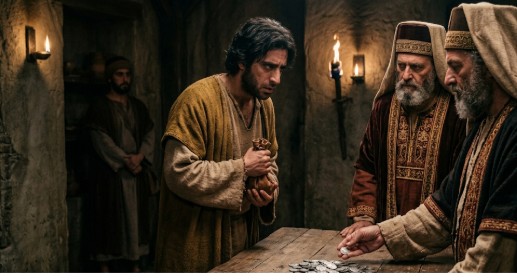
‘What are you prepared to give me if I hand him over to you?’ This is clearly the language of commercial exchange, of business negotiation. But how did Judas fare as a businessman? There is a responsory for the Holy Week Tenebrae service set to music by various composers, notably Tomás Luis de Victoria. It reads: Judas mercator pessimus, roughly translated as ‘Judas the worst possible merchant.’ The refrain of this hymn completes the indictment: ‘For a number of coins he delivered Christ to the Jews.’ The folly of Judas is vividly expressed here. Good merchants know how to make profits. They know the true value of what they sell and seek profits commensurate with the goods or services they deliver. Does Judas know the value of his Master? What profit could thirty pieces of silver procure for him? He is indeed the worst possible merchant; not just a bad trader, but a foolish one. He sold his Master ‘for nothing and made no profit by the sale’ (Ps. 44:12).
Good merchants who have a glimpse of the true value of the Master, Jesus, the embodiment of God’s reign, sell everything to possess that precious pearl (cf. Mt. 13:44). Christ is that treasure of immeasurable value, worth sacrificing everything else for. But Judas sold the treasure for which he should have sold everything else. Those who follow Jesus give up everything, including relationships, in order to be His disciples (cf. Mt. 19:27). They are not mistaken; it is because of Christ’s inestimable worth that they dare to lose every other thing. St Paul captures this in his letter to the Philippians: ‘Indeed, I count everything as loss because of the surpassing worth of knowing Christ Jesus my Lord. For his sake I have suffered the loss of all things and count them as rubbish, in order that I may gain Christ’ (3:8, emphasis added). Paul is a good merchant.
This relationship with Christ is the only thing that counts for St John of the Cross: ‘Well and good if all things change, O Lord, provided I am rooted in You.’ He insists that ‘the beauty of creatures compared with the infinite beauty of God is supreme ugliness.’ Yes, the beauty of God is infinite, making every comparison foolish. But this realisation comes by contemplating His love on the Cross, as Isaac Watts suggests: ‘When I survey the wondrous Cross on which the Prince of glory died, my richest gain I count but loss, and pour contempt on all my pride.’
People consider their well-being whilst seeking profits. They rejoice because the profit is an opportunity to live a happier life. But did Judas consider his own spiritual welfare? The obvious beneficiary of the gain of knowing Christ is the soul. Judas came very close to Him, yet chose to lose Him. Again, the folly of his choice is indisputable: ‘For what shall it profit a man if he shall gain the whole world and lose his own soul?’ (Mk. 8:36). Our prayer must be: ‘Forbid it, Lord, that I should boast, save in the death of Christ, my God! All the vain things that charm me most, I sacrifice them through his blood’ (Isaac Watts).
The story of Judas also reflects our tendencies. Do we consider the glory of God and the salvation of our soul in the choices we make? Do we not have or chase certain things that boost our sense of worth in opposition to God’s design for us? The mood of this day, commonly referred to as Spy Wednesday, should make us reflect. Perhaps in contemplating what Christ is about to suffer for our sake, we would be drawn to appreciate how valuable He Himself considers us. What could be more valuable than His precious blood? Yet that is the red coin with which He pays for our redemption. He too gave up everything, He wilfully lost everything, including His very life, in order to gain us for Himself. He has shown us how dear we are to Him. Should we not, therefore, imitate His gesture and seek Him with the same zealous love with which He seeks us? His is a sacrifice of love and, as we contemplate His cross, we feel the urgency of that amazing love which, according to Isaac Watts, ‘demands my soul, my life, my all.’
Prayer
Lord Jesus Christ, by the price of Your precious blood, You have shown us our infinite worth in Your eyes. Grant us the wisdom to be truly discerning, willing to count all things as loss for the surpassing joy of knowing You. May the contemplation of Your saving Passion root us so deeply in Your love that nothing in this world may ever tempt us to betray or forsake You. Amen.
Questions to Ponder
1. What comfort, reputation, money, or habits—for which I am sometimes tempted to trade my relationship with Christ?
2. What thing in my life would be the hardest to count as rubbish for the sake of the Gospel?
3. How does truly accepting that Christ values me that much change the way I view myself and the choices I make today?
Practice for the Day
On this ‘Spy Wednesday’, consciously identify one area of your life where you have been ‘driving a hard bargain’ with God—holding something back from Him. Generously surrender that specific thing to Him today, acknowledging His surpassing worth.
Memory Phrase
Christ Values Us