
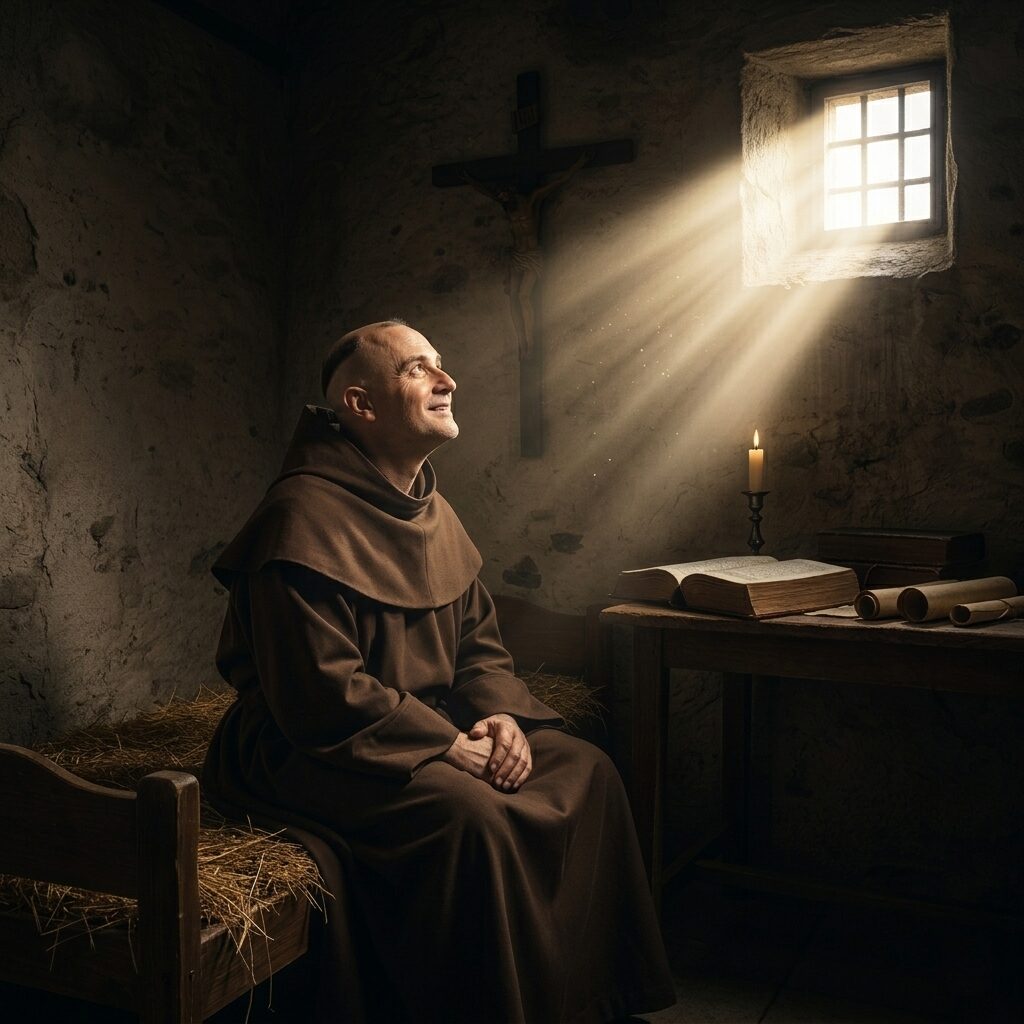
Can John of the Cross, the poet who wrote about “the dark night”, possibly have anything to say to people celebrating resurrection and new life? Easter shouts triumph, light, joy, victory over death. John whispers darkness, emptiness, unknowing, the via negativa.
John didn’t write about darkness because he was depressed. He wrote about darkness because he had encountered Light so brilliant that it blinded him. He wrote about emptiness because he had been filled to overflowing. He wrote about God’s absence because he had experienced God’s presence so intensely that ordinary consciousness couldn’t contain it.
John’s dark night isn’t the opposite of Easter joy. It is the path into its depths.
The Darkness That Easter Creates
We misunderstand Easter if we think resurrection eliminates all darkness. The first witnesses to resurrection were terrified. The women fled the empty tomb “trembling and bewildered” (Mark 16:8). The disciples hid behind locked doors even after Jesus appeared to them, still afraid. Thomas refused to believe without physical proof. The Emmaus disciples walked miles with the Risen Christ and didn’t recognise him. Resurrection didn’t make everything clear. It made everything strange.
Easter creates a crisis; everything you thought you knew about God, about death, about reality itself — resurrection shatters it all. The old frameworks can’t contain what’s happened. John describes this spiritual crisis thus: When God begins to transform us at deep levels, our ordinary ways of perceiving and knowing God stop working. Prayer that once felt rich becomes dry. Scripture that once nourished us feels like words on a page. Practices that brought consolation bring nothing. In actuality, we are growing; but growth feels like loss.
This is the dark night. God is present, but in ways our limited consciousness can’t perceive. It’s like staring directly at the sun: the brightness blinds us, and we experience it as darkness. Easter does this too. The resurrection is so radically new, so utterly beyond our understanding of the possible and the impossible, that encountering it leaves us disoriented. The old self dies. The new self being born doesn’t fully know itself yet.
We’re in the tomb between crucifixion and resurrection. That is John’s dark night.
The Emptiness That Makes Room for Joy
John famously drew a sketch of Mount Carmel with the path to union with God marked repeatedly with one word nada. “Nothing. Nothing. Nothing.” At first reading, this seems joyless. Give up everything? Desire nothing? Empty yourself completely? How is this remotely compatible with Easter’s exuberant celebration of life?
John is teaching freedom. Think about the resurrection narratives. Mary Magdalene at the tomb has lost everything — her beloved teacher, her hope, her understanding of God’s plan. She is completely empty. And precisely in that emptiness, she encounters the Risen Christ. If she had still been clinging to what was, she couldn’t have received what is. The disciples in the Upper Room had their dreams shattered. Their revolutionary kingdom didn’t happen. Their leader was executed. Everything they had hoped for was dead. Emptied of their expectations, they were finally able to receive something infinitely greater than they had imagined; i.e., the Holy Spirit at Pentecost.
John’s nada is Easter preparation. We empty ourselves of our small hopes so we can receive hope beyond imagination. We let go of our limited understanding of God so we can encounter the God who exceeds all understanding. We release our need to control the story so we can receive the story God is actually telling. This is why John’s path leads to profound joy; that is, the deep gladness that comes from total union with Love itself, and not the superficial happiness that depends on circumstances. “In the evening of life, we will be judged on love alone,” John writes. Everything else — possessions, achievements, spiritual experiences — falls away. Only love remains.
Easter joy is exactly this: the discovery that Love is stronger than death, that nothing can separate us from it, that all our grasping, clinging and protecting were unnecessary because we are already held.
The Dark Night As Resurrection
The dark night is resurrection happening to us. John describes the dark night as God’s purification of the soul, God doing “surgery” on our attachments, God burning away everything false so only truth remains. This is violent imagery — fire, surgery, purgation. It doesn’t sound like joy.
But what is Easter if not violent transformation? A body broken on a cross. Laid in a tomb. Death itself conquered from the inside. The old order shattered completely. Something entirely new erupting into existence. Resurrection isn’t gentle. It is catastrophic. It doesn’t improve the old life; it replaces it. Paul uses such language constantly: “I have been crucified with Christ and I no longer live, but Christ lives in me” (Galatians 2:20). The old self dies. A new creation emerges.
This is what happens in John’s dark night. The false self, the one built on achievements, on spiritual experiences, on others’ approval, on our carefully constructed identity, is crucified. It dies, often painfully, often slowly. We grieve it. We rage against its loss. We beg God to give it back. But God is merciful. He won’t resuscitate what needs to die. Instead, he stays present in the darkness, undetectable but utterly faithful, until the new self emerges — the self that knows it’s love, and that can love without needing anything in return.
Ask anyone who has been through serious suffering and emerged transformed. Ask the cancer patient who discovered what really matters. Ask the one who lost faith and found something deeper than belief on the other side. They will tell you:
Something died. Something rose. Both were necessary. Both were painful. Both were grace.
So where does this leave us practically? How do we live in the tension between John’s darkness and Easter’s light?
- First, we stop creating false opposition. We stop thinking we must choose between Good Friday and Easter Sunday, between suffering and joy, between the cross and resurrection. Christianity holds both simultaneously. The Risen Christ shows Thomas his pierced hands and side. Even in glory, the marks of suffering remain, not as scars we are ashamed of but as badges of love’s victory. John’s dark night and Easter joy aren’t sequential; i.e., first darkness, then light. They are interwoven – darkness revealing light’s brilliance, light illuminating darkness’ purpose.
- Second, we learn to trust darkness. When prayer goes dry, when God seems absent, when our spiritual practices stop “working,” John teaches us: Don’t panic. Don’t immediately assume you are doing something wrong. Don’t rush to fix it with new techniques or different practices. Ask instead: Is God inviting me deeper? Am I being weaned from spiritual consolations so I can learn to love God for His own sake rather than for how He makes me feel? Is something false dying so something true can be born? This doesn’t mean all darkness is God’s purifying work. Clinical depression needs treatment. Trauma needs healing. But sometimes, the darkness is sacred. Sometimes God is most present precisely when God feels most absent.
- Third, we embrace resurrection as a process, not an event. Easter Sunday is glorious, but the transformation it celebrates took three days: crucifixion, tomb, resurrection. Sometimes our transformation takes three years. Or thirty. John’s dark night can last years. Decades even. Teresa of Ávila experienced nearly twenty years of spiritual aridity. But she kept showing up, kept praying, kept trusting. And eventually, breakthrough came. The darkness gave way to light more brilliant than she had imagined possible. We are invited into this same patience. To trust that resurrection is happening even when we can’t see it yet. To believe that the darkness isn’t abandonment but intimacy so deep our ordinary senses can’t perceive it.
John was writing from the other side. He had been through the dark night. He had experienced the union with God that comes after all the stripping away, all the darkness, all the apparent loss. And what he found there was joy. Profound, unshakeable joy. He learnt that losing everything meant gaining everything. That dying with Christ meant rising with Christ. That the dark night was preparation for daybreak more glorious than any Easter sunrise.
John’s message to us is this: Don’t be afraid of the darkness. Don’t waste energy trying to avoid it or rush through it. The risen Christ meets us in both darkness and light — in the locked Upper Room and the bright morning garden, in Holy Saturday’s unknowing and Easter Sunday’s recognition, in the dark night of the soul, and in the brilliant dawn of union.
Both are resurrection. Both are joy.
Both are the same Love meeting us exactly where we are and refusing to leave us there, calling us always deeper, always forward, always into more life than we thought possible.