
V/ My eyes are turned to you, O Lord.
R/ You are the joy and gladness of my youth.
V/ Grant me the Wisdom that sits by your throne.
R/ That I may dwell as a child in your presence.
Let us pray
Lord, in your all-providential plan, you have led me to this moment to rediscover myself in your Word and Wisdom. Aid me to make this time of meditation and prayer enriching, transforming, and liberating for my well-being and others.
“SHOW US THE FATHER”: FINDING OUR MANY ROOMS IN CHRIST
By Clement Obiorah, OCD
FIFTH SUNDAY OF EASTER, YEAR A
Acts 6:1-7; Psalm 33(32):1-19; 1 Peter 2:4-9; John 14:1-12
The readings for this Fifth Sunday of Easter weave a profound tapestry concerning space, habitation, and the ultimate purpose of our creation: union with the Father. From the restructuring of the early Church in Jerusalem to the mystical heights of Christ’s farewell discourse, we are presented with a unified vision of what it means to dwell in God, and for God to dwell in us.
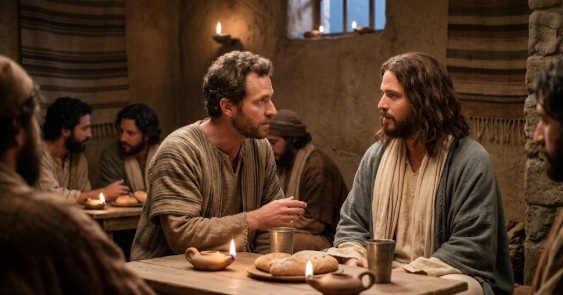
Amidst the joy of Eastertide, a poignant human ache surfaces in the Gospel: Philip’s plea: “Lord, show us the Father, and it is enough for us.”
Philip’s request is the ultimate desire of every human heart—for home, total security, unconditional love, and ultimate purpose. Jesus opens the way to the Father. When Jesus speaks of his departure to the Father’s house, Thomas, ever pragmatic, objects: “Lord, we do not know where you are going. How can we know the way?” Thomas wants a roadmap.
Jesus counters: “I am the way, and the truth, and the life. No one comes to the Father except through me.” The way is a Person.
Through a Carmelite lens, we understand the spiritual life is not about mastering techniques or navigating complex terrains; it is about deepening a relationship with a Person. Christ does not just show us the path; He is the path. St. Teresa of Avila describes the soul as a diamond castle containing “many mansions” or rooms, with God dwelling at the very center. We reach that center only through Christ, the Sacred Humanity, who is the door and the way. To go to the Father, we enter more deeply into Jesus.
Jesus offers comfort regarding our destination: “In my Father’s house are many rooms.” These are not separate “cubicles” to divide groups; it suggests abundance. In the economy of salvation, there is no scarcity. Heaven is not a prize where “only one wins.” This abundance in the Father speaks to the rich diversity of vocations within the one body of Christ. In Christ, there is room for the contemplative’s solitude and the deacon’s active service; for the scholarly priest and the simple widow.
This is brought to life in Acts. The young Church faces conflict over diverse needs. The Hellenists feel their widows are neglected. The Twelve recognize they cannot do everything and prioritize their vocation—prayer and the ministry of the Word—by delegating. They choose seven men to serve tables. But notice, this office is not merely administrative; like Stephen and Philip, they immediately begin to preach and baptize, included in the Word’s ministry through specialized charity. There is “room” in the Church’s mission for this expansion. Delegation isn’t just about solving a problem; it’s about recognizing that different purposes and gifts all find their home in Christ, revealing the Father as a united people.
This brings us to the ecclesiology in the second reading from Peter, who uses a different image for the Father’s house—a reality we are building now.
“You yourselves, like living stones, are being built up as a spiritual house, to be a holy priesthood, to offer spiritual sacrifices acceptable to God through Jesus Christ.”
This is the great shift of the New Covenant: Christ has achieved unrestricted access to the Father. Under the old dispensation, only the Levitical priest could enter the Holy of Holies. But now, because of Easter, because of Christ the cornerstone, the whole people is sacred. By our baptism, we are all “living stones,” part of this Royal Priesthood.
Carmelites highlight this universal call: the cell, the choir, and the kitchen are altars. St. Thérèse of Lisieux understood her vocation: to be “love in the heart of the Church.” We offer “spiritual sacrifices”—our daily trials, works of charity, silence, and fidelity to prayer. These are made acceptable to God, not through our own effort, but “through Jesus Christ.”
Like living stones in a cathedral, we all have different shapes and occupy different places. Some are hidden (contemplatives), some are visible pillars (preachers), some add joy (the simple of heart). All are necessary to hold up the spiritual roof. The “many rooms” these living stones create are not just for rest in eternity; they are degrees of relationship, stages of intimacy with the Trinity that begin right now within the interior castle of your soul.
Jesus said, “Whoever has seen me has seen the Father,” revealing the highest possibility of union even in this world. And he promises to prepare a place for us, “that where I am, you may be also.” This is the unmatched generosity of the Son, whose spiritual gifts make us like his glorious self—the Carmelite goal of transformation in love.
Philip asked, “Show us the Father, and it is enough for us.” Today, as we prepare to receive Christ in the Eucharist, let us make Philip’s prayer our own. Let us surrender our need for roadmaps and checklists, and simply cling to Christ, the Living Cornerstone, the Way, the Truth, and the Life. For in Him, we find our room, our purpose, and the Face of the Father that is, truly, enough for us. Amen.
Prayer
Heavenly Father, show us Your face. May we abandon our need for spiritual roadmaps and trust entirely that by clinging to Jesus, the Way, the Truth, and the Life, we have already found the path to Your heart and our true home. Amen.
Ponder Questions
1. Like Thomas, do I look for guarantees in my spiritual life rather than trusting in a deepening relationship with Jesus?
2. What unique purpose or service do I feel called to offer as a “living stone”?
3. Where and when am I creating the space to cultivate that intimacy with the Father in the example of Jesus?
Practice for the Week
Choose one mundane, repetitive task—whether at work, in the kitchen, or during unwelcome interactions—and perform it with total presence and love. Offer that specific moment to God as your “spiritual sacrifice” for the good of our relationship, viewing it not as a conversation to be avoided but as an altar of encounter with Christ.
Memory Phrase
“Lord, show us the Father, and it is enough for us.” (John 14:8)