
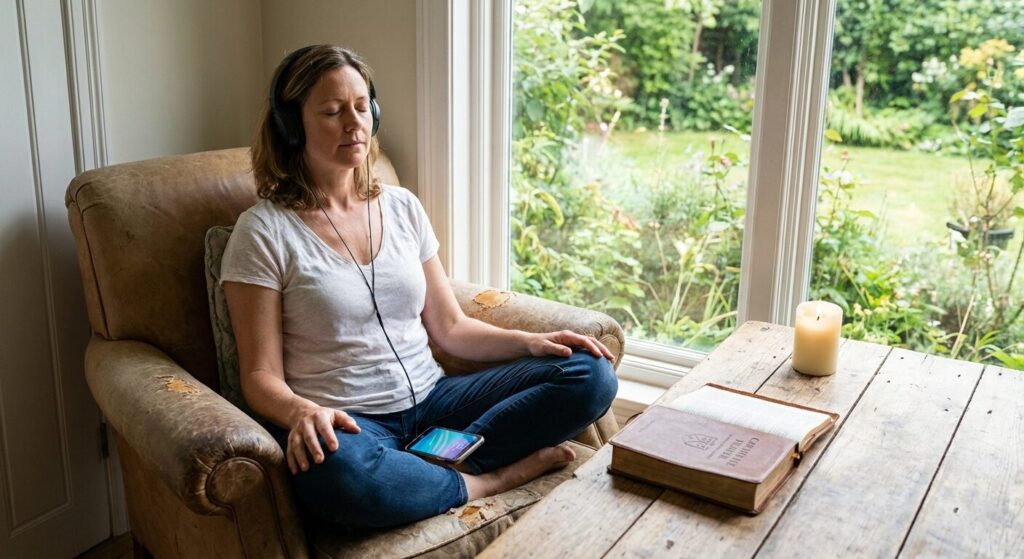
Susan is 42, a working mum juggling two kids, a demanding job, and the persistent feeling that her spiritual life is running on fumes. She loves Teresa of Ávila – she’s been listening to the Interior Castle audiobook during her train commute for months. But her parish is 45 minutes away, which means weekday Mass is impossible. She craves deeper prayer, real formation, a contemplative community. But time and logistics keep getting in the way.
Last month, Sarah discovered an online contemplative community offering guided meditations and courses on Carmelite spirituality. She was immediately sceptical. “Isn’t digital spirituality an oxymoron?” she wondered. “Can pixels really convey presence? Can I encounter God through a screen?”
These are the right questions. And this article answers them honestly: Yes, you can pray online. But with significant nuance.
The Scepticism (And Why It’s Valid)
Let’s start by acknowledging the legitimate concerns about digital spirituality, because there are many. We live in an age of screen addiction and distraction culture where our attention is constantly fragmented, hijacked, monetized. The internet trains us for shallow engagement, a kind of ‘spiritual snacking’ instead of sustained nourishment. We scroll, we click, we consume, but rarely do we actually digest anything.
Then there’s the problem of embodied community. Digital connection cannot replace physical presence; the warmth of sitting beside someone in prayer, the shared silence of a retreat, the eucharistic intimacy of Mass. And we cannot ignore the commercialization of spirituality online, where everything becomes content, everything becomes a product, everything is optimized for views and ratings rather than genuine transformation.
Add Zoom fatigue and digital overwhelm to the mix, and the concerns multiply. Many of us are drowning in screens already. The last thing we need is more digital noise masquerading as spiritual practice.
Carmelite values seem almost diametrically opposed to digital culture. Teresa and John championed silence, solitude, simplicity. Their monasteries were places of withdrawal from the world, not deeper immersion in it.
Teresa reformed from within a cloister.
How do we reform from within cyberspace?
So, the scepticism makes absolute sense…
But here’s what sceptics often miss…
What Teresa Would Actually Do
Let’s look at historical context. Teresa of Ávila was a brilliant, pragmatic reformer who used the cutting-edge technology of her time without hesitation. She embraced the printing press, which had revolutionized access to Scripture and spiritual texts just decades before her lifetime. She used the postal service extensively; scholars have preserved over 500 of her letters, which created and sustained community across vast distances when physical travel was expensive, dangerous, and time-consuming. And she wrote in the vernacular, in Spanish rather than Latin, making her teachings accessible to ordinary people, rather than just educated elites.
Teresa’s fundamental principle was simple: use whatever tools are available to spread God’s love more effectively. She famously wrote that “God walks among the pots and pans,” insisting that everyday life, and not just the chapel, was the place where holiness happened. Translating that to today: God walks among the pixels and platforms too.
What mattered to Teresa wasn’t the medium. It was the mission. She asked: Does this bring people closer to God? Does it serve the poor in spirit — those hungering for deeper relationship with the Divine but lacking access to traditional formation? Does it build authentic community rooted in mutual love and support? Is it characterized by humility rather than self-promotion?
Apply those criteria, and the landscape shifts dramatically. Consider what Teresa would likely do if she were alive today:
- She would absolutely love audiobooks. Most of her nuns were illiterate, and she spent countless hours reading aloud to them. Imagine her delight at technology that could bring Scripture and spiritual classics to people during commutes, walks, household chores.
- She would use Zoom to connect her dispersed reformed communities. Her letters reveal constant concern for nuns in distant convents. Video calls would have thrilled her — real-time conversation, seeing faces, maintaining relationships across geographies.
- She would share her teachings through video, rather than relying only on letters that took weeks to arrive and could be lost or intercepted.
- She would create online formation programmes for laypeople who couldn’t travel to Ávila or Toledo or enter a monastery but still longed for contemplative wisdom.
If Teresa were alive today, she’d have a podcast. And it would be wildly popular. And she’d use it to point people to silence, not noise.
The real question isn’t “Digital or analogue?” The question is: “Does this tool serve love?” Does it genuinely help people encounter God and grow in holiness? Or does it just add to the noise, distraction, and commodification?
CACSDigital: Technology Serving Contemplation
This brings us to CACSDigital, the launch of which is slightly delayed – we’ll be in touch when we have a new launch date. We have spent eighteen months asking Teresa’s questions as we designed this platform, trying to create something that genuinely serves contemplation rather than exploiting people’s spiritual hunger.
CACSDigital is an online platform for Carmelite formation featuring courses, meditations, and live Q&As with our faculty. But let’s be clear about what it is not. It is not an entertainment platform. It is not an endless content library designed to keep you scrolling, because that would be spiritual overwhelm disguised as formation. It is not 24/7 distraction or another app competing for your attention.
Instead, CACSDigital is built on different principles. It is curated and intentional, quality over quantity. It follows a weekly rhythm rather than daily overwhelm; you will not find new content bombarding you every morning. It is silence-friendly, with audio meditations designed for walks or commutes where you can be attentive without staring at a screen. And it is community-building, with moderated discussion forums where Carmelite friars facilitate genuine conversation rather than leaving you to the chaos of unmoderated comment sections.
Our design principles reflect Carmelite values translated to digital space. Less is more. We are committed to restraint. We have built contemplative pauses directly into the platform, moments of silence within videos and courses. We observe Sabbath rest: the platform essentially “closes” on Sundays with no new content released, encouraging real rest. And everything is mobile-friendly so you can engage while walking in nature or sitting in a park, not just hunched at a desk.
We are not bringing contemplation online.
We are bringing online tools into contemplation.
We are not trying to digitise silence or reduce prayer to pixels. We are offering tools that can support your embodied, physical, everyday contemplative practice.
How to Use Digital Tools Contemplatively
Whether you use CACSDigital or any other online spiritual resource, here are five principles for contemplative digital engagement:
- Set Boundaries. Schedule specific times for digital spiritual practice rather than constant scrolling. Treat it like you would treat going to a class or attending a retreat… something you do intentionally, not compulsively.
- Use for Formation, Not Just Inspiration. Beautiful quotes and inspiring images have a place, but real growth requires sustained teaching. Prioritize courses, substantive content, and structured learning over bite-sized inspiration.
- Combine with Embodied Practice. Online should supplement, never replace, real community. Keep attending Mass, going on retreats, meeting with a spiritual director in person when possible. Digital is the 20%, not the 80%.
- Practice Silence After Engagement. After watching a teaching video or listening to a meditation, sit in silence. Let it sink in. Do not immediately move to the next thing. This is how digital becomes contemplative, rather than just more consumption.
- Discern Addiction. If your digital spiritual practice feels compulsive, if you are checking apps constantly, if you feel anxious when you cannot access content, step back. That is not contemplation. That is just addiction with a spiritual veneer.
Consider Susan’s new rhythm as an example. On Tuesday mornings, she listens to a 10-minute CACSDigital audio meditation while walking to the train station — beauty and teaching during time that would otherwise be lost. Friday evenings, she watches a 30-minute course video after the kids are in bed, then sits in silence for five minutes before bed. Sundays are her digital Sabbath: no phone after breakfast, just embodied presence with her family and parish community. And once a month, she attends an in-person parish retreat day.
Balance matters. Her spiritual life is 80% real, embodied practice, and 20% digital support. That proportion keeps things healthy.
Try This: One Week Digital Discernment
Days 1-3: Simply notice your current digital habits around spirituality. When do you reach for your phone for spiritual content? Why? How long do you spend? Don’t judge. Just observe with curiosity.
Days 4-5: Choose ONE contemplative digital practice to try. Maybe it is a podcast episode on prayer or a meditation app. Engage it intentionally.
Days 6-7: After each time you engage with digital spiritual content, sit in five minutes of silence. No phone. No input. Just sitting.
Then ask: Did this digital tool bring me genuinely closer to God, or did it just fill time? Did it increase my hunger for silence and prayer, or decrease it?
That’s the test. Good digital spiritual tools should make you want less screen time, not more.
CACSDigital is our experiment in contemplative technology. It will not be for everyone, and that is completely okay. But if you are like Susan — genuinely hungry for formation, constrained by time and distance, looking for tools that serve rather than distract — this might be exactly what you need.
Early subscribers who join the waitlist will receive a one-month free trial when we launch. Register your
interest here.