
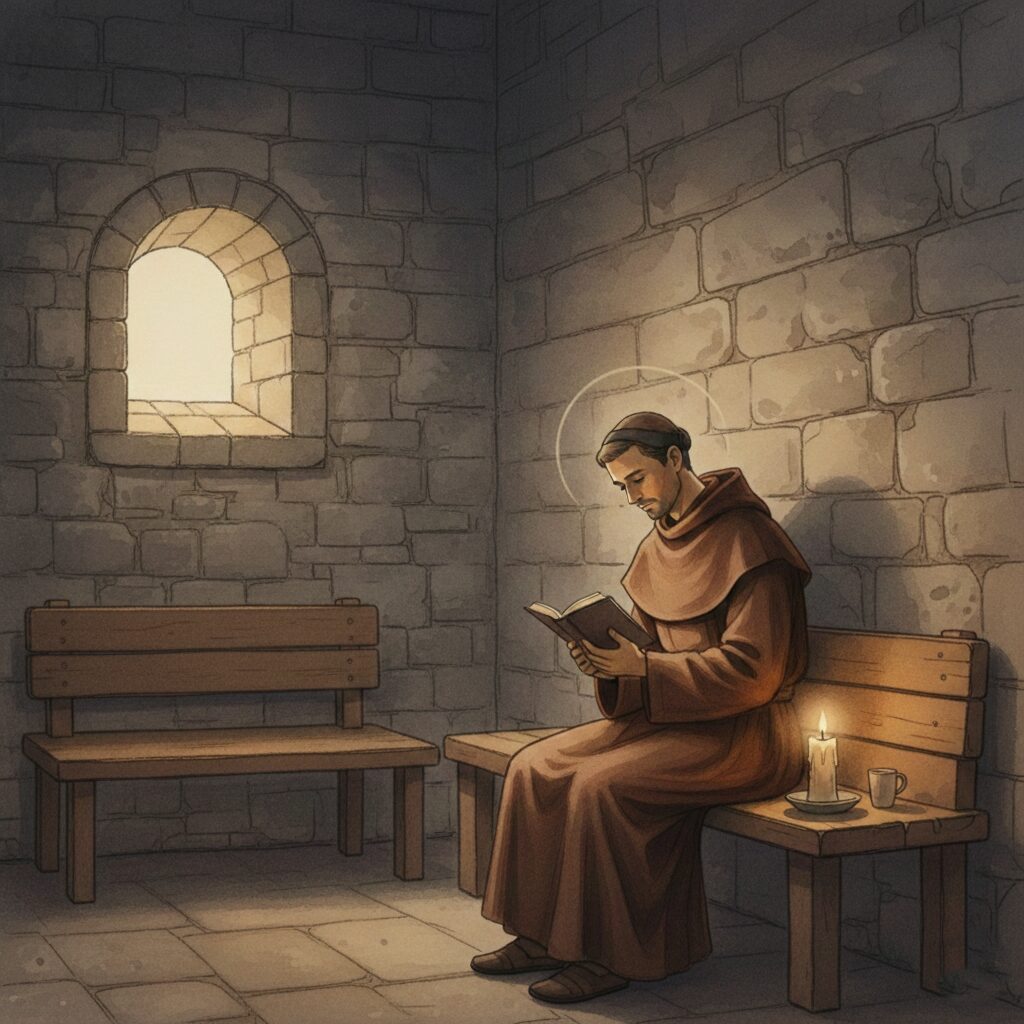
The Daily Examen is an Ignatian practice, but Teresa of Ávila used a remarkably similar method in her own spiritual life, described in Chapter 13 of her Book of Life. This 10-minute nightly practice aids you in noticing God’s presence throughout your day. Think of it as spiritual attention training, helping you recognise where God was already moving, already speaking, already loving you. This practice prepares you to follow your star by teaching you to see the light that’s already shining. Teresa’s version emphasises gratitude, gentle awareness, and the conviction that God’s mercy is always larger than our failures.
The 5 Steps
1. Presence (2 minutes)
Begin by settling into this simple truth: “I am here. God is here.” Take several deep breaths, feeling your body in the chair, your feet on the ground. Notice tension in your shoulders, your jaw, your hands. Let it soften. Teresa taught that recollection (i.e., gathering your scattered attention) begins with remembering that God is already with you. You are not trying to make God present. You are acknowledging the presence that is always with you, that never leaves.
2. Gratitude (2 minutes)
Ask yourself: “What gift did I receive today?” Teresa insisted on this: thanksgiving first, always. Before examining anything else, start with gratitude. This reorients your heart toward abundance rather than scarcity, toward grace rather than judgment. Even on the hardest days, there are gifts: the breath in your lungs, the sunrise you almost missed, the text from a friend who thought of you, the stranger who held the door. Name one specific gift. Let yourself feel grateful.
3. Review (3 minutes)
Now gently review your day, asking: “Where did I encounter God today?” This is not about examining sins; that is a different prayer. This is more holistic; it is about noticing everything. When were you most alive? Most yourself? Most loving? Perhaps it was during morning coffee, really tasting it. Perhaps it was listening deeply to your colleague’s struggle. Perhaps it was the moment in the grocery store when you felt sudden tenderness for the exhausted mother ahead of you in line.
Then notice the opposite: When were you least alive? Going through the motions? Closed off? When did you miss what was right in front of you? Again, no judgment; just honest seeing. Teresa believed self-knowledge is the foundation of all spiritual growth. You cannot follow your star if you do not know where you actually are.
4. Healing (2 minutes)
Ask: “Where do I need mercy?” Be brief and specific: “I was impatient with my daughter when she interrupted me.” “I judged that person harshly.” “I hurried past a person I could have helped.” Do not just ask for forgiveness; ask for healing. There is a difference. Teresa wrote that God’s mercy is an ocean, vast and generous beyond imagining. Let yourself receive it. Your failures do not surprise God. They are already held in love.
5. Tomorrow (1 minute)
Finally, look toward tomorrow and ask: “What grace do I need?” Perhaps patience for a difficult meeting. Perhaps courage to have an overdue conversation. Perhaps simply the grace to stay present. Offer tomorrow to God, then close with Teresa’s beloved motto: “Todo se pasa” – all things pass. Tomorrow, you begin again with hope.