
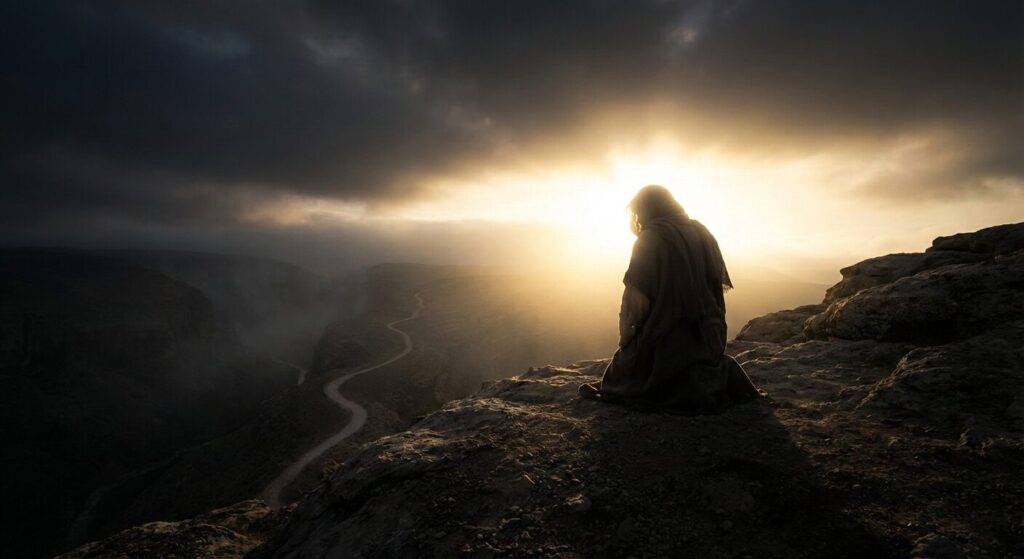
Most of us have seen the memes… the Instagram quotes overlaying moody photographs. “Dark Night of the Soul” has become shorthand for depression, existential crisis, or those seasons when God feels absent and life feels meaningless. Self-help books use the phrase. Pop psychology has claimed it. Even well-meaning Christians use it to describe any kind of spiritual suffering or emotional darkness.
The “Dark Night” that St John of the Cross speaks of isn’t what most people think it is. Actually, it is the opposite of what we assume. And that’s good news for anyone who feels spiritually lost, dry, or confused right now.
What John Actually Meant
Context matters. John of the Cross was a sixteenth-century Spanish Carmelite priest writing primarily for the nuns in Teresa of Ávila’s reformed convents. He wasn’t writing a self-help book for beginners. He was describing an advanced stage of contemplative prayer that those committed to the spiritual life would encounter on their journey toward union with God.
John identifies two distinct “nights”: the ‘Dark Night of the Senses’ (which comes first) and the ‘Dark Night of the Spirit’ (which goes deeper). Both are passages, not destinations. Both involve a particular kind of darkness. But this darkness isn’t the absence of God. It is too much presence.
Think about staring directly at the sun. The brightness is so overwhelming that it blinds you. Your eyes can’t process that much light, so you see darkness instead. That is what John means. God is so intensely present, so radically close, that our normal ways of sensing and experiencing God completely fail. Our spiritual “eyes” — our imagination, our emotions, our conceptual thinking — simply can’t process this level of divine intimacy. Hence, we experience it as darkness, emptiness, absence.
The closer you get to the sun, the darker it seems…
until your eyes adjust and you see only light.
John’s Dark Night is emphatically not clinical depression. If you are experiencing symptoms of depression, like persistent sadness, loss of interest in everything, feelings of worthlessness, thoughts of self-harm, please seek professional mental health support. That is a medical issue, not a spiritual stage. John’s night is also not punishment for sin. If you’re drowning in guilt and shame, that is something different — perhaps unconfessed sin or unhealthy religious formation. And it is definitely not a permanent state. John describes it as a passage, a transition, a process of transformation.
So, what is it? It is deepening intimacy with God. It is growing beyond images, feelings, and consolations into a more mature relationship with the Divine. It is learning to love God for His own sake, not for how He makes us feel. It is the spiritual equivalent of a child learning to love his/her parents not because they give candy, but because they are mom and dad.
Why This Matters for Your Life
You don’t have to be a sixteenth-century mystic or a cloistered nun to experience elements of what John describes. Many committed Christians go through seasons that feel remarkably similar to John’s Dark Night, and it helps to understand what might actually be happening.
Common experiences of spiritual “darkness” include prayer feeling completely dry, where the words that once moved you now feel empty and mechanical. Bible reading that used to nourish your soul suddenly leaves you cold and distracted. Going to church feels like going through motions — liturgy that once lifted your heart now just makes you aware of how empty you feel. God seems silent, distant, maybe even absent. You wonder if you have lost your faith, if God has abandoned you, if you are doing something terribly wrong.
John of the Cross would say: Wait. This might not be spiritual failure. This might actually be spiritual growth.
God may be weaning you from dependence on spiritual “feelings” and leading you into deeper reality. You are learning to love Him not because prayer feels good or because you get emotional highs from worship, but simply because of who He is — God. It is like a child maturing beyond loving their parents only when they get what they want, learning instead to love them for who they are.
John offers a practical test to help discern whether you are experiencing his Dark Night or simply drifting away from faith. Ask yourself these questions: Do you still desire God, even without “feeling” God? Despite the dryness, is there still a pull toward prayer, toward holiness, toward deeper relationship? Do you feel drawn to silence, solitude, and simplicity more than you used to? Are you less interested in noise, distraction, and busyness? Do you find yourself avoiding distractions more naturally than before?
If you answer yes to these questions, you might actually be in what John calls the Dark Night. Which means you are not failing, you are growing.
The dark night isn’t the end of your spiritual life. It’s the middle.
And the middle is where transformation happens.
How to Navigate the Darkness
- First, do not try to go back to old methods that no longer work. When meditation on Scripture feels dry, when imaginative prayer leaves you cold, when familiar devotional practices produce nothing, do not force it. Those methods served their purpose in an earlier stage. Clinging to them now is like an adult insisting on baby food.
- Second, stay in the silence. Just be present to God without agenda, without trying to manufacture feelings or force insights. Sit in the darkness. Let God work in ways you cannot perceive or control. This requires enormous trust.
- Third, trust the process. God isn’t abandoning you; rather, the Great Physician is doing surgery. Divine love is cutting away your dependence on spiritual consolations, your need to control the relationship, your attachment to feelings instead of faith. It hurts. But it is healing.
- Fourth, and critically, get a spiritual guide. This is precisely why spiritual direction exists. You need someone who knows these territories, who can assure you that what feels like disaster is actually transformation. This is a core reason why programmes like the Spiritual Direction Formation Programmematter — directors need training to accompany others through these dark passages.
What does darkness teach us? It teaches faith without feelings; i.e., faith that believes even when nothing confirms belief. It teaches hope without certainty; i.e., hope that trusts God’s goodness when all evidence seems to contradict it. It teaches love without reward; i.e., love that continues loving God simply because He is worthy of love, not because we get anything from it. These are the theological virtues in their purest form.
Darkness is gift, not punishment. Teresa of Ávila went through exactly this and describes it vividly in the Sixth Mansion of her Interior Castle. Every saint who pursued deep intimacy with God experienced it. Do not worry. You are in good company.
Our Spiritual Direction Formation Programme specifically trains graduates to recognise and guide people through these dark nights. They learn to distinguish between clinical depression and contemplative darkness, between spiritual crisis and spiritual growth, between abandonment and transformation.
Try This: One Week in the Dark
This week, experiment with ten minutes of “dark” prayer each day.
- Set a timer. Sit comfortably. Then simply be present to God with no words, no images, no agenda, no expectations.
- When thoughts come (and they will) gently return to this simple awareness: “I am here. You are here.” Do not try to feel anything. Do not evaluate whether it is “working.” Do not judge yourself for distraction or dryness.
- Trust that God is working even when you feel absolutely nothing. In fact, especially when you feel nothing.
- At the end of the week, journal briefly: What did you notice? What was difficult? What surprised you? Did anything shift, however subtly?
The purpose of this is not to achieve some mystical experience but to learn to rest in God’s presence without needing proof that the presence is real.
John of the Cross remains one of the most reliable guides for those experiencing spiritual darkness. His wisdom is for anyone who has discovered that following Jesus eventually leads beyond feelings into something more profound and more real.
If you are in darkness right now, you are not alone. You are not failing.
You might actually be exactly where God wants you.