
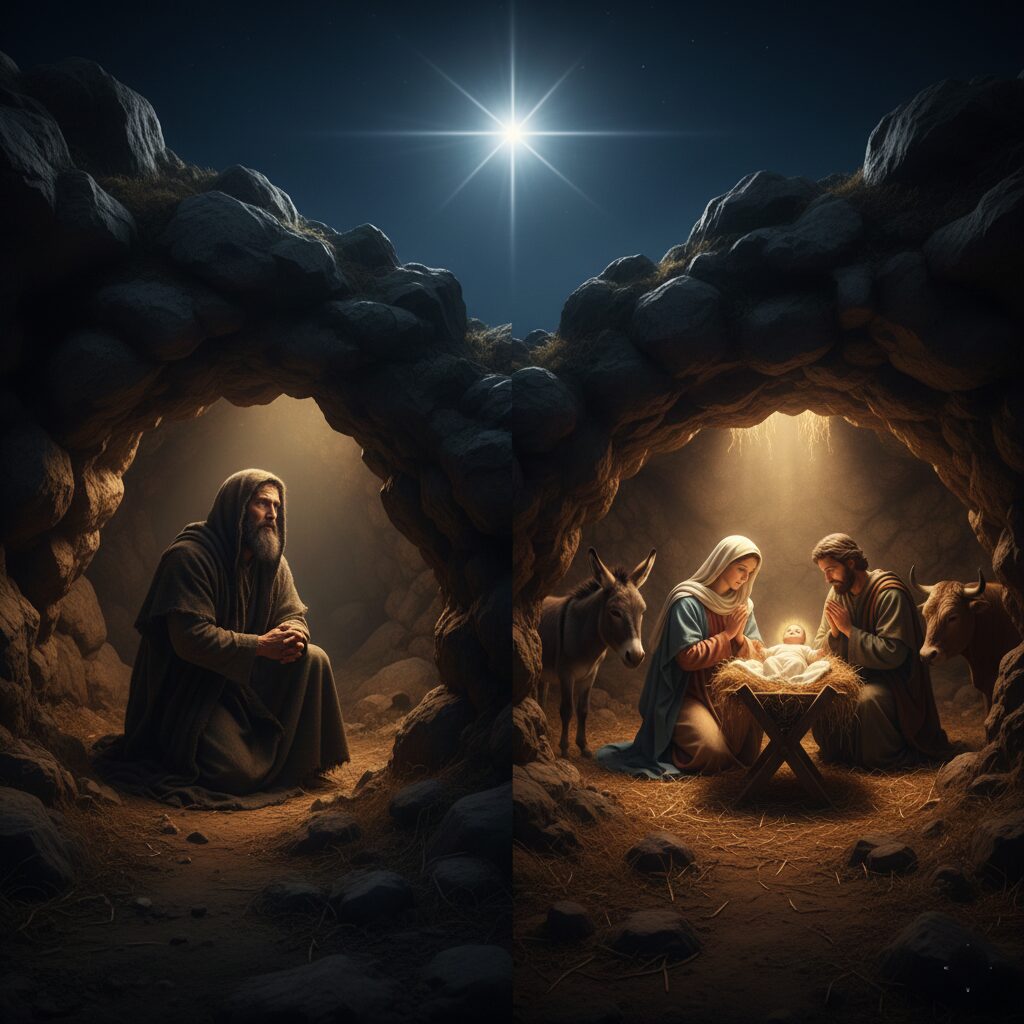
Throughout salvation history, caves have served as unexpected wombs of transformation. These dark, hollowed spaces, far from palaces and temples, become the places where God meets His servants and reveals His purposes. Two caves in particular illuminate the profound connection between solitude and service, between divine encounter and mission: Elijah’s cave on Mount Horeb and the cave-stable in Bethlehem. Together, they teach us that before we can truly serve, we must first learn to wait in darkness, and that the greatest service begins in the most unlikely places.
Elijah’s Cave
When Elijah flees to the cave on Mount Horeb, he arrives as a broken man. Fresh from his triumph on Mount Carmel, where fire fell from heaven and false prophets were defeated, the prophet has received Jezebel’s death threat and crumbled. “It is enough; now, O Lord, take away my life,” he prays under a broom tree before journeying forty days to the mountain of God, where he takes refuge in a cave. Here, in this hollow darkness, God asks him: “What are you doing here, Elijah?” The prophet’s response reveals his despair: “I have been very jealous for the Lord… and I, even I only, am left, and they seek my life, to take it away.” Elijah has lost sight of everything except his own exhaustion, fear, and isolation. He believes the story is over, that his ministry has failed, that he stands alone against overwhelming darkness. But God is not finished with Elijah. “Go out and stand on the mount before the Lord,” God commands. What follows is a theophany unlike any other. A great wind tears the mountains and breaks rocks, but the Lord is not in the wind. An earthquake shakes the ground, but the Lord is not in the earthquake. Fire blazes, but the Lord is not in the fire. And then, after all the sound and fury, comes “a still, small voice.”
This is the lesson of Elijah’s cave: sometimes God strips away all the dramatic manifestations we expect — the fire from heaven, the spectacular victories — and meets us instead in silence, in darkness, in the emptiness where we have nothing left but naked dependence on Him. The cave becomes a place of re-formation, where the prophet’s grandiose ideas about ministry are stripped away and replaced with something deeper — the realization that he is not alone, that seven thousand in Israel have not bowed to Baal, that God’s work continues beyond his understanding or control. Elijah enters the cave in despair; he emerges with renewed mission — a mission has been refined by solitude. He has learned that service to God does not rest on his strength, his success, or his survival. It rests on God’s faithfulness and the quiet voice that speaks in darkness.
It is no accident that the Carmelite Order traces its spiritual origins to Mount Carmel and to Elijah’s legacy. The early hermits who settled in the caves of Mount Carmel in the twelfth and thirteenth centuries saw themselves as heirs to Elijah’s contemplative solitude and prophetic mission. They understood that these two elements — contemplation and action, cave and service — cannot be separated.
St Teresa of Ávila and St John of the Cross deepened this understanding. For Teresa, the interior castle with its many mansions was itself a kind of cave, an interior space where the soul journeys inward to encounter God before emerging to serve others. For John, the dark night was the cave experience par excellence: a stripping away of all consolations, all attachments, all false securities, until the soul rests in God alone. He writes in The Dark Night: “God perceives the imperfections within us, and because of His love for us, urges us to grow up. His love is not content to leave us in our weakness.” The cave, whether literal or metaphorical, becomes the place where God’s love does its purifying work, preparing us for a service that flows from union with Him rather than from our own craving to be needed or to succeed.
Bethlehem’s Cave
Centuries after Elijah, another cave becomes the stage for God’s dramatic intervention in human history. If Elijah’s cave was about a prophet being remade, Bethlehem’s ‘cave’ is about God himself entering the human experience in the most vulnerable way imaginable – a babe in a manger. Consider the parallels. Just as Elijah fled to the cave in weakness and desperation, so God chooses to enter the world in weakness — as a helpless infant, born to parents with no room in the inn, laid in a feeding trough. Just as Elijah encountered God in silence rather than spectacular display, so the Incarnation happens in hiddenness — no armies of angels visible to the town, no proclamation in the Jerusalem temple, just shepherds keeping watch by night and a few animals in a cave.
But there is also a profound reversal. Elijah went to the cave to escape service, exhausted and ready to die. Christ enters the cave to begin His service, embarking on a mission that will culminate in His death. Elijah’s cave was about learning that he was not alone in God’s work; Bethlehem’s cave reveals that God Himself has entered the work, taking on human flesh to accomplish what no prophet could achieve. The cave-stable becomes a cradle of hope precisely because it demonstrates the inverted nature of God’s kingdom. The King of the universe is born in a place meant for animals. The Light of the World enters through darkness. The Bread of Life is laid in a feeding trough. Omnipotence wraps itself in swaddling clothes. This is service in its most radical form – God himself becoming servant, taking “the form of a slave” as St Paul writes, humbling himself to the point of death on a cross. (cf. Philippians 2:6-8)
The Teaching of the Caves
What connects these two caves is the truth that authentic service flows from encounter with God in hiddenness. We cannot give what we have not received. We cannot serve effectively from a place of burnout, ego, or desperation. We must first enter the cave. This is counterintuitive in our age. We are conditioned to believe that service means constant activity, that ministry requires perpetual availability, that love is measured by exhaustion. But both Elijah and the Incarnation teach otherwise. There must be seasons of withdrawal, of silence, of darkness where God does His hidden work in us. There must be caves before there can be authentic mission.
The Carmelite tradition has always insisted that contemplation and action are not opposites but partners. Prayer and service are not competing demands but complementary dimensions of Christian life. We go to the cave not to escape the world but to be remade for it. We embrace solitude not to avoid service but to purify our motivation for it. Teresa expressed this beautifully when she wrote: “Martha and Mary must join together.” (The Interior Castle, VII, 4:12) We need both the active service of Martha and the contemplative listening of Mary. The cave teaches us to be Mary before we are Martha, to receive before we give, to be filled before we pour out.
Both caves — Elijah’s and Bethlehem’s — function as wombs. In Elijah’s cave, a broken prophet is re-born into renewed mission. In Bethlehem’s cave, God Himself is born into human existence. Caves are places of gestation, of waiting in darkness, of hidden transformation that eventually bears visible fruit. This offers hope for anyone in ministry, anyone called to serve, anyone who has experienced the cave of exhaustion, doubt, or spiritual dryness. The cave is not the end of your story but its middle; that is, the place where God does His deepest work, often invisibly, preparing you for service you cannot yet imagine. What feels like burial may actually be planting. What seems like death may be the darkness before birth. We live between Elijah’s cave and Bethlehem’s cave — between the call to contemplative solitude and the summons to active service. The rhythm of Christian life requires both. We need our Horeb moments when we withdraw to encounter God in silence. We need our Bethlehem moments when God calls us to enter the messy, vulnerable places where He is being born anew. The cave reminds us that hope often gestates in darkness, that transformation happens in hiddenness, that the greatest movements of God begin in the most unlikely places. Whether you find yourself in Elijah’s exhaustion or are preparing for new service like Mary and Joseph traveling to Bethlehem, remember: the cave is not a dead end but a cradle. It is the womb where God shapes prophets and where He Himself chose to enter the world.
Enter the cave. Wait in its darkness. Listen for the still small voice. And trust that what feels like ending may actually be the beginning of something beautiful — hope being born in the most unexpected place of all.
Come Away and Rest Awhile
If you feel called to your own “cave” experience; that is, to a time of silence, solitude, and encounter with God, we invite you to consider a personal or guided retreat at the Carmelite Priory, Boars Hill, Oxford. In the peace of our contemplative community, you can step away from the demands of daily life and allow God to meet you in the stillness. Whether you need time for discernment, healing, or simply deeper prayer, our priory offers a sacred space for your journey inward.
For more information about personal directed or private retreats, please click here.