
V/ My eyes are turned to you, O Lord.
R/ You are the joy and gladness of my youth.
V/ Grant me the Wisdom that sits by your throne.
R/ That I may dwell as a child in your presence.
Let us pray
Lord, during this Lent, I commit myself to You and ask that You take over my life. Remove distractions and fill me with Your spirit of love for my failings. Strengthen my resolve with Your power as I engage in prayer, fasting, and charity. Nurture my love for Your Word and keep me attuned to Your voice. Amen.
FINDING JOY IN THE SHEPHERD’S GUIDANCE
Rev. Fr. Emeka K. Agboeze, OCD
Laetare: Fourth Sunday Of Lent, Yr A
1 Samuel 16: 1, 6-7, 10-13; Psalms 22(23); Ephesians 5:8-14; John 9:1-41
Rejoice, Jerusalem! The entrance antiphon of today’s Mass captures the mood of the Church today. Trusting in God’s mercy, which is infinitely greater than our faults, we know that our penitence has not been in vain. Therefore, we have reason to rejoice and exult, all of us who have remorsefully mourned and wept on account of our sins. God does not abandon us in our infidelity. He stays with us and leads us – and this seems to be the major theme of today’s liturgy. The story of Israel reflects this. They rejected God’s direct rule and preferred human kings to be like their neighbours, yet God used those human kings to show his closeness to them. Samuel mourned over Saul’s rejection, but God gave him and Israel a reason to rejoice. He chose and anointed David in a rather joyful ceremony as the king of Israel. Through him, God would continue to lead the people, for God’s spirit had “seized on David and stayed with him”.
Samuel’s mournful mood reflects our penitential mood during this season of Lent, but God gives us reasons to be joyful: our penitence has not been fruitless. It has served to prepare us for the Paschal Mystery, and to draw us nearer to God so that we, like Zacchaeus, might experience the joy of being pardoned, “the joy of salvation” (Ps. 51:12).
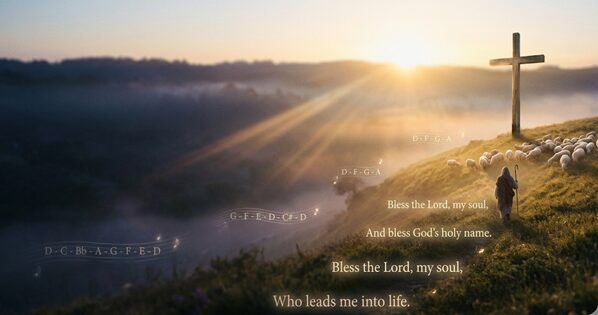
The responsorial psalm continues this theme of leadership. We all could joyfully say with David, “The Lord is my shepherd.” This psalm, with its deep spiritual significance, evokes a pastoral setting in which, through the desert of this world, the Lord finds an oasis for us: a green pasture and a restful spring where he refreshes us and renews our strength to continue our spiritual pilgrimage. Our journey may at times seem dreadful and lonely as we walk through the valley of darkness. Yet we are not alone. The sound of the shepherd’s crook and staff striking the ground comforts us and reassures us, in that darkness, of a presence capable of protecting, capable of overcoming every loneliness and fear – he is Emmanuel (God with us). Our joy in being led by such a provident shepherd remains immeasurable, for even in the destitution of the desert, he does not just give us bread to satisfy our hunger, but prepares a banquet for us. Truly, “there is nothing I shall want”. Moreover, the Shepherd knows the way, guiding us “along the right path”. He is true to his name as a shepherd.
This Shepherd has gone through the valley of darkness, passed through the shadow of death, and has come back in the glory of his Resurrection. Therefore, he knows the way that leads beyond death with an unrivalled familiarity. In the final steps of our journey, when we must cross the threshold of this earth, he leads us to eternal life. And what is more consoling is that he leads us not to a place he is unfamiliar with, but to his “own house [where] I shall dwell for ever and ever”.
The Gospel gives us a glimpse of how the Lord leads us from darkness to light, giving sight to the man born blind. We, too, are born blind, conceived in sin and born into the darkness of sin (Ps. 51:5). But through Baptism Christ “called us out of darkness into his marvellous light” (1Pt. 2:9). Significantly, today’s liturgy features the second scrutiny of catechumens who shall be led into the light of Christ’s Paschal Mystery. Without Christ, we would remain in the darkness of sin, as the second reading affirms: “You were darkness once, but now you are light in the Lord.”
Therefore, let us walk in the light as “children of light”. For St. John of the Cross, this light guides us even in our dark night: “How well I know where its waters spring, though it is night.” Lord of hosts, bring us back, let your face shed its light upon us, and we shall be saved (Ps. 80:3).
Concluding Prayer
Lord God, our Provident Shepherd, we thank you for not abandoning us in our infidelity, but instead preparing a banquet of mercy for us. You have called us out of the valley of darkness and into your marvellous light. Give us the humility to trust your crook and staff, the grace to rejoice in your salvation, and the courage to live always as children of the light. We ask this through Christ our Lord. Amen.
Reflective Questions
On Trust: Am I humble enough to trustingly allow the Shepherd to lead me, or do I insist on choosing and seeing my own path?
On Identity: As a Christian who has been called out of the blindness of sin, do my daily thoughts, words, and actions truly show that I am a “child of light”?
On Grace: When I experience the joy of conversion and forgiveness, do I strive earnestly to maintain that state of grace, or do I sometimes take God’s boundless mercy for granted?
Practice for the Week
The Evening Examen of Light: Take five minutes each evening this week before bed to review your day. Identify one moment where you allowed the Good Shepherd to lead you (walking in the light) and one moment where you resisted His guidance out of fear or pride (walking in the darkness). End by thanking God for His presence and resolving to surrender one specific worry to Him the following day.
Phrase to Remember
“You were darkness once, but now you are light in the Lord. Walk as children of light.”