
V/ My eyes are turned to you, O Lord.
R/ You are the joy and gladness of my youth.
V/ Grant me the Wisdom that sits by your throne.
R/ That I may dwell as a child in your presence.
Let us pray
Lord Jesus Christ, on this holy night You gave us the Eucharist as the enduring memorial of Your Passion, and the command to love one another as You have loved us. Open our hearts to receive Your Word, that we may truly comprehend the depth of Your sacrificial love and worthily enter into these sacred mysteries. Amen.
HE LOVED THEM TO THE END
By Rev Fr Emeka K. Agboeze, OCD
Thursday of the Lord’s Supper
Exodus 12:1–14; Psalm 116 (115): 12–18; 1 Corinthians 11:23–26; John 13:1–15
‘This evening’s liturgy marks the beginning of the Sacred Paschal Triduum. The entrance antiphon highlights the centrality of the events of these three days, into which we are introduced this evening: “We should glory in the Cross of our Lord Jesus Christ, in whom is our salvation, life and resurrection, through whom we are saved and delivered” (cf. Gal. 6:14). We recall our salvation through the death of Christ (Good Friday); we anticipate our resurrection (Easter); we commemorate our Passover deliverance (Holy Thursday)—all these are made possible, according to our antiphon, by the glorious Cross of our Lord in which we now glory.
The principal mysteries commemorated in today’s evening Mass, according to the Roman Missal, are “the institution of the Holy Eucharist and the priestly order, and the commandment of the Lord concerning fraternal charity.” The significance of these mysteries is brought to light by the prayer of the psalmist which in the Liber Usualis is sung as part of the entrance antiphon: “O God, be gracious and bless us and let your face shed its light upon us” (Ps. 67:1). God’s face perpetually shines upon His Church through these three important mysteries. The Holy Eucharist is the face of God made man in Christ. To gaze upon Christ is to contemplate the face of God hidden in this sacrament. “This is My body, this is My blood”: it is the sacrament of God’s presence. Furthermore, acting in the person of Christ, the priest incarnates God’s presence among the people. Though he is an unworthy vessel, Christ reaches His people through his actions. He is the merciful face of God through whom we tangibly receive the answer to our prayer: “O God, be gracious and bless us.” Finally, no virtue signals the presence of God as does the virtue of charity: “God is love, and he who abides in love abides in God and God in him” (1 Jn. 4:16). Rightly, then, does the offertory hymn of today declare: ubi caritas est vera, Deus ibi est (where there is true love, God is there).
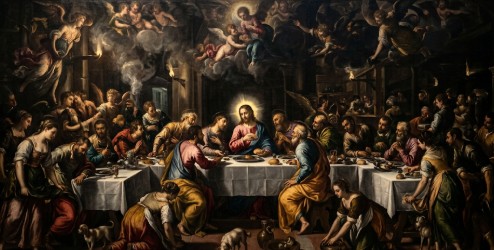
Yet it is the Holy Eucharist that stands out in this evening’s celebration, since it presupposes the other two: the Eucharist points both to the ministerial priesthood of Christ, without which no bread can become the Eucharist, and to His salvific love for us—that love which is the only worthy context of its institution: “He always loved those who were his in the world, but now he showed how perfect his love was” (today’s Gospel). It is indeed the sacrament of love (sacramentum caritatis) in which our Lord shows us the parental love of the Father, a love both paternal and maternal, for He is the source of all true love—whether fatherly or motherly. For St Therese of the Child Jesus, “the loveliest masterpiece of the heart of God is the heart of a mother.” Tintoretto expresses this truth in his Last Supper painting. Two images strike us in that painting. We find Jesus feeding Peter with the Eucharistic bread directly into the mouth. This rather maternal gesture corresponds to the image of an onlooking woman in the foreground who breastfeeds her child. The maternal love of this woman is compared to the love of Christ. Christ loves His Church so tenderly that He feeds her with His body, just as a nursing baby draws nourishing breast milk directly from the body of its mother. This helps us to understand how to live out concretely that love which the Eucharist inspires. The baby represents the poor, the weak and the defenceless—all those who, like babies, depend on others for sustenance. We ought to be charitable towards them and so fulfil the command of Christ: “I have given you an example so that you may copy what I have done to you”.
Prayer
Father, Your Son gave His life for our sake and gave us His body for our food. As we enter into these holy days, nourish our souls with the grace of the Eucharist and set our hearts on fire with the flame of charity, that we may worthily imitate Christ, who washed His disciples’ feet and gave Himself totally for us. Amen.
Questions to Ponder
1. When I approach Holy Communion, do I take a moment to truly contemplate that I am gazing upon the face of Jesus Christ?
2. Does viewing Holy Communion as such a tender, personal act of “nourishment drawn directly from Christ” shift my perspective on the sacrament?
3. Who are the “poor, weak, or defenceless” individuals in my immediate life to whom I must now offer self-giving love?
Practice for the Day
Attend the evening Mass of the Lord’s Supper if possible. Following the Mandatum (the foot washing) during the liturgy, pick one person in your community—perhaps someone whom others ignore—and intentionally greet or pray for them, recognising Christ’s face in them.
Memory Phrase
Ubi caritas est vera, Deus ibi est (Where there is true love, God is there)