
V/ My eyes are turned to you, O Lord.
R/ You are the joy and gladness of my youth.
V/ Grant me the Wisdom that sits by your throne.
R/ That I may dwell as a child in your presence.
Let us pray
Lord God, as we begin this Holy Week, open our hearts to the mystery of Your Son’s sacrifice. Like Mary of Bethany, may we offer You our very best, and with humble hearts, accompany Jesus on the road to Calvary. We ask this through Christ our Lord. Amen.
HOLOCAUST OF LOVE
By Rev Fr Emeka K. Agboeze, OCD
Monday of Holy Week
Isaiah 42:1-7; Psalm 26(27):1-3,13-14; John 12:1-11
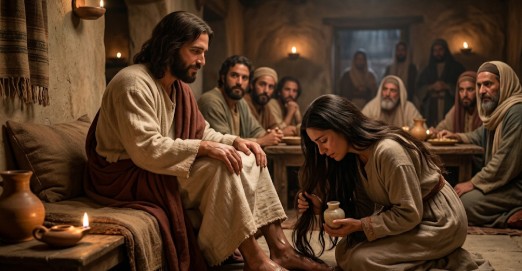
“Mary brought in a pound of very costly ointment, pure nard, and with it anointed the feet of Jesus, wiping them with her hair; the house was full of the scent of the ointment.”
Christ “suffered under Pontius Pilate,” under the Roman regime, and there seems to be something Roman going on in this passage as it pertains to the sacrifice of Christ. The ancient Roman sacrificial tradition included a preliminary ritual in which the chosen victim is washed and adorned with ribbons or, depending on the animal to be sacrificed, a richly embroidered blanket called dorsuale. These rituals seek to make the victim attractive and pleasing to the deity honoured by the sacrifice: the victim ought to appear different, pure (washed) and precious (decorated) in comparison to other animals.
The rather uncommon gesture of hospitality shown by Mary to Jesus seems to suggest the reason why Jesus has come into the Holy City. Already, Jesus had revealed to his followers that Jerusalem was the place appointed for his sacrificial death (cf. Mt. 16:21). He is here, therefore, as the sacrificial victim for the salvation of the world. He undergoes in this company the preliminary ritual which gives the idea that he is the chosen victim. Mary wipes his feet. The ‘feet’ here are a synecdoche referring to the whole person (cf. Is 52:7): it is that part of the body which best describes the visitor; he literally walks into the house of the host. She also prettifies the feet of Jesus with a rich ointment which makes the feet shine and appeal not just to the eyes but also to the olfactory sense of the convives. Jesus is the truly pure and precious victim, “my chosen one in whom my soul delights” (first reading). His sacrifice like sweet-smelling incense (cf. Ex. 30:7) is pleasing to God—the perfect sacrifice.
Yet these exterior signs only serve imperfectly to capture the worthiness of this divine victim. In his celebrated Eucharistic hymn, Adoro te devote, St Thomas Aquinas speaks of the precious blood, “one drop of which saves the whole world from all evil.” Yes, the blood of Christ is so precious, so costly, so valuable that only a drop of it infinitely suffices to pay the price of the world’s salvation. He is the pure victim which, needing no purification, rather purifies and “takes away the sin of the world” (Jn. 1:29).
We can therefore be sure that God will accept this most precious victim without hesitation. His sacrifice is eagerly awaited by Adam, all the patriarchs of old, the prophets and all the just who have not yet seen the face of God. They are the blind referred to in the first reading, for they are yet to see the light of God’s face. They are the captives of Sheol waiting for their Saviour to free them from the darkness of the dungeon. And, yes, Christ is now in Jerusalem to die in order to “open the eyes of the blind, to free the captives from prison, and those who live in darkness from the dungeon” (first reading). He will open for them the gates of heaven and introduce them into God’s luminous presence.
Nevertheless Christ calls us to participate in this saving work. St Therese of Lisieux captures in her life what our response should be. She writes: “In order to live in one single act of perfect love, I offer myself as a victim of holocaust to your merciful love, asking you to consume me incessantly.” She clearly understood, like St Paul, that “we are like sweet-smelling incense offered by Christ to God, which spreads among those who are being saved and those who are being lost” (2 Cor. 2:15). Having a share in Christ’s priesthood also entails being victims with him. Does this frighten me? Am I willing to offer my whole self to him as a holocaust in imitation of St Therese? What attachment could hold me back from such a total offering?
Prayer
Heavenly Father, we thank You for the pure and perfect victim, Your Son Jesus Christ, whose sacrifice opened the gates of heaven for us. Like St Therese, grant us the grace to offer ourselves daily to Your merciful love, so that our lives may become a sweet-smelling incense, pleasing in Your sight. We ask this through Christ our Lord. Amen.
Reflective Questions
1. When I look at the cross, do I see a tragedy, or do I recognise it as the ultimate, voluntary, and “perfect sacrifice” offered for me personally?
2. What is the most “precious ointment” in my life (time, talent, or a beloved attachment) that I am hesitant to offer completely to Jesus this Holy Week?
3. Does the idea of offering my daily struggles and successes as a total sacrifice to God frighten me, or does it inspire me to live my faith more deeply?
Practice for the Day
Like Mary, who perfumed the house with her offering, perform one act of humble, unexpected service for someone today, holding nothing back, as a sweet-smelling offering to Jesus.
Memory Phrase
“We are like sweet-smelling incense offered by Christ to God.” (2 Cor. 2:15)