
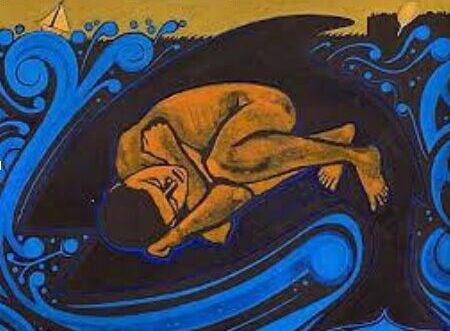
(Artist: Michael O’Brien)
IN THE BELLY OF THE WHALE
By Vivien Foster, OCDS
Holy Saturday
Lamentations 3:1-9,19-24; Psalm 31:1-4,15-16; 1 Peter 4:1-8; John 19:38-42
Holy Saturday is without a doubt the emptiest day of the liturgical year. For it is the only day of the year when Mass is not celebrated, and even the Real Presence of the Eucharist is taken away. For this reason, we may not see any compelling reason to visit a church during the daylight hours of Holy Saturday. Yet, if we do, we will nonetheless experience something important.
We will experience the desolation of the Eleven in the Upper Room, transmitted through a series of liturgical metaphors: the stripping away of altar vestments, the covering-up of religious images, the extinguishing of the sanctuary lamp, and the emptying of the tabernacle – with its door flung uncharacteristically open. There is an unmistakable sense that all is lost.
[Pause]
The Paschal Mystery of Christ – His Passion and Resurrection – forms the pattern for all spiritual development. And, if we look at the Paschal Mystery, we see three main elements: initially a death, ultimately a resurrection, but standing between these two (and perhaps easy to miss) a kind of hiatus, an empty space, a Holy Saturday. This hiatus, it turns out, is much more than just an incidental gap; rather, it is an essential and unavoidable part of the transformation process.
In fact, once you start to look, these gaps are ubiquitous throughout salvation history. And the gaps come in all shapes and sizes: both big and small.
Jesus’s sojourn in the tomb was a relatively short gap, measured – according to the conventions of the time – as three days; although, based on modern timekeeping, it probably lasted no more than forty hours.
One of the longest gaps that we commemorate in Scripture is the forty-year wandering of the Israelites in the desert, between their Exodus from Egypt and their entry into the Promised Land. Considering the distance between these two locations is not much more than 250 miles, the forty-year delay was certainly not justified from a transportation perspective. Its purpose, rather, was to enable them to travel the necessary distance spiritually.
And so it goes on. Noah spent a whole year in the Ark. Jonah spent three nights and three days in the belly of the whale. Paul retreated for three years into Arabia between his conversion and his apostolic ministry. I am sure you can think of many other examples.
All these gaps have something in common. They correspond to what modern psychologists would describe as liminal spaces. Liminal spaces mark the threshold between life transitions, so often characterised by uncertainty and disorientation. In a liminal space, we know that we have already experienced a death of some sort, without yet being certain whether it will be followed by a resurrection. Despite the intense discomfort and desolation that such spaces may cause, in reality they are times of great spiritual fruitfulness, because they are the place where something new is being brought to birth.
In St Teresa of Avila’s masterpiece, The Interior Castle, she uses as a metaphor for the spiritual life a silkworm entering the cocoon from which it will later re-emerge as a butterfly. In deep contemplative prayer, she explains, a person ‘cocoons themselves’ in silent recollection, allowing God to undertake the mysterious work of transformation.
Cocooning moments are often involuntarily thrust upon us through liminal life experiences. However, Teresa suggests that by embracing spiritual disciplines, we may voluntarily choose to enter such a cocoon. At times, contemplative prayer may feel decidedly liminal: a threshold between the human and the Divine, a place where we risk losing our bearings.
For St John of the Cross, this cocooning process proved to be a literal one, since he was confined for nine months in a cramped, dark prison cell. Despite his deplorable treatment, the very deprivation he experienced forced him to rely on faith and love alone, in an experience that he later described in a letter to a friend as being ‘swallowed by the whale’ – ‘a sharing in the sign of Jonah’. This dark experience proved transformative for him in ways that are most evident in his poetry, as he eventually escaped from prison with a first draft of the Spiritual Canticle tucked into his habit.
[Pause]
If you do venture into a church on Holy Saturday, you will be entering the liturgical equivalent of a liminal space. Pause there for a moment, and, after a while, you may begin to notice that the empty tabernacle – symbolising the physical absence of Jesus – bears a remarkable resemblance to the empty tomb – symbolising His Resurrection presence.
Prayer
Lord, we pray for the strength to endure the Holy Saturdays of our lives. We pray for the faith to persevere, to remain in the belly of the whale, confident that your work of transformation is underway, without needing to see or understand what is taking place, but only trusting fully in the strength of Your love and the power of Your grace. Amen.
Questions to Ponder
1. How does the liturgical symbolism of Holy Saturday affect you?
2. Do you ever experience prayer as a liminal space?
3. Why is it so frightening, but so fruitful, to enter the cocoon?
Practice for the Day
Thinking back over your life, try to recall one or two liminal spaces that you experienced during major life transitions. With the benefit of hindsight, what spiritual fruits emerged for you from those challenging times?
Memory Phrase
The endurance of darkness is the preparation for great light.
(St John of the Cross, Letter 11 to Doña Juana de Pedraza)