
V/ My eyes are turned to you, O Lord.
R/ You are the joy and gladness of my youth.
V/ Grant me the Wisdom that sits by your throne.
R/ That I may dwell as a child in your presence.
Let us pray
Lord, in your all-providential plan, you have led me to this moment to rediscover myself in your Word and Wisdom. Aid me to make this time of meditation and prayer enriching, transforming, and liberating for my well-being and others.
OH HAPPY FAULT!
By Vivien Foster, OCDS
Divine Mercy Sunday
Acts 2: 14a,22-32; Psalm 16; 1 Peter 1:3-9; John 20: 19-31
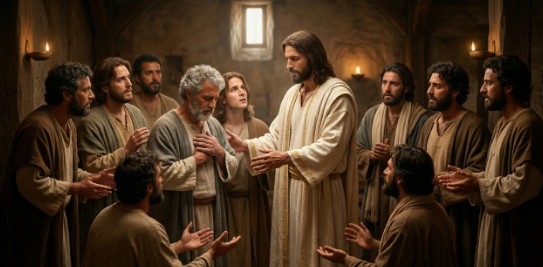
In today’s reading from St John’s Gospel, we see the Risen Christ breathing the Holy Spirit on his disciples and sending them forth into the world. In doing this, Jesus is strikingly clear about the purpose for which he gives the Holy Spirit and the purpose for which he sends them out into the world. His purpose is mercy – ‘the forgiveness of sins’ – the principal fruit of His Passion. This second Sunday of Easter has become known as Divine Mercy Sunday – a modern feast introduced by Pope St John Paul II in the year 2000. This renewed confidence in God’s mercy is important because the heresy of Jansenism – prevalent in earlier centuries – portrayed instead a severe Deity intent on justice and retribution. Perhaps some of us have actually encountered this distorted version of God, whether in our own imagination or in the perceptions of others. In some ways, we may be more comfortable with this kind of deity. In pride, we may prefer to get what we deserve from God rather than depending entirely on Divine generosity. St Therese of Lisieux, an enclosed Carmelite nun living in France towards the end of the nineteenth century, was among the first to insist boldly on the merciful nature of God. Turning upside down the prevalent Jansenist thinking of her time, she brilliantly declared that God’s justice was his mercy. ‘I hope as much for God’s justice as for his mercy. It is because He is just that “He is compassionate and gentle, slow to punish and full of mercy. Because He knows our frailty, He remembers that we are only dust”.’
But what is this mercy exactly? Erik Varden helpfully defines mercy as a ‘readiness to look on others without illusions, conscious of their faults, and yet to love them’. This makes it clear that mercy requires a degree of love that is truly exceptional, indeed superhuman, because mercy entails loving the unlovely, or even the unlovable. The Gospels attest, again and again, to the merciful nature of God, and nowhere more so than in St Luke’s consecutive parables of the lost sheep, the lost coin and the lost (or prodigal) son. In the midst of these intriguing stories, Jesus slips in this remarkable saying: ‘There will be more joy in heaven over one sinner who repents than over ninety-nine righteous persons who need no repentance’ (Luke 15:7).
In saying this, Jesus points to a great paradox, namely that our sinfulness provides God with an opportunity to express the extraordinary mercy of His Heart, a mercy that would be entirely redundant if we were all absolutely perfect. St Paul takes this even further in his letter to the Romans, by saying: ‘God has consigned all to disobedience, that he may have mercy on all’ (Romans 11:32). It is as if God allows sin in order to have the opportunity to exercise his mercy.
And this same audacious idea reverberates in the great Exsultet hymn that opens the Easter Vigil on the night of Holy Saturday, proclaiming, ‘O happy fault (felix culpa)! That won for us so great a redeemer’. In other words, only the fallen can experience the marvel of the redemption.
The implication for our spiritual lives is profound, for it means that our only path to God leads by way of His mercy. St Elizabeth of the Trinity, writing to one of her closest friends just weeks before her untimely death, spells it out for us as follows: ‘love your misery, for that is where God exercises His mercy’. But to avail ourselves of that mercy, we need to understand and acknowledge our need for it, and this can be difficult. Yet every smarting discovery of self-knowledge is a territory newly opened up to the healing mercy of God. God invites us to plumb the depths of our moral bankruptcy, only to realise that for us there is nothing left but to cast ourselves upon the ocean of His mercy. In the very moment that we see ourselves at our most wretched, we discover that it is not who we are that really matters, but only who He is.
In this mysterious economy of salvation, our liabilities become our only real spiritual assets.
Prayer
In the evening of this life, I shall appear before You with empty hands, for I do not ask You, Lord, to count my works. All our justice is stained in Your eyes. I wish, then, to be clothed in Your own Justice and to receive from Your Love the eternal possession of Yourself.
St Therese of Lisieux. Excerpt from Act of Oblation to Merciful Love.
Ponder Questions
1. Do you recognise any remnants of the severe Jansenist God in yourself or among people you know, or older family members?
2. Do you struggle to believe in God’s mercy? Are you more comfortable with his justice?
3. What would it mean to think of your spiritual liabilities as your principal spiritual assets?
Practice from Insight
Identify someone that you find difficult to love, and try to show Divine Mercy towards them; remembering that God’s mercy looks on us without illusions, conscious of our faults, and loves us nonetheless.
Memory Phrase
“Love your misery, for that is where God exercises His mercy”.
St Elizabeth of the Trinity