
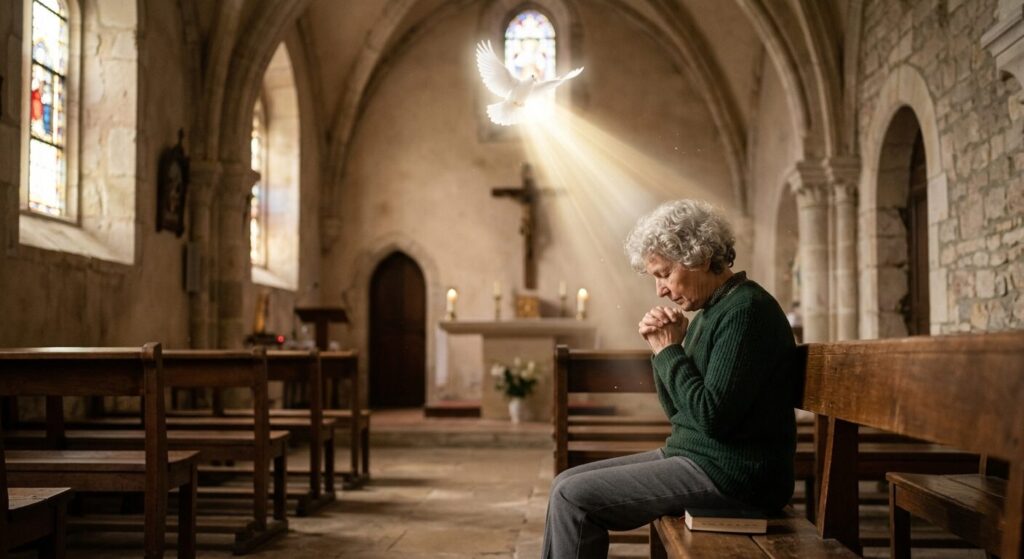
When we hear “praying in the Spirit,” most of us think of something we can feel — hands raised, voices passionate, maybe tongues, certainly energy. We think of prayer that moves us, prayer we can sense happening, prayer that creates an atmosphere we can almost touch. The Spirit feels present because something visible is happening.
This experience is real and valuable. The Spirit does move powerfully in community worship, in passionate intercession, in the gifts of tongues and prophecy. Paul celebrates these gifts throughout his letters.
But here’s what the Carmelite tradition wants to whisper to us: The Holy Spirit also prays in silence. In fact, some of the Spirit’s deepest work happens when nothing seems to be happening at all. When prayer becomes so simple it looks like doing nothing. When the Spirit prays through us in ways our conscious mind can’t detect or control.
Let us introduce you to a different way of praying in the Spirit, one that might feel strange at first, especially if you are used to prayer being something you actively do. This is prayer as receptivity, prayer as being present, prayer as allowing the Spirit to work beneath the surface of your awareness.
This is contemplative prayer, and the Carmelites have been teaching it for eight hundred years.
The Spirit Prays What We Cannot Say
Paul writes in Romans 8:26: “The Spirit helps us in our weakness. We do not know what we ought to pray for, but the Spirit himself intercedes for us through wordless groans.” Paul is talking of wordless groans. Not eloquent prayers or passionate declarations. Wordless. Beyond language.
Teresa of Ávila spent years trying to pray with words… meditating on Scripture, talking to God about her day, making requests. This is good prayer, necessary prayer. But eventually, she found words becoming obstacles. She wanted to tell God everything, but somehow everything felt like too many words and not enough truth. So she learned to sit in silence. Just being with God. Not speaking, not asking, not even thinking particularly holy thoughts. Just being present.
From her experience, she wrote: “Mental prayer is nothing else than an intimate sharing between friends; it means taking time frequently to be alone with Him who we know loves us.” Notice what’s missing from her definition: words, feelings, experiences, manifestations.
Prayer, for Teresa, is fundamentally about relationship – being with Someone who loves you.
Sometimes that involves conversation. Sometimes it’s just sitting together in comfortable silence. The Spirit prays in that silence. We stop generating words, and the Spirit begins interceding at depths we can’t access through language.
When the Spirit Leads Into Quiet
John of the Cross describes a transition many people experience in their prayer journey. He calls it moving from meditation to contemplation. Meditation is active; you are thinking about God, reflecting on Scripture, engaging your imagination and emotions. You are doing something you can feel and measure. Contemplation is receptive; you are simply being present to God, often without thoughts or feelings to confirm the connection. You are not doing; you are allowing God to do.
John teaches that when God begins to give you the grace of contemplation, your old active methods stop working. Scripture that once moved you feels flat. Prayers that once energised you feel empty. Your mind wanders constantly. You wonder if you’re doing something wrong. Well, you aren’t.
The Spirit is teaching you a new way to pray.
John gives three signs that this transition is happening:
First: You find no satisfaction in thinking about God or anything else during prayer. Your usual methods don’t work anymore.
Second: You have no desire to fix this by trying new techniques or methods. The dryness persists no matter what you do.
Third: Despite the emptiness, you still want to be alone with God. You are drawn to silence and solitude. You don’t want to abandon prayer; it’s just that you can’t pray the old way anymore.
If these signs describe you, the Spirit might be inviting you into contemplative prayer. The move from noise to silence is progress in the journey within.
The Spirit is praying deeper than your conscious thoughts can reach.
How To Pray Contemplatively
What does this actually look like practically? How do you “do” contemplative prayer? The short answer: You mostly stop doing and start being.
Here’s a simple practice to begin:
Set aside 20 minutes. Find a quiet space. Sit comfortably but alert… not so relaxed that you will fall asleep but not tense either.
Begin with presence. Take a few deep breaths. Acknowledge you are here and God is here. You might say internally: “I am here Lord, and You are too. That suffices.”
Choose a sacred word. This will be your anchor… a single word that represents your intention to be present to God. For example, ‘Jesus’, ‘Peace’, ‘Love’, ‘Abba’. The word itself doesn’t matter. Your intention does.
Rest in silence. Now simply sit. Don’t try to think holy thoughts. Don’t analyse your spiritual state. Don’t worry about whether you are “doing it right.” Just be.
When thoughts come (and they will), gently return to your sacred word. “Jesus.” Then back to silence. Thoughts will come again. Return again. “Jesus.” Silence.
Don’t evaluate. This is crucial. Don’t spend the 20 minutes wondering if it’s working, if God is present, if the Spirit is moving. Trust that the Spirit is praying beneath your awareness. Your job is simply to show up and stay present.
End gently. When time is up, don’t rush back to activity. Sit for another minute. Pray a simple prayer of thanks. Then return to your day.
The Spirit’s deepest work often happens beneath conscious awareness.
When you sit in silence, when you stop generating your own prayers and simply rest in God’s presence, the Spirit begins interior work you can’t monitor or measure.
The Spirit is:
- Purifying your motivations (why do you really pray?)
- Deepening your capacity for intimacy with God
- Teaching you to love God for God’s sake, not for spiritual experiences
- Healing wounds at depths you can’t consciously access
- Conforming you to Christ in ways you can’t engineer
- Praying the prayers you don’t know you need
This isn’t prayer that produces immediate results you can feel. It’s prayer that transforms you slowly, often imperceptibly, from the inside out.
Here’s how you know if contemplative prayer is genuinely the Spirit’s work in you: not by what you feel during prayer but by how you live after prayer.
Does silence in prayer produce greater love in life? Are you becoming more patient, more compassionate, less judgmental? Can you stay present with difficult people without needing to fix or flee? Are you growing in what Paul calls the fruit of the Spirit – love, joy, peace, patience, kindness, goodness, faithfulness, gentleness, self-control?
If yes, the Spirit is praying in you, even when prayer itself feels empty.
Many of us have experienced powerful moves of the Spirit in worship. Beautiful. Essential. Thank God for those moments. But if that’s the only way we know how to pray, we are missing something. Because the Spirit also moves in silence. The Spirit also prays when we can’t. The Spirit also does deep work when nothing visible is happening.
The question isn’t which way is right. The question is: Are you open to both?
An Invitation to Silence
If you have never prayed contemplatively, you’re invited to try it for one week. Just 20 minutes a day. You’ll probably feel like you are failing. Your mind will wander constantly. You will wonder if anything is happening. You might feel bored, restless, even frustrated. But that is exactly where contemplative prayer begins… in the humbling realisation that we can’t manufacture God’s presence, we can’t control spiritual experience, we can’t engineer transformation.
All we can do is show up. Sit down. Be present. Trust that the Spirit is praying “wordless groans” too deep for conscious awareness.
The Spirit invites you into the silence today. Will you come?