
V/ My eyes are turned to you, O Lord.
R/ You are the joy and gladness of my youth.
V/ Grant me the Wisdom that sits by your throne.
R/ That I may dwell as a child in your presence.
Let us pray
Lord, in your all-providential plan, you have led me to this moment to rediscover myself in your Word and Wisdom. Aid me to make this time of meditation and prayer enriching, transforming, and liberating for my well-being and others.
TAKING PRECEDES GIVING
By Vivien Foster, OCDS
ASCENSION DAY
Acts 1:1-11; Psalm 47; Ephesians 1:15-23; Luke 24:44-53
There is always something bittersweet about Ascension Day. Think of it from the disciples’ perspective. We can imagine their joy and relief at encountering the Risen Lord in bodily form at Easter, and so we can empathize with their likely dismay at losing his presence for a second time just a few weeks later at the Ascension. For what could be better than having Christ bodily among them? From their perspective at that time, probably nothing. But we, of course, have the benefit of hindsight…
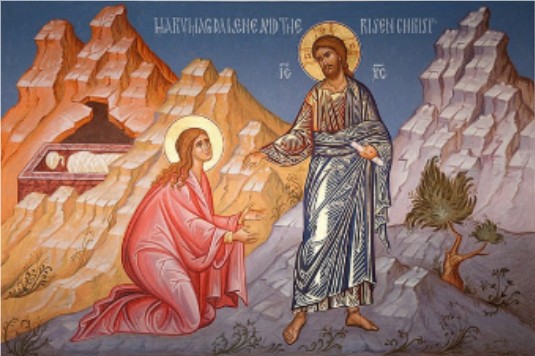
If we look carefully, we find that Jesus announces his imminent Ascension as early as Easter Sunday morning itself. In fact, it is one of the first things he says to Mary Magdalen, whom he encounters in the garden: “Do not hold on to me, for I have not yet ascended to the Father. Go instead to my brothers and tell them, ‘I am ascending to my Father and your Father, to my God and your God’” (John 20: 17).
Jesus is concerned that the disciples will cling to his Risen Body, preventing him from returning to the Father and giving birth to his Ecclesial Body through the outpouring of the Holy Spirit. Christ’s Risen Body, for all its awesome beauty, could only ever reach the few. Whereas his Ecclesial Body, vivified by the Holy Spirit, would embrace the whole of humanity across the whole of history. The Body of Christ must evolve from a literal corpus to a figurative community.
But for all of this to happen, the disciples had to let go of what seemed to be their highest good – the bodily presence of Jesus among them – and make space for an even greater good beyond their wildest imagining – the coming of the Holy Spirit and the birth of the Church at Pentecost.
And this, indeed, provides the pattern for all God’s giving to us: something typically needs to be taken first to make way for the new gift. Making space for greater things often entails letting go of lesser ones. But the problem is that we are very much attached to the lesser things that we already have and struggle to imagine that anything greater might be able to replace them. And this mindset stands in the way of our spiritual growth.
The Carmelite Doctor, St John of the Cross, uses the image of a mother weaning a child to explain how we progress in the journey of prayer (Dark Night, 1.2). A mother initially nurses her baby with nourishing breast milk but must eventually withhold this if the child is ever to advance to solid food. Similarly, John argues, God lavishes consolations on beginners in the spiritual life to encourage them in the ways of prayer but will subsequently withdraw these consolations and allow them to experience darkness as a means of advancing towards spiritual maturity.
John’s weaning metaphor highlights two important lessons.
First, unless the mother withholds the milk, the child will never experience the emptiness needed to take in solid food. There is a need to create space for something new to be received.
Second, while the child may initially experience great distress at the loss of breast milk, this is because he or she cannot yet imagine the marvels of adult food. With the benefit of hindsight, she will later be able to celebrate this transition.
Starting in infancy, this pattern repeats itself in so many ways throughout our lives. Hopefully, this very repetition may eventually help us to learn not to fear these losses. One helpful definition of penance provided by the Cistercian writer Andre Louf, is that penance is “a disposition to let God take”. This disposition is the fruit of a faith that is reinforced by each successive cycle of God’s taking in order to give a greater gift. Bodily death itself will be the ultimate instance of God’s taking from us, and the greatest test of our faith that something greater will result. Throughout the many different losses of life, we pray that God may give us the faith to keep believing in His goodness and Providence towards us.
Prayer
Dear Lord, help us to remember that “what no eye has seen, what no ear has heard, and what no human mind has conceived” are the things you have prepared for those who love you. Ease our fears and help us to trust in the goodness of your designs, even in the face of inscrutable loss. Amen. (1 Corinthians 2:9)
Ponder questions
- Can you remember a time when it felt as though God was taking something away from you that ultimately resulted in a greater gift that you could not have anticipated?
- Is there anything that God is asking you to leave behind at present? Are you able to have faith in what God may subsequently have in store for you?
Practice from Insight
Take stock of the many good gifts that God has given you. Feel the extent of your attachment towards them. Imagine what it would be like to lose any one of them. Allow this anticipation to loosen your grip and make space for your hands to receive new gifts.
Memory Phrase
Penance is a disposition to let God take (Andre Louf OCSO)