
V/ My eyes are turned to you, O Lord.
R/ You are the joy and gladness of my youth.
V/ Grant me the Wisdom that sits by your throne.
R/ That I may dwell as a child in your presence.
Let us pray
Lord, in your all-providential plan, you have led me to this moment to rediscover myself in your Word and Wisdom. Aid me to make this time of meditation and prayer enriching, transforming, and liberating for my well-being and others.
THE HIDDEN COMPANION: EMBRACING THE GIFT AND THE TASK
By Clement Obiorah, OCD
THIRD SUNDAY OF EASTER, YR A
Acts 2: 14, 22-33; Psalm 16: 1-11; 1 Peter 1:17-21; Luke 24: 13-35
“Christianity is the present. It’s both gift and task. Receiving the gift of God’s inner closeness and as a consequence bearing witness”. These words from Pope Benedict XVI serve as a perfect lens through which we can view today’s Gospel: the familiar story of the road to Emmaus. Moreover, all the readings, viewed in the light of Carmelite tradition, offer a roadmap of the soul’s interior journey toward an intimate friendship with God. It is a journey that unfolds in three distinct stages: the darkness of the journey, the awakening of the heart, and the call to witness.
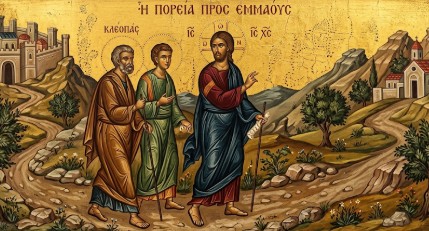
Our Gospel begins in profound disappointment. Two disciples are walking away from Jerusalem, their community, and the traumatic events of Good Friday. In our first reading, Peter bluntly summarises what they witnessed: Jesus of Nazareth was “crucified and killed by the hands of lawless men.” Because of this, the disciples are immersed in what St. John of the Cross calls a “dark night.” Listen to their heartbreak: “But we had hoped that he was the one to redeem Israel.” They are not just sad; as the Carmelite Jewish convert St. Teresa Benedicta of the Cross (Edith Stein) points out, they are stumbling over the scandal of the Cross. Their messianic expectations shattered, they experience what feels like the agonizing, total absence of God.
Yet, in their spiritual desolation, Jesus walks right beside them. “But their eyes were kept from recognising him.” This is a deeply Carmelite reality. Often, God purposefully hides Himself from our spiritual senses. He weans us off our need for spectacular feelings or clear visions, teaching us to walk by unadorned faith.
Notice how the Risen Lord accompanies them. He does not immediately fix their sadness or lecture them. Instead, He offers what Edith Stein called divine empathy. He enters their lived experience of despair, asks gentle questions, draws out their grief, and walks at their pace—even when they walk in the wrong direction.
Before their eyes are opened, their hearts are ignited.
Jesus begins to open the Scriptures to them. He is doing more than giving a theology lesson; He draws them into a profound interior dialogue, reframing the broken pieces of their story within the loving narrative of God’s providence. St. Teresa of Avila taught that prayer is simply “an intimate sharing between friends.” This is exactly what is happening. Edith Stein wrote that “anyone who seeks truth is seeking God”. When the disciples ask, “Did not our hearts burn within us…?” it is not just an emotional reaction; it is the profound resonance of the human soul encountering Absolute Truth.
Reaching Emmaus, the disciples pray the essential prayer of the contemplative soul: “Stay with us.” God waits for our invitation, respecting our freedom entirely until we ask Him to dwell within us.
When He sits at the table, takes the bread, blesses, and breaks it, their eyes are finally opened. In Carmelite thought, the highest heights of union with God are found not in the spectacular, but in the humble, ordinary, and small. The profound gift Joseph Ratzinger speaks of—”God’s inner closeness”—is perfectly realized in the Eucharist. St. Peter reminds us of this gift’s staggering cost: we were ransomed “with the precious blood of Christ.” Jesus vanishes from physical sight because He no longer needs to sit across from them; through the broken bread, He now dwells within them.
Contemplation and intimate prayer never exist solely for their own sake. Authentic union with God always overflows into apostolic action.
Notice what the disciples do the moment they recognize Him: “They rose that same hour and returned to Jerusalem.” They leave the comfort of the inn and walk seven miles back into the dark. He is the answer to the Psalmist’s cry: “You will show me the path of life, the fullness of joy in your presence.” God’s presence safeguards the soul, stripping away the desire for self-preservation and replacing it with a wholehearted devotion to reliving the transformed experience of Jerusalem.
As Ratzinger notes, receiving God’s inner closeness inherently demands bearing witness. But Edith Stein dramatically raises the stakes. Returning to Jerusalem means stepping back into the shadow of the Cross, embracing the “Science of the Cross”. The Eucharist heals our spiritual blindness so we can become co-redeemers with Christ, carrying His empathetic love to a world walking its own lonely Emmaus roads of modern polycrisis. Christianity is not nostalgia; it is the present. The Risen Lord uniquely accompanies you right now, in the exact reality of your life. The Lord has risen indeed within your transformed self, and He is with us on the road. Alleluia!
Prayer
Lord Jesus, thank You for walking beside us, even when our grief, expectations or distraction keeps us from recognising You. In our moments of disappointment, give us the grace to invite You in. Set our hearts on fire with Your truth, open our eyes in the breaking of the bread, and give us the courage to step back into the world as joyful witnesses of Your Resurrection. Amen.
Ponder Questions
1. Where in my life am I currently experiencing disappointment or a “dark night,” and how might Jesus be walking incognito right beside me in this very situation?
2. When was the last time I wondered through Scripture, prayer, or the Eucharist?
3. What specific “Jerusalem” (a relationship, a workplace, a community challenge) is the Lord asking me to return to so I can bear witness to His resurrection?
Practice for the Week: Embracing the Liturgy
To live this Sunday’s liturgy is to embrace both the gift and the task:
The Gift: Allow Jesus to walk with you in your unresolved questions. Let Him speak to your interior depths until your heart awakens to truth. Allow Him to feed you with this in the Eucharist, fulfilling the Psalmist’s promise to show you “the path of life.”
The Task: Rise from the table. Return to your community, family, and workplace. Accept your own crosses with joy, and bear the living witness of the Easter Alleluia.
Memory Phrase
Receive the gift of His presence; embrace the task of His witness.