
V/ My eyes are turned to you, O Lord.
R/ You are the joy and gladness of my youth.
V/ Grant me the Wisdom that sits by your throne.
R/ That I may dwell as a child in your presence.
Let us pray
O God, who make this most holy night radiant with the glory of the Lord’s Resurrection, stir up in Your Church a spirit of adoption. Renew us in body and mind that we may render You a pure service and come to the joy of the new life in Christ. Amen.
THE LIMINAL BETWEEN THE PROMISE AND THE HOPED-FOR
By Clement Obiorah, OCD
SEVENTH SUNDAY OF EASTER, YEAR A
Acts 1:12-14; Ps 27(26):1. 4. 7-8; 1 Peter 4:13-16; John 17:1-11a
The Seventh Sunday of Easter places the Church on a profound spiritual threshold. Between the promise of the Ascension and the fiery descent of Pentecost, the liturgy suspends us in a sacred interim. The disciples have watched the Lord depart; the clouds have hidden Him from their sight. Yet, they are not fully attuned to the ever-abiding Advocate. This is the ‘liminal space’ of the Christian life—a space of profound hope, stripped of immediate consolations, where the promise has been given, but its ultimate realisation is still hoped for.
In the reading from the Acts of the Apostles, we find the disciples returning to Jerusalem, mindful of the events preceding and following the promise. The Responsorial Psalm echoes the cry of the pilgrim Church in this time of waiting: ‘I believe I shall see the Lord’s goodness in the land of the living.’ It is not a distant hope, but a declaration of hope proper to an immediate fulfilment. The Carmelite tradition offers a profound lens through which to view this sacred, liminal space. St John of the Cross explains that when God withdraws the sweet spiritual waters we used to taste, He is preparing the soul for something more, much like fire transforms a log of wood.
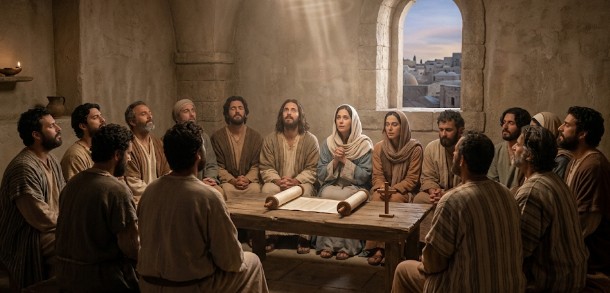
When the familiar mode of the Lord’s presencing seems withdrawn, the soul is invited to a darker, yet purer, faith. The disciples retreat to the upper room, forming the first nucleus of the Church in a posture of intense, unified waiting: ‘All these with one accord were devoting themselves to prayer, together with the women and Mary the mother of Jesus.’ This waiting is neither a passive idling nor a vacuum of despair, nor is it a committee of aggrieved fellows. It is an active, deeply formative period of expectant receptivity. The disciples are stripped of their reliance on Christ’s physical, earthly presence so that their hearts might be expanded to receive the indwelling of His Spirit.
If the reading from Acts provides the exterior setting of this space, the Gospel of John provides a glimpse of the hoped-for in its ultimate theological meaning. We are given the immense privilege of listening to the High Priestly Prayer of Jesus. It is a profound glimpse into the intimate, filial dialogue between the Son and the Father in the Spirit.
The generosity of the Son draws us into the heart of this eternal life, defined not merely as a future destination, but as a present relational reality: ‘And this is eternal life, that they know you, the only true God, and Jesus Christ whom you have sent.’ To ‘know’ God is a communion of love. St Teresa of Avila visualised this profound interior reality where the ‘secret exchanges between God and the soul take place’. Even as we wait in the upper rooms of our own lives, grappling with the shadows of the present age, we already possess the seed of eternal life through the indwelling Trinity.
This reality led Blessed Elizabeth of the Trinity to pray: ‘O my God, Trinity whom I adore; help me to forget myself entirely that I may be established in You as still and as peaceful as if my soul were already in eternity.’
The First Letter of St Peter reminds us that inhabiting this intermediate space between Christ’s earthly ministry and His final return in glory involves an embrace of the Cross. ‘Rejoice insofar as you share Christ’s sufferings, that you may also rejoice and be glad when his glory is revealed.’ To live in the hope of the promise is to live in the tension between the already and the not yet. As we navigate this intermediate time, let us not be perplexed by the endurance that comes with waiting. Instead, like Brother Lawrence, we can embrace a ‘quiet and secret conversation of the soul with God that is lasting’. Let us gather in the upper room of the heart, faithful in living in one accord and fervent in prayer, asking the Father to glorify His Son in our lives. For it is precisely in the context of this waiting that the Holy Spirit finds the space to descend and make all things new.
Prayer
Father, as we stand on this profound spiritual threshold; expand our hearts to endure the tension of the “already and the not yet.” Grant us the grace of expectant receptivity, that we may gather in the upper room of the heart and there, in silence and unity, await your Holy Spirit through Christ our Lord. Amen.
Ponder questions
- In what area of your life right now do you feel you are in a “liminal space” of groanings and hope?
- In moments of great desperation and anxieties, how can you embrace them as a deeper, purer invitation to faith and genuine community?
- How does Jesus’ definition of eternal life as knowing God (a present communion of love) change the way you navigate the shadows of the present age?
Short Practice for the Week: The Upper Room of the Heart
This week, following the examples of the disciples, Mary, and Brother Lawrence, commit to forming an “upper room” in your own heart. Set aside 10 minutes each day for silent, unified waiting. Do not bring a committee of grievances or a checklist of demands to God. Instead, explicitly offer your current anxieties and longings to Him, adopting a posture of intense, “expectant receptivity” for the Holy Spirit.
Memory Phrase
This waiting is not a passive idling, but an active, deeply formative period of receptivity.