
V/ My eyes are turned to you, O Lord.
R/ You are the joy and gladness of my youth.
V/ Grant me the Wisdom that sits by your throne.
R/ That I may dwell as a child in your presence.
Let us pray
Lord Jesus Christ, on this solemn day, we stand beneath Your Cross. Open our hearts to the profound mystery of Your saving passion. Grant us the grace to contemplate Your suffering not as a tragedy, but as the glorious battle wherein love conquered death, that we may rightly adore You as our Victor and Redeemer. Amen.
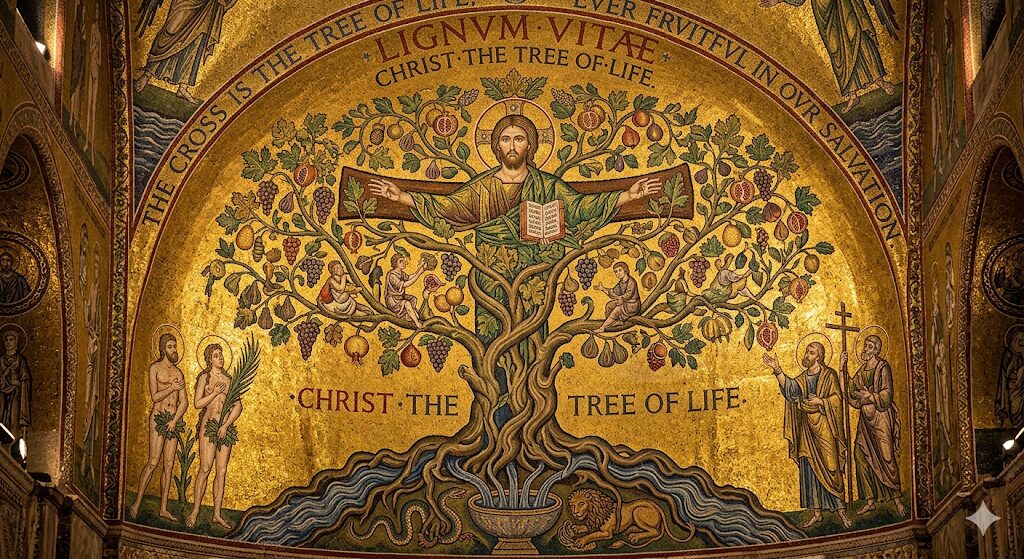
THE TREE OF LIFE, EVER FRUITFUL
By Rev Fr Emeka K. Agboeze, OCD
Good Friday
Isaiah 52:13–53:12; Psalm 31(30):2, 6, 12–13, 15–17, 25; Hebrews 4:14–16, 5:7–9; John 18:1–19:42
In the evening liturgy of yesterday, a popular hymn by St Thomas Aquinas invited us to meditate on the mystery of the Holy Eucharist: pange lingua gloriosi corporis mysterium. Today’s liturgy has another hymn which contains similar words: pange lingua gloriosi proelium certaminis (sing, my tongue, the glorious battle). Composed by Venantius Fortunatus in the 6th century, this lesser-known hymn directly inspired St Thomas Aquinas to compose his famous Eucharistic hymn. While Aquinas sang of the Body of Christ, Fortunatus focused on the mystery of the Holy Cross, highlighting Christ’s victory over the devil following a mortal battle. What battle? The battle fought on the wood of the Cross, which, according to Didier Rimaud, is “adorned with the blood that protects us, Cross where the Lamb has subdued the evil lion.” This is the victory we commemorate today, a victory marked by a sorrowful mood, for the Lamb overpowered the prince of death by dying. He won by sacrificing Himself, says Fortunatus: immolatus vicerit.
But the death of Christ is not a tragedy. It is the victory of God’s saving love which liberates from bondage those who are held captive by the devil. This is realised on at least two levels. Firstly, His death is the price of our ransom, for “without the shedding of blood there is no remission of sin” (Heb. 9:22). The Church’s piety acknowledges this in adoration: “By your Holy Cross you have redeemed the world.” Christ died that He might set us free from our captor. He died that we might live (cf. 1 Pt. 2:24). He essentially undid through His death on the Cross what the devil had done (cf. 1 Jn. 3:8). Fortunatus refers to this, noting that “Our first father was defrauded into misery. When with a bite of the fatal fruit he fell into death, the Creator then marked the tree that would undo the harm wrought by a tree.” It is from this tree that the Cross was fashioned—the Tree of Life.
On another level, the death of Christ was the long-awaited occasion for Him to go down into Hades. By His death, “he descended into hell” and liberated Adam and all the just of old who were imprisoned there. His words to the penitent thief are also addressed to Adam, on account of whose sin the thief, and indeed the entire human race, went astray: “Today you will be with me in paradise” (Lk. 23:43). Adam was expelled from paradise, and with him, and in him, all his descendants. But now he is once again restored to that state which he lost, and caused his children to lose, by his disobedience. Fortunatus again captures this in another hymn, Salve Festa Dies, and remarks: “You who, seeing mankind to have plunged into the deep, that you might save man, were also made man.”
He entered into the deep, into Hades, thanks to His mortal humanity in which He died and went down to the land of the dead to free the dead from death. Here, one recalls the importance St Teresa of Avila attaches to the humanity of Christ, a mystery she loved to contemplate, as well as the words of a hymn inspired by St Thérèse of Lisieux which highlights the inestimable love of God “who takes my nature, who becomes my brother, capable of suffering.” It is love that transforms the scandal of the Cross into a glorious sign of triumph. Does Christ’s invitation to take up my cross and follow Him frighten me? Have I accepted the challenge to fight the good fight in imitation of the Master? In the battle against vices, do I rely on Christ’s victory for support and encouragement?
Prayer
O God, who through the Passion of Your Son, our Lord, dissolved the inheritance of death in our nature, grant that by being conformed to Him we may, just as we have borne by necessity of nature the image of the man of earth, bear by the sanctification of grace the image of the Man of heaven. We ask this through Christ our Lord. Amen.
Questions to Ponder
1. How does the perspective of glory in the cross challenge my human understanding of victory, and can I find strength in viewing my own struggles not as defeats, but as potential battles for spiritual triumph?
2. What specific “fatal fruit” of sin, vice, or old habit in my own life do I need to bring to the foot of the Cross today to be “undone” and healed in the Tree of Life?
3. Knowing that Christ entered into the “deep”—Hades, and the depths of human suffering—does this truth alleviate my fears about carrying my own crosses drawing courage from Jesus my brother?
Practice for the Day
Keep absolute silence if possible, or observe strict sacred quietness, between 12:00 pm and 3:00 pm. Participate fully in the Veneration of the Cross during the Solemn Liturgy of the Passion, making a specific, deliberate act of reverence (a kiss, a bow, or a prostration), and offering a private sin or struggle to be redeemed by Christ’s blood.
Memory Phrase
The Cross is the Tree of Life, ever fruitful.