
V/ My eyes are turned to you, O Lord.
R/ You are the joy and gladness of my youth.
V/ Grant me the Wisdom that sits by your throne.
R/ That I may dwell as a child in your presence.
Let us pray
Lord Jesus, as we enter this Holy Week, we walk with You into Jerusalem. Open our hearts to the mystery of Your Love, that in the waving of palms and the weight of the Cross, we may recognize You as our King and Saviour. Amen.
THE VICTIM AND VICTOR
By Fr Emeka Agbo, OCD
Passion Sunday, Yr A
Matthew 21:1-11; Isaiah 50:4-7; Psalm 21(22):8-24; Philippians 2:6-11; Matthew 26:14-27:66
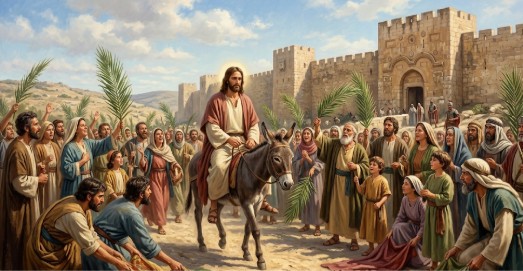
The official name of today’s celebration is Dominica in palmis de passione Domini (Palm Sunday of the Lord’s Passion). This name seems to contain a contradiction: the palm, a symbol of victory (cf. Rev 7:9), and the passion, in which the human weakness of Christ is fully manifested. This apparent contradiction fittingly introduces us to Holy Week, as it provides an insight into the events that follow. Christ enters the Holy City acclaimed as a King with branches waved in His honour, but He will leave ignominiously like a criminal under the terrible weight of the Cross.
Yet, the contradiction is only apparent. Humiliation and exaltation belong together in Christ. The triumphal entry points to Christ’s victory through self-abasement as He gives a new meaning to the Cross. He faces His Passion already assured of His victory. For, as John Cardinal Wright remarks, it was before, not after, His Passion that Christ told His disciples: “In the world you will find tribulations, but be of good cheer, for I have overcome the world” (Jn 16:33). His victory over the enemy was already underway from the moment He entered the domain of the prince of this world through His Incarnation (cf. Jn 14:30). He, the stronger man, entered the house of the strong man, subdued him, plundered his house (cf. Mk 3:27), and began the process of setting his captives free. He came simply “to undo what the evil one has done” (1 Jn 3:8).
The Vatican obelisk, where the Pope begins the Passion Sunday ceremonies, contains the following inscription: Ecce crux Domini. Fugite partes adversae. Vicit Leo de Tribu Iuda (Behold the Cross of the Lord. Take flight, hostile ranks; the Lion of the tribe of Judah has conquered). The entire week of the Lord’s Passion is introduced under this sign, which recalls the victory of Christ who, like the lion, conquers and puts His enemies to flight (cf. Ps 144:5-6).
However, while His victory associates Him with the lion, the battle itself presents Him as the lamb, the victim, as the enemy appears to be the strong one. Christ undergoes the most excruciating suffering and suffers in shame. In the eyes of the unfaithful, He appears to have been defeated. Yet, in the words of St Augustine, victor quia victima (He is the victor by being the victim). It is because He humbled Himself and became obedient unto death that God highly exalted Him (cf. Phil 2:6-11). “Humility kills pride,” says Caravaggio.
For Christ, and indeed for all Christians, the path of victory is the path of suffering. If we wish to share in His victory, we must become victims like Him. St Thérèse of the Child Jesus understood this clearly. She prayed: “Jesus, may I die a martyr for You. Give me martyrdom of the soul or of the body. Ah, rather give me both.” She truly wanted her body and soul to partake in Christ’s suffering, all out of love for Him. In this way, she wished to give her whole self to Christ, who gave Himself to her and for her. She wanted to be a victim of Divine Love.
Prayer
O Lord, grant us the grace of true humility. May we never flee from the Cross, but rather embrace it with love, knowing that by dying to ourselves, we shall rise with You in glory. We ask this through Christ our Lord. Amen.
Questions to Ponder
1. What does the Passion of Christ demand from me in my daily life?
2. Am I willing to make sacrifices, no matter how small, for the sake of Christ as a participation in His victimhood?
3. Does my religiosity focus only on the glory of the Resurrection while avoiding the abasement that leads to it?
Short Simple Practice
Identify one “hidden” sacrifice today—such as performing a chore without being asked or choosing to remain silent instead of complaining—and offer it to Jesus as a small act of love.
Memory Phrase
“Victor quia victima: He is the victor by being the victim.”