
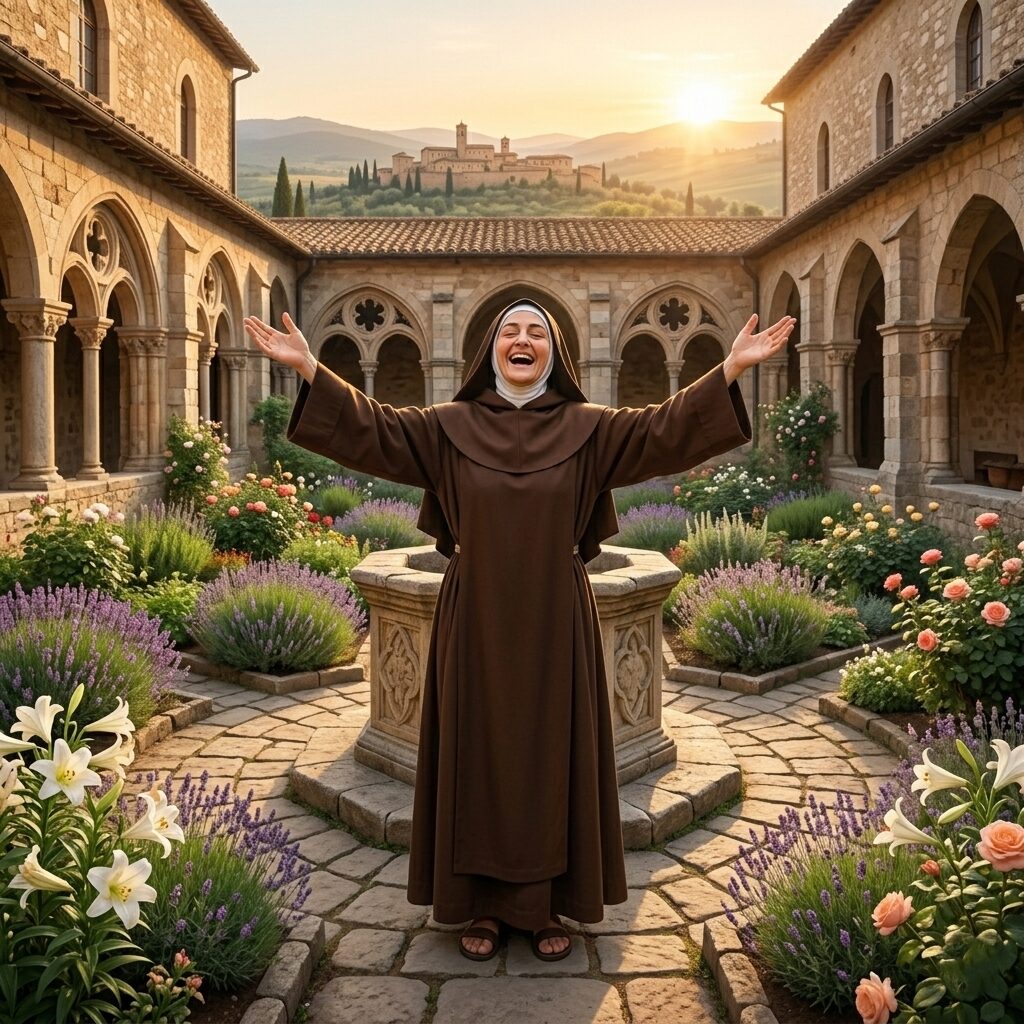
There are those who, when they hear St Teresa’s name, picture a stern Spanish mystic, a reformer who established seventeen convents through sheer willpower, a woman of intense prayer and rigid discipline. They imagine someone perpetually serious, perpetually holy, perpetually removed from ordinary human experience. Well, they’ve never actually read Teresa.
The real Teresa; that is, the one who leaps off the pages of her autobiography and letters, is vibrant, funny, deeply human, and surprisingly joyful. She complained about bad food and difficult nuns. She made jokes. She sang. She danced. And woven through all her writings, even in the midst of great physical and spiritual suffering, runs a thread of unmistakable Alleluia, a deep, resilient joy that couldn’t be extinguished by circumstances. This is the Teresa we need to meet; the real woman who discovered that joy isn’t the absence of suffering but the presence of God in the midst of everything.
The Alleluia of Being Fully Human
Teresa’s first Alleluia is simply this: God loves us as we actually are, not as we pretend to be. In her autobiography, The Book of Her Life, Teresa is brutally honest about her struggles. She writes about her vanity as a young woman, her love of romance novels, her resistance to religious life, her years of lukewarm prayer. She confesses to being distracted, stubborn, and at times spiritually lazy. “I was more anxious to get the hour of prayer over than I was to remain there,” she admits about her early years in the convent. “The sadness I felt on entering the oratory was so great that it required all my courage to force myself inside.”
This radical honesty is itself a kind of Alleluia.
Teresa is celebrating the truth that God doesn’t wait for us to become perfect before loving us. He meets us in our actual mess, our actual resistance, our actual humanity. We don’t have to pretend to be holier than we are. We can bring our whole selves — doubts, distractions, failures — before God and discover we are still loved.
Teresa’s humour throughout her writings is another expression of this embodied Alleluia. When she encountered nuns who were overly scrupulous, Teresa remarked: “From sour-faced saints, good Lord, deliver us!” While she was traveling to start a new convent, and her carriage overturned in a muddy stream, she looked up at heaven and said, “Lord, if this is how You treat Your friends, no wonder You have so few!” She wasn’t irreverent. She was free — free to be human before God, free to laugh, free to complain, free to be herself. That freedom is Alleluia in flesh and blood.
The Alleluia of Desire
Teresa’s second Alleluia is found in her understanding of desire. Most spiritual traditions of her era taught that desire was dangerous, something to suppress and control. But Teresa discovered something different: desire itself can be holy. In fact, our deepest desires point us toward God. In The Interior Castle, her masterpiece on the spiritual life, Teresa describes the soul as a magnificent castle with seven dwelling places or “mansions.” God dwells at the centre, in the seventh mansion, and invites every person to journey inward toward complete union with Him. The catalyst for this journey? Desire. “The door of entry to this castle is prayer and reflection,” Teresa writes. But what drives us to prayer? Not obligation. Not fear. It is desire that drives us to prayer. The longing for more — more meaning, more love, more life, more God.
Teresa experienced this herself. Even in her early years of half-hearted religious life, something in her wouldn’t stop wanting God. That persistent hunger, that refusal to settle for spiritual mediocrity, eventually pulled her into depths of prayer she never imagined possible. She writes famously: “I die because I do not die.” This is an expression of passionate longing. Teresa wants God so intensely that ordinary life feels constraining. She is not satisfied with partial connection, distant relationship, superficial faith. She wants everything — complete union, total intimacy, perfect love that can come to fruition only in eternal life.
This longing is Alleluia. It is the soul recognising what it was made for and refusing to settle for less.
Teresa teaches us that our deepest desires — for love, for meaning, for beauty, for home — aren’t distractions from God. They are echoes of God. When we pay attention to what we truly long for beneath our superficial wants, we discover we are longing for Him.
The Alleluia in Darkness
Teresa’s most profound Alleluia might be the one she sang in darkness. People often assume that saints experience constant spiritual consolation, that their prayer is always sweet and their faith always certain. Teresa shatters this illusion. She writes extensively about spiritual dryness, about years when prayer felt empty and God seemed absent. She struggled much with what she called “aridity” where she experienced no consolation in prayer, no sense of God’s presence, no encouragement. She was tempted to give up countless times. Yet she kept showing up. She kept praying even when prayer felt pointless. And looking back, she recognised those dry years weren’t wasted time or spiritual failure. They were forming her.
This is dark-night Alleluia — the joy of knowing that even when we can’t sense God, He hasn’t left our side.
Even when prayer feels dead, something deeper is happening. Even when we are stumbling through darkness, we are still moving toward Light. Teresa experienced mystical graces later in life, like visions, ecstasies, and experiences of union with God that words couldn’t express. But she insists these extraordinary experiences are not the goal. What matters is faithfulness in the ordinary. What matters is continuing to love when loving feels impossible.
The Alleluia of Mission
Teresa discovered her Alleluia wasn’t just for her own soul. It was meant to be shared. At age 47, she embarked on her reform of the Carmelite order. She would spend the next twenty years founding seventeen convents across Spain, traveling dusty roads in donkey carts, negotiating with bishops and noblemen, managing finances, dealing with opposition from within her own Order and from civil authorities. It was exhausting work. She was frequently sick, often in pain, constantly frustrated by obstacles.
Yet she never stopped. Why? Because she had encountered God’s love so profoundly that she couldn’t keep it to herself. She wanted to create spaces where other women could enter the ‘Interior Castle,’ could discover contemplative prayer, could experience the intimacy with God that had transformed her. Her joy in God overflowed into mission, into action, into service.
This is incarnational Alleluia.
Teresa didn’t withdraw from the world into mystical bliss. She brought contemplation into action. She demonstrated that union with God makes us more effective, more creative, more resilient.
The Alleluia We Can Sing
So, what does Teresa’s Alleluia mean for us, centuries later, in our own struggles and joys?
- First, it means we can stop pretending. We can bring our whole selves, mess and all, before God and trust that we are loved, not despite our humanity but within it. Teresa teaches us to be real.
- Second, it means our desires matter. The hunger in our hearts is not something to suppress but something to follow. When we pay attention to our deepest longings, we will find they are pulling us toward God.
- Third, it means darkness isn’t the opposite of faith. When prayer feels dry and God seems distant, we haven’t failed. We are being invited into deeper trust, more mature love. Hence, keep showing up.
- Fourth, it means joy and mission belong together. The gladness we discover in God isn’t meant to be hoarded. It’s meant to overflow into service, into creative action in the world.
The Alleluia Teresa discovered is the deep gladness that comes from knowing you are loved. It is the joy of relationship with a God who meets you in the mess and invites you into mystery. It’s the Alleluia we can sing too, right now, in our actual lives, with our actual struggles, in our actual humanity.
Teresa would tell us: Stop waiting to be holy enough. Stop thinking you need to clean yourself up before approaching God. Just come. Bring everything. Start where you are. And then discover, as she did, that the whole journey is Alleluia — from beginning to end, from stumbling start to glorious finish, all of it praise, all of it joy, all of it grace.
Alleluia. Alleluia. Alleluia.