
V/ My eyes are turned to you, O Lord.
R/ You are the joy and gladness of my youth.
V/ Grant me the Wisdom that sits by your throne.
R/ That I may dwell as a child in your presence.
Let us pray
Lord, in Your all-providential plan, You have led me to this moment to rediscover myself in Your Word and Wisdom. Aid me to make this time of meditation and prayer enriching, transforming, and liberating for my well-being and others.
THE DIVINE DANCE: AN INVITATION TO LIFE
By Clement Obiorah, OCD
SOLEMNITY OF THE MOST HOLY TRINITY, YEAR A
Exodus 34:4b-6, 8-9; Dan 3:52 – 56. ℟52b; 2 Corinthians 13:11-14; John 3:16-18
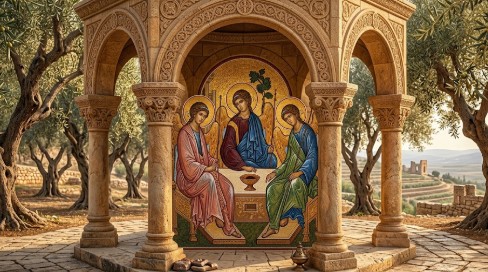
The solemnity we celebrate today is the distinct hallmark of the Christian faith, setting it fundamentally apart from other Abrahamic religions: Judaism and Islam. God is rightly One, yet not in the sense of a solitary, monarchical sovereign, ruling from an impenetrable distance. Rather, God is a vibrant community of love. From His very being, we have received our being human: “Let us make man in our image, after our likeness” (Gen 1:26). We are created from communion, for communion. Humanity is of one substance, instantiated in a multitude of persons, but this logic remains beautifully incomplete if we lose sight of our eternal destiny. We were not made merely to exist; we were made to participate in the Divine life.
Pope Benedict XVI frequently drew our theological gaze to this supreme truth: the Christian God is not a mute, isolated monad, but a dynamic, relational dialogue—a constant exchange of self-giving love (cf. Deus Caritas Est, 12). To know this God is to step into that very dialogue.
In our first reading from Exodus, Moses dares to seek the face of God and live. Here, the Lord reveals His name in a manner that radically altered Israel’s understanding of the Divine: “The Lord, the Lord, a God merciful and gracious, slow to anger, and abounding in steadfast love and faithfulness” (Ex 34:6). This is a profound revelation. This is a God who can be invited to walk with His people, to accompany them through the barren wilderness of their lives. This identification of God’s nearness became the enduring pride of Israel: what other nation has a God so close to them? (cf. Deut 4:7). Today, that blessing is the inheritance of the Church—the new assembly of God’s people. The Almighty is intimately involved in our human condition, perfectly bridging the chasm between infinite majesty and tender compassion.
Through the mystery of the Incarnation, God becomes what He was not, in order to grant us unrestricted access to the tender heart of a Father. The uncreated Son of God becomes the Son of Man to draw us, in the Spirit, into His likeness and elevate our fragile human nature.
Christ’s discourse with Nicodemus in the Gospel of John points to this radical rebirth. God so loved the world that He gave His only begotten Son (Jn 3:16). He came not to condemn the world, but to save it (Jn 3:17). Our salvation therefore consists precisely in recognising and receiving this love—a love that conquers sin, dispels our fear of condemnation, and overcomes our profound hesitation to dare to be intimate with God.
Our Carmelite tradition offers a piercingly clear lens through which to view this Trinitarian mystery. St John of the Cross illuminates the ultimate aim of our spiritual journey, noting that the fundamental property of love is unitive—it makes the lover equal to the Beloved (cf. The Spiritual Canticle, 12.7).
Through the sheer grace of the Triune God, we are invited to become by participation what Christ is by nature (cf. The Living Flame of Love, 3.78). The divine rescue mission is designed to embrace us into the inner dance of the Godhead.
St Paul captures this perfectly in his concluding blessing to the Corinthians, which has become the foundational greeting of our liturgy:
The grace of the Lord Jesus Christ: The saving action of the Son who reconciles us.
The love of God: The initiating, unending affection of the Father.
The fellowship of the Holy Spirit: The unitive bond that gathers us into communion (2 Cor 13:14).
This Trinitarian blessing is our identity, our worship, and our mission. We are identified in God, worshipping the Father in the Spirit of adoption through the Son (cf. Gal 4:6), and defining our eternal mission as a kingdom of priests (Rev 1:6)—called to be the celebration we have witnessed, radiating this truth to the rest of creation for the glory of God.
Mary’s completely receptive fiat at the Annunciation demonstrates the very essence of becoming God by participation. By yielding her entire being to the overshadowing of the Spirit and the will of the Father, she offered the humanity through which the Son could enter the world. She did not grasp at the divine, but received it in profound praise in her Magnificat, which resonates with today’s responsorial song of Daniel. In her soul, the love of the Father, the grace of the Son, and the fellowship of the Spirit coalesced perfectly. She stands as the eternal model for the Church, teaching us that to be drawn into the life of the Trinity is fundamentally an act of loving surrender to the divine mystery—allowing the triune God to make His dwelling place within us (cf. Jn 14:23).
As we stand before the majesty of the Most Holy Trinity, let the profound words of St Elizabeth of the Trinity echo in our hearts as our personal plea:
“O my God, Trinity whom I adore, help me to forget myself entirely so to establish myself in you, unmovable and peaceful as if my soul were already in eternity… May I become for Him always another humanity where He might renew His whole mystery.”
— St Elizabeth of the Trinity
We adore you, most ancient of all mysteries, Holy Trinity, one God. Amen.
Ponder Questions
- How do I typically envisage God in my daily prayer: as a solitary, distant figure, or as a dynamic, inviting community of love?
- In what specific areas of my life is my love for God actively transforming me into the likeness of Christ?
- How might I more closely imitate Mary’s receptive fiat this week, surrendering my own plans to allow the triune God to make His dwelling place within me?
Practice for the Week
Whenever you make the Sign of the Cross this week, pause deliberately. Rather than letting it be a hurried, mechanical gesture, use it as a conscious moment of entering the Divine Dance. Acknowledge the initiating love of the Father, the saving grace of the Son, and the fellowship of the Holy Spirit, silently offering your own humble surrender to this indwelling mystery.
Memory Phrase
Created from communion, destined for communion.