
V/ My eyes are turned to you, O Lord.
R/ You are the joy and gladness of my youth.
V/ Grant me the Wisdom that sits by your throne.
R/ That I may dwell as a child in your presence.
Let us pray
Lord, in Your all-providential plan, You have led me to this moment to rediscover myself in Your Word and Wisdom. Aid me to make this time of meditation and prayer enriching, transforming, and liberating for my well-being and others.
ITE MISSA EST: A KINGDOM PROCLAMATION
By Clement Obiorah, OCD
11th SUNDAY IN ORDINARY TIME, YR A
Exodus 19:2-6a; Ps 100(99):1-2. 3. 5; Romans 5:6-11; Matthew 9:36-10:8
The marvel of divine election lies precisely in its staggering disproportion. When we confront the mystery of our Christian vocation, we are immediately met by the uncomfortable reality of our own miserable state, in stark contrast to the absolute holiness of God. Yet, it is precisely in the depths of our poverty that the gratuitous love of the Saviour is made manifest.
The narrative of Exodus presents Israel as a broken, enslaved people, wholly dependent on divine intervention. The crossing of the Red Sea was not merely a liberation from physical bondage; it was a transition into a profound liturgical vocation. God redeems Israel so that they might become a “kingdom of priests and a holy nation.” This universal call to holiness is not a human achievement but an infusion of God’s own sanctity into the very vessels that seem most prone to fracture. St. Paul drives this paradox into the very heart of the unfathomable logic of redeeming love: “While we were still weak, at the right time Christ died for the ungodly.” Here, the theology of justification is laid bare. We do not earn our proximity to the Divine; it is an entirely unmerited privilege. The enmity we forged through sin is undone by the overwhelming obedience and love of the Son.
In the Gospel of Matthew, looking upon the crowds, Jesus sees them as “harassed and helpless, like sheep without a shepherd.” The Incarnate Word does not look upon human misery with aloof detachment; He is moved to the very depths of His being. It is from this profound, empathetic love that the mission of the Church is born. Jesus constitutes the Twelve—the nucleus of a New Israel—and sends them forth. The mandate is clear: they are to heal, to cast out demons, and to proclaim the nearness of the Kingdom.
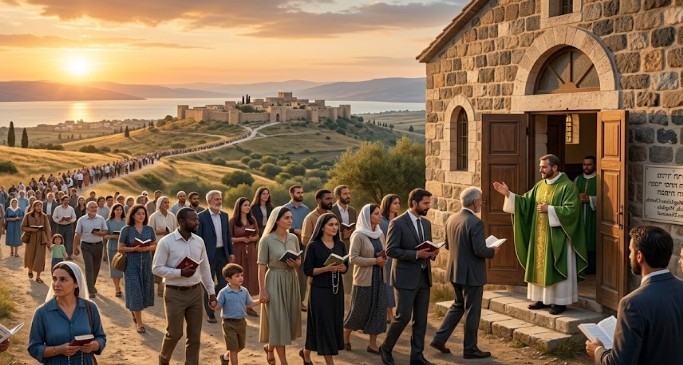
To put this vocation of a “kingdom of priests” in our context, we must first rescue the concept of liturgy from being confined exclusively to the sanctuary. Today, in an aggressively secularised culture, the baptismal priesthood of all Christians is the vocation to transform the world itself into an altar. This means that the entirety of human existence—our labour, our joys, our sufferings—is drawn into the life of the Word. The secular world is not a profane wasteland to be fled, but the very material we are called to consecrate. When a Christian acts with justice, loves with Christ’s charity, and works with integrity, they are performing a deeply liturgical act. They are gathering the fragmented, often chaotic realities of our existence and offering them back to the Father in union with the Eucharistic sacrifice.
Where the world cannot or will not pray, the priestly people pray on its behalf. Like Moses interceding on the mountain, the faithful offer a sacrifice of praise and petition for a culture that has lost its voice. We see a staggering example of this mediatorial priesthood in Edith Stein’s response to the rising horrors of Nazi Germany. By consciously uniting her impending suffering with the Cross of Christ for the sake of her people, she transformed the brutality she would face into a profound liturgical offering. This involves a deep interiority—a contemplative gaze that looks upon the modern metropolis, the boardroom, the university, and the hospital, and silently harvests them for Christ.
Exercising our priestly vocation rarely involves dramatic public gestures; rather, it is lived on the altar of the ordinary. And even when the “ordinary” becomes difficult, this vocation endures. The Second Vatican Council articulated this beautifully, noting that for the lay faithful, “all their works, prayers and apostolic endeavours, their ordinary married and family life, their daily occupations, their physical and mental relaxation… all of these become spiritual sacrifices acceptable to God through Jesus Christ.” By living intentionally, sustained by the sacraments, the Christian disciple ensures that the stream of divine grace continues to flow into un-shepherded human nature. In this way, the “kingdom of priests” does not compete with the secular sphere but completes it. We become the very means by which God’s righteousness completes the good work He has begun, drawing all of creation toward its final, glorious perfection in Christ.
The work of God, coming to perfection in Christian discipleship, ushers in an intentional life of holiness. We are called to be apostles of this experience of Christ. As a “new Israel” transcending borders, language, and culture, our dedication to these higher spiritual realities becomes the most profound evangelical witness. Yet, it is not by our own strength that we accomplish this, but by God acting intimately within us, transforming our frailty into a radiant testament of His enduring mercy.
Prayer
Lord God, we stand in awe of Your gratuitous love, which reaches down into the depths of our poverty and raises us up to be a kingdom of priests. Give us the eyes of Christ to see the harassed and helpless, and the faith to transform the reality of our daily lives into an altar. May our ordinary labours, joys, and sufferings become a holy and living sacrifice, uniting the world to You. Through Christ our Lord, Amen.
Ponder Questions
- How does confronting the reality of my own spiritual “poverty” and weakness change the way I receive God’s unmerited love?
- Looking at my current daily routines, how can I begin to intentionally offer them to God as a liturgical act?
- Who around me seems “harassed and helpless,” and how can I exercise my mediatorial priesthood to silently intercede for them this week?
Practice for the Week: The Altar of the Ordinary
Each morning this week, identify one mundane, frustrating, or completely ordinary task you must face that day (e.g., a difficult meeting, a daily commute, folding laundry). Before you begin that specific task, pause and make a silent, intentional offering: “Lord, I gather this ordinary moment and unite it to the Eucharistic sacrifice for the sake of [name a specific person or situation in need of grace].”
Memory Phrase
The Harvest (of grace) is plentiful.