
V/ My eyes are turned to you, O Lord.
R/ You are the joy and gladness of my youth.
V/ Grant me the Wisdom that sits by your throne.
R/ That I may dwell as a child in your presence.
Let us pray
Lord, in Your all-providential plan, You have led me to this moment to rediscover myself in Your Word and Wisdom. Aid me to make this time of meditation and prayer enriching, transforming, and liberating for my well-being and others.
ANCHORED IN APOSTOLIC FAITH
By Clement Obiorah, OCD
SOLEMNITY OF SAINTS PETER AND PAUL, YR A
Acts 12:1-11; Ps 34(33):2-9; 2 Timothy 4:6-8, 17-18; Matthew 16:13-19
Every teacher knows the joy of seeing a student grasp a deep lesson. We catch a glimpse of this in today’s Gospel. The deep lesson about His life and mission is precisely to reveal the Father; so Jesus asks His disciples who they believe He truly is, Peter steps forward with a flash of inspiration to declare: ‘You are the Christ, the Son of the living God’ (Matthew 16:16).
Yet, the knowledge Peter reveals is unique. He did not figure this out through human cleverness, guesswork, or passing opinion. Instead, Peter showed an openness to a truth received as a pure gift from above. Jesus confirms this: ‘Blessed are you, Simon Bar-Jonah! For flesh and blood has not revealed this to you, but my Father who is in heaven’ (Matthew 16:17). We are not expected to understand this all at once. It is a mystery we must contemplate—a revelation that slowly changes our hearts and lives out with conviction.
Today’s liturgy invites us to share in this deep confession. It is a call to step into a close friendship with God. We respond through two essential actions: believing and loving. Believing is more than agreeing with a list of teachings. It is a personal attachment and radical commitment to Jesus, connecting our existence to Him. Because this faith is alive, we are always growing. This journey naturally includes doubt and trial. Yet, as Brother Lawrence of the Resurrection reminds us, walking through these trials strengthens our hope. Loving flows naturally from this belief. Living in loving communion with God gives our lives true meaning and total fullness.
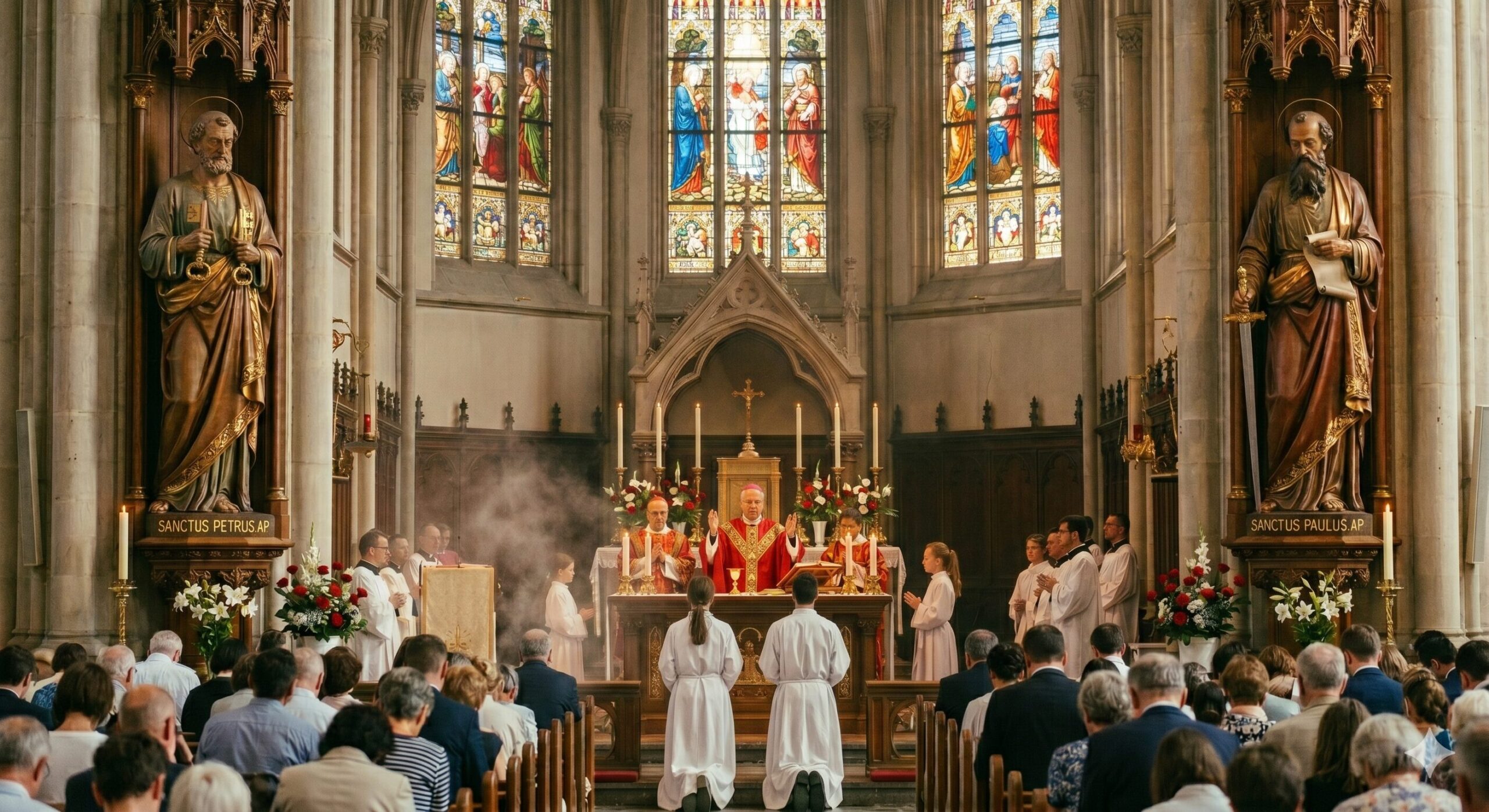
When we look closely at the two great pillars of our faith, Saints Peter and Paul, we do not see flawless statues. If Peter is the rock upon which the Church is built, he is a remarkably cracked and fragile one. He walks on water, only to panic and sink. He swears absolute loyalty, only to deny his Master. In today’s First Reading, Peter is completely helpless: locked inside a prison cell, bound with heavy chains, and asleep between soldiers (Acts 12:6). Yet, God sends an angel to break his chains, proving that the Lord always rescues the lowly from their distress.
Paul is often pictured today as a strict intellectual. Yet, he constantly reminds us of his own agonising weakness, his inner battles, and his painful ‘thorn in the flesh’. Nearing the end of his life, Paul admits that his success was never his own doing: ‘The Lord stood by me and strengthened me’ (2 Timothy 4:17).
God did not choose them to prove human greatness, but to show the unstoppable power of divine grace. St Thérèse of Lisieux beautifully understood this reliance on grace. She knew Jesus simply asks for our surrender and gratitude. We must recall what Christ said to St Paul: ‘My grace is sufficient for you.’
We admire the Church best when we stop treating our faith like a complicated puzzle to be solved, where every piece must fit perfectly. Instead, we should view our faith as a beautiful icon. We are invited to gaze lovingly upon it, finding rest in the unique experience the Father gives us through His Son. It is here we trust Christ’s promise: ‘On this rock I will build my Church’ (Matthew 16:18).
From this deep faith comes a divine mission as a reconciling community: Peter receives the keys to sustain the visible Church. “I have prayed for you that [this] faith may not fail, and when you have returned, you must strengthen your brethren.” Paul fights the good fight to carry the Gospel in its pure form to the ends of the earth. This makes our faith apostolic and, at the same time, prophetic in a world that constantly struggles with self-indulgence. It is never static; it is always sending. Jesus says, ‘As the Father has sent me, so I am sending you.’ This faith, embracing and touching all of our brokenness, which allows us to be vessels of the Spirit for those craving God’s healing touch. Only this conquers and unbinds us from the world’s spell to evil. Amen!
Prayer
Almighty Father, who through the lives of Apostles Peter and Paul give us the noble and holy joy of this day, grant, we pray, that your Church, may in all things follow the teaching of those through whom she received the beginnings of right religion. Through our Lord Jesus Christ. Amen.
Reflective Questions
- Where am I treating faith as a complicated puzzle to be solved, rather than a mystery to be received with an open heart?
- Looking closely at the ‘fissures’ and weaknesses in my own life, how might God be using these exact vulnerabilities to demonstrate the sufficiency of His grace?
- In what specific way is the Lord grace empowering and saying to me today, ‘I am sending you’?
Practice Exercise
Spend ten minutes today sitting in silence before a crucifix, a holy image, or the Blessed Sacrament. Do not use this time to intercede, solve problems, or analyse your spiritual state. Instead, simply gaze lovingly upon the Lord, practising the presence of God. Whenever your mind begins to drift toward your anxieties or feelings of inadequacy, gently redirect your attention back to Him, resting entirely in His unmerited grace.
Memory Phrase
‘My grace is sufficient for you.’