
V/ My eyes are turned to you, O Lord.
R/ You are the joy and gladness of my youth.
V/ Grant me the Wisdom that sits by your throne.
R/ That I may dwell as a child in your presence.
Let us pray
Lord, in Your all-providential plan, You have led me to this moment to rediscover myself in Your Word and Wisdom. Aid me to make this time of meditation and prayer enriching, transforming, and liberating for my well-being and others.
REAL FOOD FOR REAL HUNGER: A WILDERNESS JOURNEY
By Clement Obiorah, OCD
SOLEMNITY OF CORPUS CHRISTI, YEAR A
Deut. 8:2-3, 14-16; Psalm 147: 12-20; 1 Corinthians 10:16-17; John 6:51-58
As humans, we are a complex bundle of desires, yearning for both bodily sustenance and spiritual fulfilment. Yet, when placed upon the scales of what endures, these appetites reveal a profound equaliser bordering on life and belonging. For this reason, our desires must be emptied of finite attachments and purified by faith. Any lesser, worldly nourishment merely wearies, darkens, and starves the spirit, making it incapable of true nourishment. That is why our first reading from Deuteronomy comes across as a divine test and pedagogy set within a wilderness of privation. Moses tells the people:
“He humbled you and let you hunger and fed you with manna, which you did not know… that he might make you know that man does not live by bread alone, but man lives by every word that comes from the mouth of the LORD.”
This is not merely a historical tale of material lack; it is a necessary, purifying ‘dark night’. God strips away earthly consolations and superficial securities to expose our rock-bottom need. He lets us hunger so that an unadulterated thirst for His Word might emerge. Just as the Israelites had to be weaned from the fleshpots of Egypt to desire the bread of heaven, our appetites for worldly things must be mortified so that we might recognise our absolute dependence on God. To seek not God for the bread that he gives but to seek Him as the Bread that He is. The manna in the desert was the prefiguration, but the Word of the Lord is the only guarantor of true nourishment.
“These words,” notes St John of the Cross, “are perceived by souls who have ears to hear them… are cleansed and enamoured. Those who do not have a sound palate, but seek other tastes, cannot taste the spirit and life of God’s words; His words, rather, are distasteful to them.”(Living Flame 1. 5) Hence, the lofty words of the Son of God in our Gospel today were tasteless and meaningless to the impure and to the materially starving. Unfortunately, rather than cultivating a real hunger for God, they sought only temporal sustenance. The Gospel, concluding the Bread of Life discourse, transitions perfectly from identifying this profound human hunger to revealing the only food that satisfies. Jesus addresses the wilderness wanderings of the human heart by presenting the sacramental reality of His divine life. He declares with uncompromising realism:
“For my flesh is true food, and my blood is true drink. Whoever feeds on my flesh and drinks my blood abides in me, and I in him.”
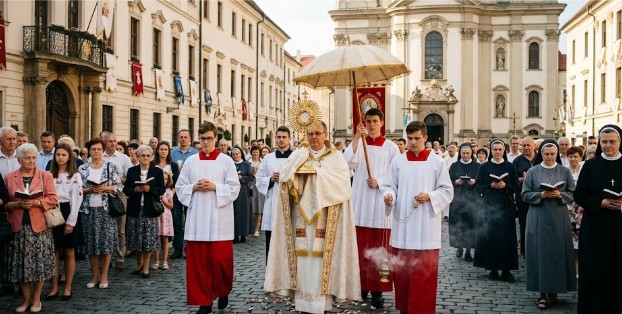
Let us elaborate on this astonishing claim. Jesus does not offer us an idea, a philosophy, or a mere symbol; He offers us His sacred humanity. He is the Word and Wisdom of the Most High made flesh. As Pope Benedict XVI so often reminded us, the Eucharist is not a static object but an event of communion, a real assimilation. When we consume earthly food, it is broken down and becomes part of our physical bodies; but when we consume this heavenly food, the dynamic is beautifully reversed. We do not assimilate Christ; rather, we are assimilated by Him, drawn into His divine life and transformed into His likeness. We become what we consume.
This reciprocal indwelling—“abides in me, and I in him”—is the very heartbeat of St Teresa of Avila’s Interior Castle. Recognising our common hunger is the ground for true ecclesial unity and solidarity with others. St Paul, writing to a fractured community in our second reading, grounds the unity of the Church not in human consensus, but in the reality of the Sacrament:
“Because there is one bread, we who are many are one body, for we all partake of the one bread.”
To drink the Blood of Christ is to share in the divine bloodstream. We cannot partake of this one bread and remain indifferent to the brothers and sisters with whom we share the table of the Lord. At this altar, all earthly differences and worldly privileges are consumed in the blazing fire of divine generosity, expressed in our common begottenness and nourishment. The Eucharist demands that we share our lives, our talents, and our goods, knowing we are fellow heirs of the one Lord. The authentic contemplative life, grounded in this mystery, always yields the fruit of apostolic love and selfless service to the mystical body.
Therefore, we are called to cultivate a real hunger for food that endures. We seek the profound, interior reality that the Lord is uniquely and intimately present with us, no matter the wilderness we face. This is the bread of the presence; the bread of angels; the bread of life. Come, let us adore His wondrous presence.
Prayer
Lord Jesus Christ, Word made flesh and true Bread of Heaven, we thank You for drawing near to us in the wilderness of our earthly journey. Purify our appetites and empty our hearts of all that is not You, that we may be filled with Your infinite presence. Transform us through the Sacrament of Your Body and Blood, so that, abiding in You and guided by faith, hope, and charity, we may become blazing fires of apostolic love for a hungering world. Amen.
Ponder Questions
- Do I allow myself to expose my deepest hunger for God, or do I seek superficial, worldly comforts to mask the emptiness?
- In what ways can I more consciously prepare myself by fasting from other satisfactions so as to be filled by Christ as my deepest nourishment when I receive the Eucharist?
- How does my participation in the “one bread” challenge me to practise selfless charity and solidarity within my community?
Practice for the Week
Identify one specific, worldly appetite or superficial distraction that frequently occupies your time or thoughts, or a habit of idle complaint. This week, intentionally use the time or energy to contemplate more on the wondrous privilege of our humanity and the manna we take for granted. Allow the resulting wonder to drive your perception of the shadows and emptiness of chasing everything else besides God, or seeking God for the less.
Memory Phrase
You in me and I in you!