
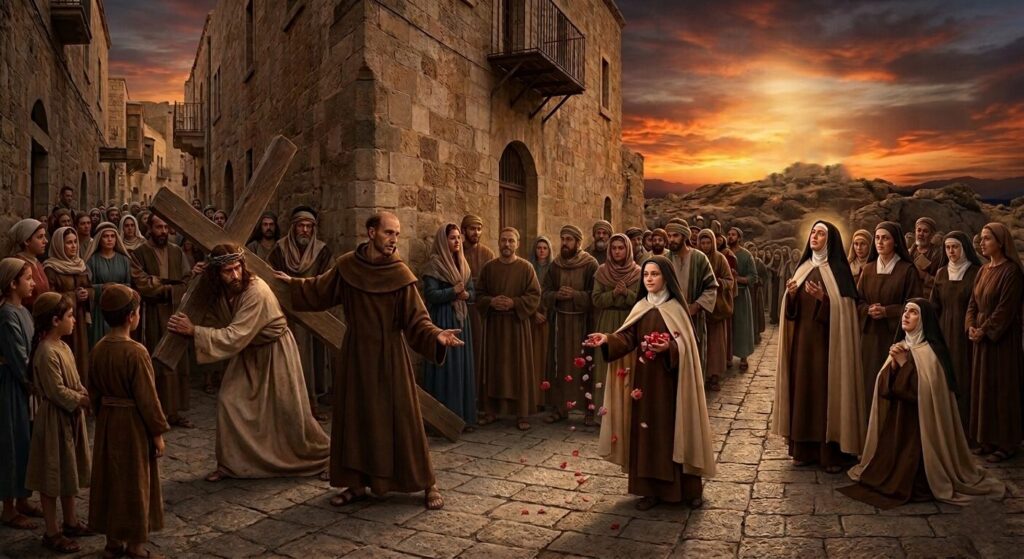
Opening Prayer
Lord Jesus Christ, we walk with you today through your passion and death. Teach us, through the wisdom of the Carmelite saints, to enter this mystery not as distant observers but as companions on the way. May we discover, as they did, that your cross is not the end but the doorway to resurrection.
Teresa, teach us your courageous love. John, teach us to embrace the darkness. Thérèse, teach us your hidden way. Elizabeth, teach us to find heaven in suffering. Amen.
Station I: Jesus is Condemned to Death
Pilate asks Jesus, “What is truth?” but doesn’t wait for an answer. He condemns an innocent man to please the crowd.
Teresa of Ávila wrote: “Truth suffers, but never dies.” In this station, Truth himself stands silent while lies condemn him. Teresa teaches us that integrity costs everything; she reformed an entire religious order and faced fierce opposition because she refused to compromise truth.
When have I chosen popularity over truth? Where do I stay silent when I should speak? Jesus doesn’t defend himself before Pilate. Sometimes our truest witness is quiet endurance.
Lord, give me courage to stand for truth even when it costs me. Teach me when to speak and when to trust silence. Like You before Pilate, may I remain anchored in who I am even when the world demands I be someone else.
Station II: Jesus Takes Up His Cross
Jesus accepts the cross placed on his shoulders. He doesn’t resist. He doesn’t argue. He takes it up.
John of the Cross wrote his entire spiritual theology around one image: the cross. He drew a sketch of Mount Carmel with a single path to the summit marked repeatedly with the word “nada” — nothing. To reach union with God, we must embrace the cross, not avoid it.
What cross am I avoiding? What suffering am I running from that God is asking me to accept? John doesn’t teach us to seek suffering for its own sake but to stop exhausting ourselves trying to escape what love requires of us.
Jesus, you didn’t choose the cross, but You didn’t refuse it either. Teach me to do the same. Show me which burdens are mine to carry and which I need to release. Give me strength to pick up what is mine.
Station III: Jesus Falls the First Time
Jesus stumbles under the weight. He falls hard onto the stone street, the cross crushing him.
Thérèse of Lisieux wrote about her own falls: “If I’m unfaithful, if I commit the slightest infidelity, I pay for it by terrible trials.” But she also insisted: “I’m not discouraged. I throw myself into Jesus’ arms.” Her little way isn’t about being perfect; rather, it’s about getting up after every fall.
I fall. Constantly. I fail at prayer, fail at love, fail at showing up. Thérèse says falling is part of the path, not departure from it. What matters is that I keep getting up, kept trusting that Jesus hasn’t abandoned me in the dust.
Lord, I’m tired of falling. But Thérèse teaches me that You don’t love me less when I’m on the ground. You are already reaching down to lift me. Help me stop wasting energy on shame and simply reach for Your hand.
Station IV: Jesus Meets His Mother
Their eyes meet. Mary cannot stop this. She can only witness. The sword Simeon predicted now pierces her heart.
Teresa wrote extensively about Mary’s compassion, and especially about her standing at the foot of the cross when the disciples fled. “The Blessed Mother teaches us,” Teresa said, “that love means staying present even when we cannot fix anything.”
Who in my life is suffering while all I can do is stay present? Where am I called to simply witness, to stand with someone in their pain without trying to solve or escape it? This is love stripped of all power except presence.
Mother Mary, you couldn’t save your son, but you didn’t leave him. Teach me to love without needing to rescue. Give me courage to stay when all I can offer is my witness, my tears, my remaining.
Station V: Simon of Cyrene Helps Jesus Carry the Cross
Simon is forced to help. He doesn’t volunteer. The soldiers compel him. Yet in that unwilling service, he enters salvation history.
Thérèse wrote: “Love proves itself by deeds.” Sometimes we serve not because we feel holy impulses but simply because we are standing there when help is needed. Our willingness, even reluctant willingness, becomes grace.
When have I grudgingly helped someone and discovered meaning in it? What service am I resisting that might actually be my path to God? Simon didn’t know he was helping the Saviour. Neither do I, most days.
Jesus, forgive my reluctance to serve. Transform my “I guess I have to” into genuine love. Help me see You in every person who needs my help, whether I volunteered or was volunteered.
Station VI: Veronica Wipes the Face of Jesus
A woman called Veronica breaks through the crowd with only a cloth. A small gesture. Completely inadequate to his suffering. And yet, sacred.
Thérèse’s ‘little way’ is all about small acts done with great love. “Pick up a pin for love of God, and you may convert a soul.” Veronica doesn’t save Jesus. She offers one moment of tenderness. That is enough.
I often think my small gestures don’t matter. What good is one kind word to someone drowning in depression? What difference does one prayer make in a world of violence? Veronica teaches me: offer the cloth you have. Leave results to God.
Lord, I have so little to offer You; just my ordinary life, my small kindnesses, my imperfect love. Receive these inadequate gifts as Veronica’s cloth, and let them somehow serve your purposes.
Station VII: Jesus Falls the Second Time
Down again. Heavier this time. Harder to rise.
John of the Cross speaks of the “passive night,” when even our spiritual practices fail us, when prayer feels impossible, when God seems absent. Jesus falling again and again reflects this in a way. Sometimes, the darkness intensifies before dawn.
My second (or twentieth) failure feels worse than the first. I think: “I should be past this by now.” But spiritual growth is not linear. John promises that these darker nights are actually deeper intimacy; God is so close we can’t perceive Him.
Jesus, you know what it is like to fall repeatedly, to wonder if You can get up one more time. Stay with me in my repeated failures. Convince me that falling and rising IS the path, not departure from it.
Station VIII: Jesus Meets the Women of Jerusalem
The women weep for him. Jesus tells them: “Don’t weep for me. Weep for yourselves and your children.”
Teresa warns against false compassion that focuses on Jesus’ physical suffering while ignoring our own sin. “It’s not His wounds that should make us weep but our hardness of heart.”
Do I sentimentalize Jesus’ suffering while refusing to face my own need for conversion? Real compassion leads to transformation, not just tears.
Lord, let my grief over Your passion crack open my defended heart. Show me where I need healing, where I’m still crucifying you with my selfishness, my judgments, my refusal to love.
Station IX: Jesus Falls the Third Time
He can barely walk now. He has almost reached; yet still, he falls.
Elizabeth of the Trinity wrote from her deathbed in agony: “I am going to Light, to Love, to Life!” Her body was failing completely, yet her spirit saw beyond suffering to resurrection.
When I am closest to a breakthrough, I often feel most broken. The third fall comes near the summit. Do not give up now.
Jesus, when I cannot take another step, You understand. You have been there, face in the dirt, lungs burning, wondering if you can go on. Breathe Your strength into me for one more step.
Station X: Jesus is Stripped of His Garments
They take everything. Even his clothes. He stands naked before mockers.
John of the Cross says, “To come to possess all, desire to possess nothing.” This station teaches us about radical detachment; Jesus is stripped of every earthly thing, including dignity.
What am I clinging to? What do I think defines me — my reputation, my accomplishments, my image? Jesus teaches the freedom of having nothing left to lose.
Strip me, Lord, of false identities. Take my need to impress, my fear of exposure, my carefully constructed image. Let me stand before You utterly naked and discover I am still loved.
Station XI: Jesus is Nailed to the Cross
The nails pierce. He is fixed in place. No escape now.
Teresa wrote: “I die because I do not die.” She is talking of her longing to be completely united with Christ, even if it be through suffering. The nails that hold Jesus also hold him in love’s final embrace.
What pain in my life feels like nails, fixing me in suffering I cannot escape? Can I trust that even here, God is present? That these wounds might become the very place of union?
Jesus, Your wounds become Your glory. Transform my wounds too. Let the places I have been pierced become sources of compassion, wisdom, deeper love.
Station XII: Jesus Dies on the Cross
“It is finished.” He bows his head. Death comes.
John of the Cross describes total self-emptying in this way: “In the evening of life, we will be judged on love alone.” Jesus empties himself completely — of breath, of blood, of life. This is perfect love.
What in me needs to die so resurrection can come? What false self must I release? Jesus’ death teaches that endings are not failures but necessary passages.
Lord, I am afraid of dying — to my ego, my control, my small life. Teach me Your death so I can learn Your resurrection. Into Your hands I commend my spirit.
Station XIII: Jesus is Taken Down from the Cross
Mary receives her son’s broken body. She holds death itself.
Teresa writes in the Interior Castle: “In the Seventh Mansion, even in deepest union, we still experience suffering.” Mary at the cross is already living the faith of the resurrection while holding in her bosom crucifixion’s reality.
Can I hold both death and life, grief and hope, suffering and trust? Mary teaches me how.
Mother dear, hold me as you held Jesus. Teach me to cradle my own dead dreams, my losses, my griefs with your tender strength.
Station XVI: Jesus is Laid in the Tomb
The stone seals the tomb. Darkness descends. Silence falls. It is a time of waiting.
Elizabeth of the Trinity exclaimed: “I have found my heaven on earth, since heaven is God, and God is in my soul.” Even in the tomb, the story isn’t over.
Saturday waits between Friday’s death and Sunday’s life. Can I trust the in-between? Can I rest in not-knowing?
Jesus, teach me to wait in the darkness, trusting that Sunday is coming even when I cannot see it yet.
Closing Prayer
Lord Jesus Christ, we have walked with you to Calvary and to the tomb. The Carmelite saints teach us that this isn’t the end but the transformation. We wait now in hope, knowing that resurrection comes.
Christ has died. Christ is risen. Christ will come again. Amen.