
V/ My eyes are turned to you, O Lord.
R/ You are the joy and gladness of my youth.
V/ Grant me the Wisdom that sits by your throne.
R/ That I may dwell as a child in your presence.
Let us pray
Lord, in Your all-providential plan, You have led me to this moment to rediscover myself in Your Word and Wisdom. Aid me to make this time of meditation and prayer enriching, transforming, and liberating for my well-being and others.
THE CAPACITY TO CRY OUT
By Fr Clement Obiorah, OCD
19th Sunday in Ordinary Time, Yr A
1 Kings 19:9a-13a; Ps 85(84):9-14; Romans 9:1-5; Matthew 14:22-33
The readings today speak profoundly of the wisdom of crying out to God. Have you ever found yourself in a situation where the answers you so desperately seek remain elusive, or where human words prove entirely insufficient—not because they are meaningless, but because the repose you seek is of a different order? This experience speaks to the nights of the senses, whence the zealous Elijah finds the “thunderous” and “fiery” manifestations of God insufficient to quell his deep-seated yearning for rest from his existential concerns. He eventually encounters God in the sheer silence of the mountain range.
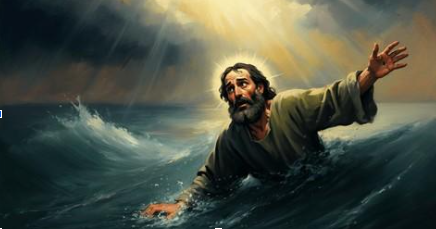
The Gospel presents a striking contrast to the stillness of Horeb. Instead of a silent mountain, we are confronted with a chaotic, roaring sea in the fourth watch of the night. The boat—an enduring image of the Church—is battered by the waves. Yet, it is precisely upon these chaotic waters of human history that the incarnate Word walks. When Peter steps out of the boat, he is sustained entirely by the command of Christ. However, the moment his focus shifts from the face of the Saviour to the violence of the wind, he begins to sink.
Just so, when we are drowning in our questions—overwhelmed by the desire to comprehend all mysteries in the face of our own frailty—the Gospel suggests that the best disposition is simply to cry out: “Lord, save me.” Peter’s terrified plea perfectly captures the petition of today’s Psalm: “Show us, O Lord, your mercy, and grant us your salvation.” This is far more than an act of desperate prayer; it is the most intelligible thing a person can do.
When we are reduced to this singular, desperate plea, “Lord, save me,” we are, as St. John of the Cross describes allowing the pure light of God to blind the eyes of our own human understanding (cf. St. John of the Cross, The Dark Night, II.16) and fixing. This is not a failure, but the necessary prerequisite for infused contemplation. By stripping away our perceived spiritual wealth, the cry itself becomes the key to true poverty of spirit, making space for a divine action that human reason cannot manufacture. Christ’s immediate reach to pull Peter from the deep is immensely consoling. The Lord does not wait for our faith to be perfect or our theological understanding to be flawless; He responds instantly to the genuine, humble cry of the heart. Christ’s gentle rebuke, “O you of little faith, why did you doubt?” is not a condemnation, but an invitation to trust more deeply in the One who commands both the wind and the waves.
We see this same desperate need for divine intervention mirrored in Saint Paul’s pastoral anguish in the Second Reading. Writing to the Romans, Paul expresses “great sorrow and unceasing anguish” in his heart. His profound disappointment stems from a tragic reality: the truth of revelation—the recognition of Jesus as the definitive fulfillment of Israelite history—has been missed by his own kinsmen. As Paul notes, to the Israelites belong the adoption, the glory, the law, the worship, and the inheritance of promises. Yet, without recognising Christ, who is “God over all,” these immense privileges remain incomplete.
This tragic misrecognition is owing to a lack of deep listening and spiritual discernment regarding the Covenant’s true implications. Paul’s conviction is so absolute, and his love so abundant, that he wishes he himself could be “accursed and cut off from Christ” for their gain. This extraordinary disposition of self-sacrifice deeply reflects the heart of a shepherd willing to sacrifice every privilege, pleading for the grace of a self-emptying (kenosis) to win souls over to the truth.
Therefore, whether God approaches us in the hushed, contemplative silence of our own Mount Horeb, or whether He walks towards us upon the stormy waters of our deepest trials, our fundamental response must be the same: we must have the wisdom to cry out. Remember, it is the Holy Spirit who brings to perfection in our hearts the “spirit of adoption,” enabling us to stretch out our hands, call upon our Father, and be drawn safely into the inheritance promised through Jesus Christ.
Prayer
Lord Jesus Christ, when the winds of human history roar and my own understanding fails, grant me the humility to keep my gaze fixed upon Your face. Stripped of my perceived spiritual wealth, may my only response be the desperate, trusting cry of a child to a Father. Save me, Lord, and draw me into the sheer silence of Your consoling presence. Amen.
Ponder Questions
- Where in my current life am I focusing more on the “violent winds” of my circumstances rather than keeping my gaze fixed upon the Person of Christ?
- Do I view my moments of spiritual poverty and desperation as failures, or as necessary prerequisites for infused contemplation and God’s saving action?
- Like Saint Paul, how far am I willing to empty myself out of love for the spiritual good and salvation of those around me?
Exercise to Practice
Sometime this week, find a place of total silence for ten to fifteen minutes. Visualise the stormy waters of your current anxieties, fears, or unanswered questions. Instead of trying to reason your way through them, intentionally surrender your need for total comprehension. Breathe slowly, and with every exhale, silently repeat Peter’s simple plea: “Lord, save me.” Allow this phrase to shift from a desperate panic into a peaceful, loving yield to Divine providence.
Phrase to Remember
Lord, save me!