
V/ My eyes are turned to You, O Lord.
R/ You are the joy and gladness of my youth.
V/ Grant me the Wisdom that sits by Your throne.
R/ That I may dwell as a child in Your presence.
Let us pray:
Lord, in Your all-providential plan, You have led me to this moment to rediscover myself in Your Word and Wisdom. Aid me to make this time of meditation and prayer enriching, transforming, and liberating for my well-being and others.
THE TERESIAN LEGACY
Invitation to the Spirit of True Friendship
By Clement Obiorah, OCD
SOLEMNITY OF SAINT TERESA OF JESUS
15th OCTOBER 2026
Wisdom 7:7-14; Psalm 83(84):2-3,5-6,9-10; Romans 8:14-17,26-27; John 7:14-18,37-39
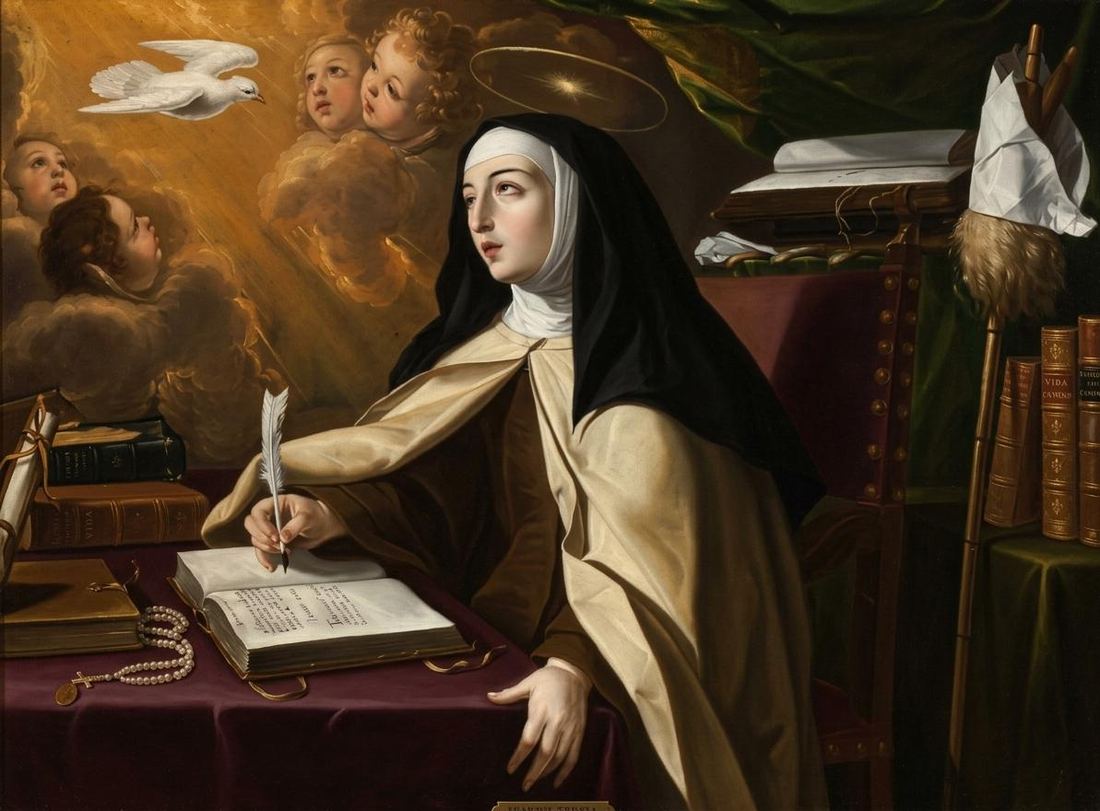
Today’s Gospel opens with people astonished that someone with no credentials could teach with such authority. The Church gives us this reading on the feast of a woman who heard much the same kind of remark in her own lifetime. Teresa of Ávila had no university degree, no theological training, and lived at a time when a woman discussing prayer could attract suspicion from the Inquisition. She called herself, half in jest and half in strategy, a “little woman,” ignorant and wretched. Yet she is the first woman Doctor of the Church.
She did not grasp at that wisdom as a possession. She received it, and as the first reading describes, “I prayed, and understanding was given me; I entreated, and the spirit of Wisdom came to me” (Wisdom 7:7). The order matters. Prayer comes first, and understanding follows. Teresa’s teaching, like the teaching of Jesus in the Temple, was “not from myself: it comes from the one who sent me” (John 7:16). This is why it remains so accessible and timeless. It was never meant to impress anyone. In the words of Wisdom, “What I learned without self-interest, I pass on without reserve” (Wisdom 7:13). Teresa wrote to share wisdom’s riches through the gift of friendship.
Most of us know from experience that friendship cannot be forced, bought, or rushed. It grows when we spend time together, speak honestly, and come back faithfully after we have been away. Wisdom herself promises this: those who acquire her “win God’s friendship” (Wisdom 7:14). Teresa’s whole legacy depends on one simple and radical statement. Mental prayer, she wrote, is “nothing else than being on terms of friendship with God, frequently conversing in secret with Him who, we know, loves us.” We do not need to be eloquent to be friends with God. We only need to turn up.
This is where Teresa speaks directly to us today. The walls that keep us from flourishing are rarely put up by others. We raise them ourselves.
Busyness, which we wear as a mark of importance even as it drains us.
Self-sufficiency, which leads us to think we must earn love before accepting it.
Suspicion, which treats every relationship as a transaction or a threat.
Perfectionism, which convinces us that we must sort ourselves out before coming to God, when coming to God is exactly how we are sorted out.
Isolation, behind screens and schedules, where we are connected to everyone and known by no one.
Teresa does not attack these walls head-on. She invites us, gently, to come inside the Interior Castle of the Soul, one room at a time. True friendship with God does not knock walls down; it makes them unnecessary. She knew that holiness is not found by escaping life but in the middle of it. When her sisters were frustrated because duties kept them from contemplative prayer, she told them that the Lord moves among the pots and pans, and that obedience and charity in the kitchen were no less a meeting with him.
She also prized good sense. For Teresa, the test of prayer was not extraordinary experience but ordinary charity: Are you kinder? Are you more humble? Do you love your neighbour better? She defined humility as “walking in truth,” which means seeing ourselves as we really are, neither inflated nor crushed. Jesus offers the same test of sincerity: the one who works “for the honour of one who sent him” is genuine, “and by no means an impostor” (John 7:18).
That is why Teresa’s wisdom is a lifelong learning. She never stopped growing. She read as a child, read again in her struggles, sought out wise counsel all her life, revised what she wrote, and was still founding convents and learning hard lessons in the year she died. Holiness, for her, was not a destination reached at profession but a path walked daily, with humility to begin again. “Let us begin” was a refrain of the reformed Carmel. Her friendship with God was a school she never graduated from.
The Teresian legacy, then, is an invitation, not a burden. Turn up. Be honest. Speak to God as to a friend who you know loves you. Do not wait to be perfect. Learn every day. Find God in ordinary duties. Let charity test your prayer. And when the walls you have built feel too high, remember that the door to the castle is already open, and the King is waiting inside.
Prayer
Lord God, you raised up Saint Teresa of Jesus to show your Church the way of perfection and the friendship of prayer. Give us her courage to enter the dwelling places of our own hearts, her good sense to find you among the pots and pans of daily life, and her humility to keep learning until our last day. Pour out on us the Spirit who prays within us when we have no words, so that, freed from the walls of fear, we may cry “Abba, Father” and come, thirsty, to the fountain of living water. Through Christ our Lord. Amen. Saint Teresa of Jesus, Mother of Carmel, pray for us.
A Word to Carry
Let nothing disturb thee,
Nothing affright thee;
All things are passing;
God never changeth;
Patient endurance
Attaineth to all things;
Who God possesseth
In nothing is wanting;
Alone God sufficeth