
V/ My eyes are turned to you, O Lord.
R/ You are the joy and gladness of my youth.
V/ Grant me the Wisdom that sits by your throne.
R/ That I may dwell as a child in your presence.
Let us pray
Lord, in Your all-providential plan, You have led me to this moment to rediscover myself in Your Word and Wisdom. Aid me to make this time of meditation and prayer enriching, transforming, and liberating for my well-being and others.
JESUS THE UNIVERSAL KING — A PROFOUND PARADOX OF THE CROSS!
By Dr Rathan N. Almeida, OCD
34th SUNDAY IN ORDINARY TIME, YR A
Ezek. 34:11-12, 15-17; Ps. 23; 1 Cor. 15:20-26; Mt 25:31-46
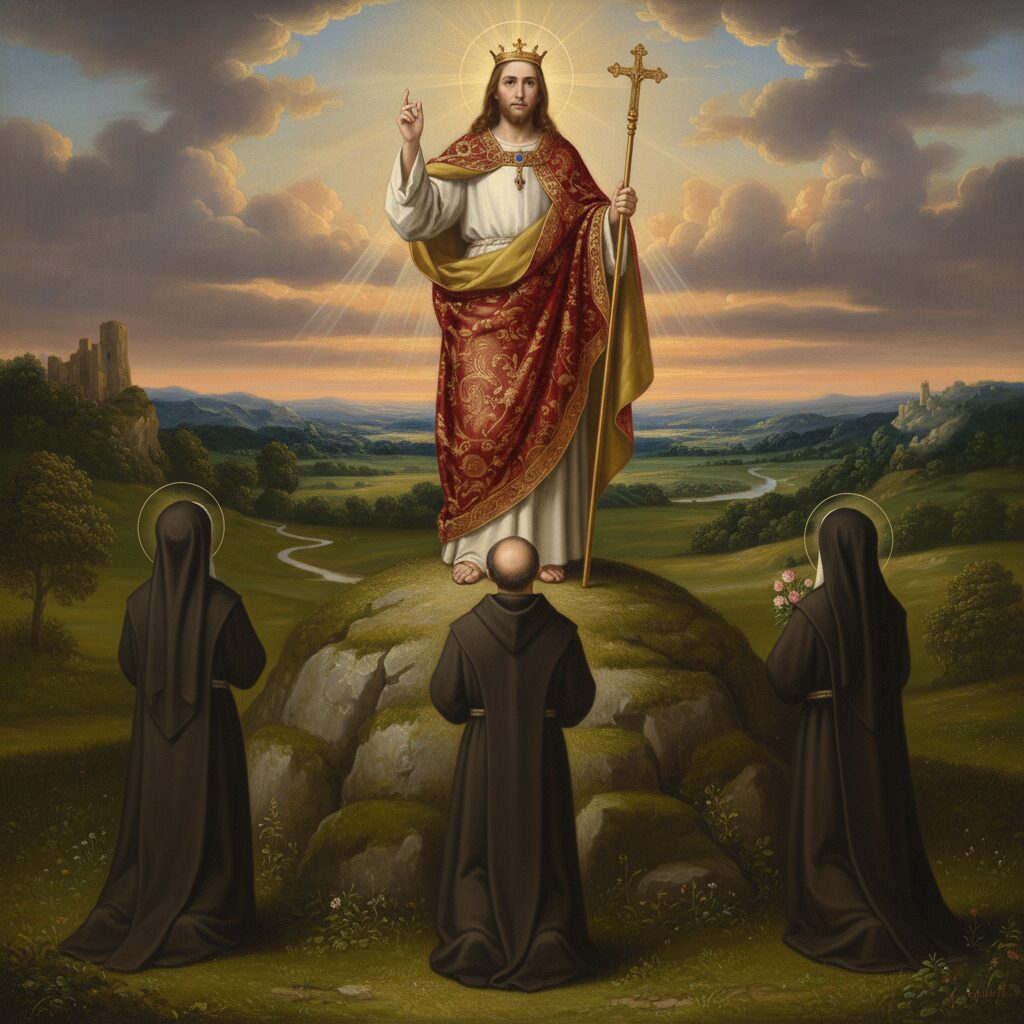
Being the last Sunday of the liturgical year, we aptly celebrate it proclaiming Jesus Christ as the King of the Universe. This feast was instituted by Pope Pius XI on December 11, 1925, in his encyclical Quas Primas reminding Christians that their allegiance was to their spiritual ruler in heaven as opposed to earthly supremacy. Due to secularism, there was an increasing denial of Christ and many doubted Christ’s existence and authority. With this celebration, we end the Ordinary Time and from next week, we start a new liturgical year with the first Sunday of Advent. This Sunday, being the crowning of the whole liturgical year, is the reason why we celebrate the Solemnity of Christ the King. The Church reminds us that Jesus is our Lord and King, and the Lordship of Christ will continue to reign supreme because he is truly “the firstborn of all creation and in every way the primacy is his”.
Every Sunday as we pray the Creed at Mass, we proudly and boldly profess our faith in Jesus Christ, affirming that “he will come again in glory to judge the living and the dead,” and we also acknowledge that his Kingdom will have no end. What do we really mean when we especially profess this truth of Christ’s kingdom? How seriously have we considered it? What really comes to our minds when we read the Gospel passages that speak to us about Christ’s Kingship, the Last Judgment, and about his everlasting Kingdom?
God’s reign does not mirror the way worldly kingdoms operate. Worldly kingdoms depend on political posturing, military power, and the annihilation of enemies. The rulers of this world have a desire and a tendency to act against those who resist their will to power. They go to war; they desire more status, power, and land. However, their powers are limited and confined. The real power belongs to Jesus the King because it is he who really brings peace, holds justice, and shows compassion and mercy.
Jesus’ kingdom is in the world and over the world but does not derive or have its origin from this world. Instead, his kingship is built on the sovereignty of truth and love. His destiny is to give his life for others rather than to annihilate them. His kingdom has no geographical borders, no capital city, no parliament building. His desire is to reign within our hearts and inspire us to do the works that He calls us to do, and thereby to liberate us and bring us closer to Him in his most gracious kingdom.
The fulfillment of his reign is what we pray every day when we say, “your Kingdom come.” We are praying and asking Jesus’ kingdom to come on earth as it is in heaven. That kingdom will come when our hearts are transformed and when we engage in making tangible the gospel values love, justice, peace, mercy, compassion and forgiveness. So, the King we are celebrating today is one who does not need any confirmation from humans because he knows who He is. The one we are celebrating today is the King of Love, who offers peace and forgiveness and governs only by the law of love.
Jesus as King comes to us with great humility; no palace, no security, no attendants, no judgment — just walking among the people whether they understand him or not. Instead of waiting to be served, he reaches out in service, he heals, and he feeds, gathering in everyone who has been excluded from the community.
Our king who is not interested in power, lives and works among his people, enduring every pain and hardship they endure, a king who treats his subjects with tender compassion of a shepherd caring for the lost and healing the injured, a king who heals body and soul, attending always to both spiritual and physical needs — while courageously calling out and condemning the structures of power that make injustice, poverty, and oppression look like something very normal and acceptable.
For St Teresa of Ávila, the human soul is like an Interior Castle, with many dwelling places, at the centre of which resides the King himself. She begins her masterpiece, The Interior Castle, by reminding us of the extraordinary dignity of the human person: we are created in the image and likeness of God and He dwells within us. Consequently, allowing Christ to reign in our lives means entering into a personal relationship with Him. This gives us a beautiful perspective on Christ the King.
For St John of the Cross, the cross is not merely an instrument of suffering; it is the revelation of God’s infinite love. In Jesus crucified, we encounter a God who empties himself completely for humanity and reveals his greatness through self-emptying, humility, and surrender. The more we cling to worldly power, prestige, possessions, and self-importance, the less space we leave for Christ to reign within us.
Jesus Christ will one day return as the King of glory and His kingdom will have no end. Everyone will recognise and confess Him as the King eternal, the King of all ages, King forever. The kingdom he brings is unshakable, immovable, and resolute. However, access might be difficult for the godless rich, the religious hypocrite, the self-indulgent, self-centred, and the self-sufficient. An inner transformation, a drastic change, and a fruitful life is all that is required to be his subjects.
The challenge of this Solemnity of Christ the King is to belong to Jesus. Belonging to Jesus does not cut us off from belonging to others but gives a clear direction to that belonging. Perhaps too often today we make our social belonging more important than belonging to Jesus and thus our faith is weak. The call today is to make us belong to Jesus, to become a part of the dominion and kingdom of Jesus, and then, our life and all the other belongings that we have will receive proper orientation and fall in their respective places because we first belong to Jesus.
We can reflect:
- What are the false kingdoms that I have established within myself?
- Am I attached to recognition, authority, appreciation, and personal importance?
- Am I willing to embrace the humility of Christ?
We can practice:
Give Christ the first place: Begin the day with Christ before attending to your phone, emails, or daily responsibilities.
Surrender one attachment: Identify one attachment that competes with Christ’s place in your heart such as recognition, appreciation, comfort, control, or personal prestige, and consciously give up any one.
Rule through service, not authority: Perform one act of service without expecting appreciation or recognition. Don’t resist someone else from taking credit.
Prayer
Lord, thy kingdom come… a kingdom of love, joy, peace, and justice! Amen.