
V/ My eyes are turned to you, O Lord.
R/ You are the joy and gladness of my youth.
V/ Grant me the Wisdom that sits by your throne.
R/ That I may dwell as a child in your presence.
Let us pray
Lord, in Your all-providential plan, You have led me to this moment to rediscover myself in Your Word and Wisdom. Aid me to make this time of meditation and prayer enriching, transforming, and liberating for my well-being and others.
DRAWN TO THANKS LIVING
By Fr Clement Obiorah, OCD
18th Sunday in Ordinary Time, Yr A
Isaiah 55:1-3; Psalm 145(144):8-9. 15-18; Romans 8:35, 37-39; Matthew 14:13-21
The liturgy for the 18th Sunday in Ordinary Time offers a profound meditation on the divine economy of grace, entirely subverting human calculations of scarcity, worth, and self-sufficiency. Across the readings, we encounter the radical asymmetry between human poverty and the sheer gratuitousness of God’s love. The tension between our anxieties over inadequacy and the invitation to step into God’s unfathomable generosity is perfectly resolved in our first reading, which entirely upends a transactional view of salvation: “he who has no money, come, buy and eat!” We labour for “that which does not satisfy”, seeking security in self-reliance. Yet, God’s providence is not merely the careful management of scarce resources; it is an invitation to a life of sheer abundance. We are asked to bring our exact poverty—our lack of currency—as the very prerequisite for attending the banquet. We are not asked to earn our keep, but to bring our absolute emptiness to the table.
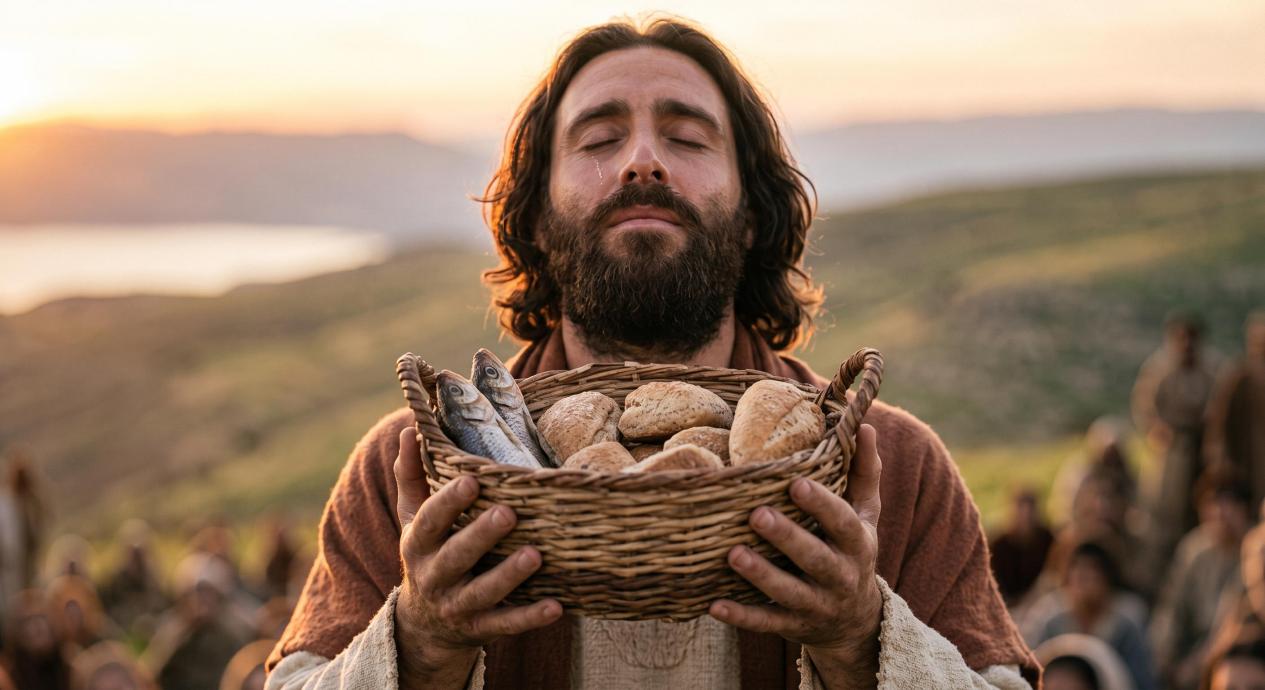
This same invitation is vividly realised in Matthew’s Gospel. Confronted with a desolate place and a hungry multitude, the disciples default to a mindset of inadequacy and transactional logic: “send the crowds away to go into the villages and buy food for themselves”. They look at their “five loaves and two fish” and see only lack, overlooking the possibilities that abound when placed in the hands of our Lord. Jesus, however, takes this meagre offering, blesses it, and breaks it. The overarching theme of being ‘Drawn to Thanks Living’ perfectly encapsulates the Christian vocation: a shift from a transactional existence into a deeply Eucharistic reality (from the Greek eucharistia, meaning thanksgiving). The staggering superabundance that follows from this disposition—twelve baskets of leftovers—demonstrates that when we surrender our acute inadequacy to Christ, it becomes the means for a Eucharistic life.
To accept this free gift requires profound vulnerability: we must allow God into the very anxieties and concerns that threaten to paralyse us. St Paul’s triumphant crescendo in Romans 8 addresses the heart of human insecurity. Tribulation, famine, nakedness, and the sword are the ultimate threats to human self-preservation. When confronted by such dangers, the temptation is to retreat into fearful self-reliance, which ultimately suffocates our capacity to love.
Paul insists that “in all these things we are more than conquerors”. The Greek verb used here, hypernikōmen, suggests an overwhelming, superabundant victory. This victory is not achieved by escaping our vulnerabilities, but by remaining steadfast in the knowledge that absolutely nothing can separate us from the love of God in Christ Jesus. When the soul is anchored in this objective theological reality, the anxieties that undermine our generosity are dismantled. We are freed to love without calculation because we are infinitely held in our perceived inadequacy.
Blessed Marie-Eugène of the Child Jesus offers profound insight in his spiritual masterpiece, I Want to See God. For Blessed Marie-Eugène, our experience of inadequacy is not an obstacle to union with God; rather, it is the exact receptacle designed for divine love.
We can draw three specific insights from this:
Marie-Eugène teaches that the fundamental disposition for receiving God’s superabundant grace is radical spiritual poverty. Just as Isaiah invites the Israelites to come “without money”, the soul must approach God completely stripped of any illusion that it can save itself. It is precisely when we feel we have nothing but “five loaves and two fish” that God’s merciful love is most powerfully attracted to us.
The translation of our poverty into ‘thanks living’ is exclusively the work of the Holy Spirit. Marie-Eugène emphasises that the Spirit breathes life into our inadequacy, transforming our natural limitations into supernatural fruitfulness.
When we experience the truth of St Paul’s words—that no distress or peril can separate us from Christ—the natural response is a radical, outgoing generosity. The soul becomes a conduit for the same superabundance witnessed in the feeding of the five thousand.
Thus, to be ‘Drawn to Thanks Living’ is to accept the invitation to the divine banquet precisely as we are: poor, occasionally anxious, and utterly reliant on grace. As Pope Benedict XVI articulated so beautifully throughout his pontificate, the Eucharist is not merely a ritual but the ongoing dynamic of Deus Caritas Est—God’s descending love elevating our human poverty. When we bring our anxieties and lay them upon the altar with the bread and wine, Christ returns them to us transformed. We do not just give thanks; our very lives become a living Eucharist, broken and poured out for a hungry world.
Prayer
Lord Jesus Christ, teach us to surrender our anxieties, our spiritual poverty, and our transactional calculations into Your wounded hands. May Your Holy Spirit breathe life into our inadequacy, transforming our meagre offerings into a living Eucharist. Held infinitely in Your untiring love, may we become conduits of Your superabundant generosity to a world starving for truth. Amen.
Ponder Questions
- Where in my spiritual life am I still clinging to a transactional relationship with God, rather than approaching Him in radical poverty?
- What specific anxieties or perceived inadequacies must I lay upon the altar this week, trusting them as an opportunity for His grace?
- How might the Holy Spirit be inviting me to transform my daily limitations into a lived eucharistia—a pouring out of love for those around me?
Practice for the Week
Each morning this week, intentionally identify one specific area where you feel ill-equipped, anxious, or overwhelmed. Instead of retreating into fearful self-reliance to solve it, consciously offer this precise limitation to Christ in quiet prayer. Visualise placing it on the altar alongside the bread and wine, asking the Holy Spirit to accept it as your “five loaves and two fish,” opening the space for God’s superabundant provision.
Phrase to Remember
“Nothing can separate us from the love of God.”