
V/ My eyes are turned to You, O Lord.
R/ You are the joy and gladness of my youth.
V/ Grant me the Wisdom that sits by Your throne.
R/ That I may dwell as a child in Your presence.
Let us pray:
Lord, in Your all-providential plan, You have led me to this moment to rediscover myself in Your Word and Wisdom. Aid me to make this time of meditation and prayer enriching, transforming, and liberating for my well-being and others.
THE ETERNAL LITURGY AND THE PURITY OF HEART
By Clement Obiorah, OCD
SOLEMNITY OF ALL SAINTS (31st SUNDAY IN ORDINARY TIME), YR A
Revelation 7:2-4, 9-14; Psalm 24; 1 John 3:1-3; Matthew 5:1-12a
Every Sunday we join something that did not begin with us and will not end when we leave the church. Long before the first hymn is sung, the praise of God is already under way. This year the Solemnity of All Saints falls on a Sunday, the day when everyone feels it right to come for Mass, and perhaps there is no better day to remind ourselves of what we are really entering. We do not simply attend a service; we step, for an hour, into a liturgy that never ceases.
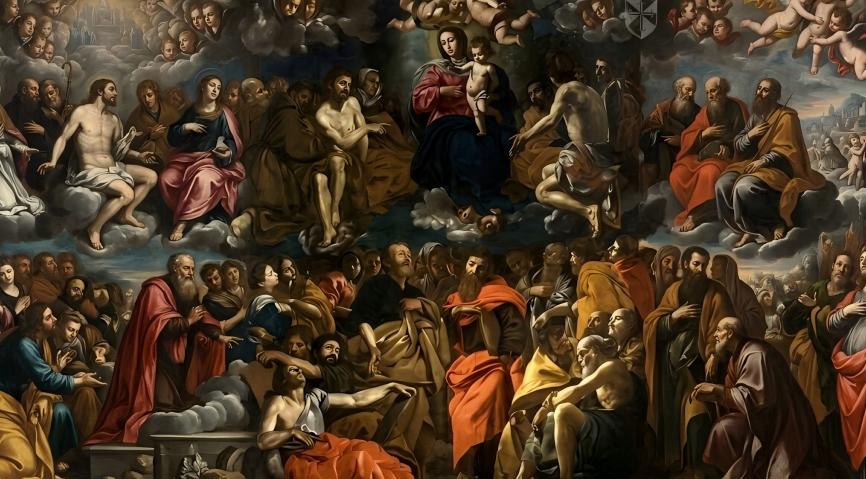
St John the Evangelist lets us glimpse it. In the first reading he sees ‘a great multitude that no one could number, from every nation, from all tribes and peoples and languages’, clothed in white, palm branches in their hands, crying out: ‘Salvation belongs to our God who sits on the throne, and to the Lamb!’ The angels fall on their faces and answer with a sevenfold blessing. This is the heavenly liturgy of the Mystical Body, the Church in glory. This assembly is ‘the ones coming out of the great tribulation’, who ‘have washed their robes and made them white in the blood of the Lamb.’ Their white robes are not their own achievement; they are the Lamb’s gift, received and kept.
What admits a person to this liturgy? The Psalmist asks the same question: ‘Who shall climb the mountain of the LORD? Who shall stand in his holy place?’ He offers a simple and searching response: ‘The clean of hands and pure of heart.’ Purity of heart here is not first a matter of moral tidiness. It is single-mindedness: a heart not divided between God and a hundred lesser things. ‘Such are the people who seek your face, O Lord.’ The Psalmist praises those who participate in this unending liturgy, living each day and experience in the light of eternal praise. To seek God’s face always and in all ways is already to stand in the holy place.
In the Gospel, Jesus goes up the mountain—and sits down to teach as the true minister of the new Covenant. We often read the Beatitudes as a list of virtues to acquire, but they are first a portrait of Christ himself. He is the poor in spirit, the meek, the merciful, the pure of heart, the peacemaker, the one persecuted for righteousness’ sake. Jesus embodies the eternal liturgy in his own body: every word, every silence, every step towards Jerusalem is offered to the Father. And he presents this way of life as beatitude, as blessedness—the joy of God’s conversation with us within every moment and event of our lives, even the hours of mourning and persecution. The single-minded heart forms the holy ground—on which God reveals himself, and by implication who we truly are.
That revelation is the subject of the second reading. ‘See what kind of love the Father has given to us, that we should be called children of God; and so we are.’ Our identity is already given, yet ‘what we will be has not yet appeared’. The actualisation of who we are as children of the Father still waits to be unveiled: ‘when he appears we shall be like him, because we shall see him as he is.’ In the interim, John adds, ‘everyone who thus hopes in him purifies himself as he is pure.’ Christian hope is not passive waiting. The hope that purifies us is an active purging of everything that is not God, or not worthy of the knowledge of so good a Father.
St John of the Cross puts this plainly with startling economy: ‘To come to possess all, desire the possession of nothing’ (Ascent of Mount Carmel, I, 13, 11). This is no contempt for creation—but freedom from the grip of vain things, so that the heart may be wholly given. St. Elizabeth of the Trinity found in St. Paul her longing to be on earth—what the saints are in heaven: a soul whose every breath is praise. She asks to forget herself entirely, that she might rest in God ‘as if my soul were already in eternity’. That is the eternal liturgy lived within the walls of a Carmel in Dijon, through illness and the ordinariness of community life. Holiness, for her, was not an escape from the everyday; it was the everyday become worship.
What, then, does this feast ask of us? Not that we become someone else, but that we become wholly who we already are. The saints we celebrate today include countless men and women whose names no calendar records—parents, labourers, the sick, the forgotten—whose lives quietly became praise. The Mass is the source and summit of this praise, the place where heaven and earth sing the same Sanctus; from the altar it goes out into kitchens, offices, hospital wards and sleepless nights. Every moment surrendered single-mindedly to God becomes part of that unending song. To be like him is nothing less than to reach the perfect revelation of love incarnate in our lives.
Prayer
Almighty Father, you gather all your saints into the unending praise of heaven. Purify our hearts, that, seeking your face always and in all ways, we may join our voices to theirs and come at last to see you as you are. Through Christ our Lord. Amen.
Ponder Questions
- Where is my heart divided? What ‘vain things’ compete with my single-minded search for God’s face?
- How might I carry the praise of Sunday Mass into the ordinary moments and events of my week?
- Which saint—known to the whole Church, or known only to me—shows me what a life of praise looks like?
Practice for the Week
Each morning, offer the coming day to God in a single sentence as a ‘praise of glory’. Each evening, name one moment in which you recognised God’s conversation with you, and one thing you are ready to let go of because it is not God. Tomorrow, on All Souls’ Day, remember by name those you have loved who have gone before us, and pray that they may share fully in the liturgy of heaven.
Phrase to Quote
Purity of heart is single-mindedness: one heart, one song, one God.