
V/ My eyes are turned to You, O Lord.
R/ You are the joy and gladness of my youth.
V/ Grant me the Wisdom that sits by Your throne.
R/ That I may dwell as a child in Your presence.
Let us pray:
Lord, in Your all-providential plan, You have led me to this moment to rediscover myself in Your Word and Wisdom. Aid me to make this time of meditation and prayer enriching, transforming, and liberating for my well-being and others.
THE SEDUCTION OF THE WORD
22nd SUNDAY IN ORDINARY TIME, YEAR A
Jeremiah 20:7-9; Ps 63(62):2. 3-4. 5-6. 8-9; Romans 12:1-2; Matthew 16:21-27
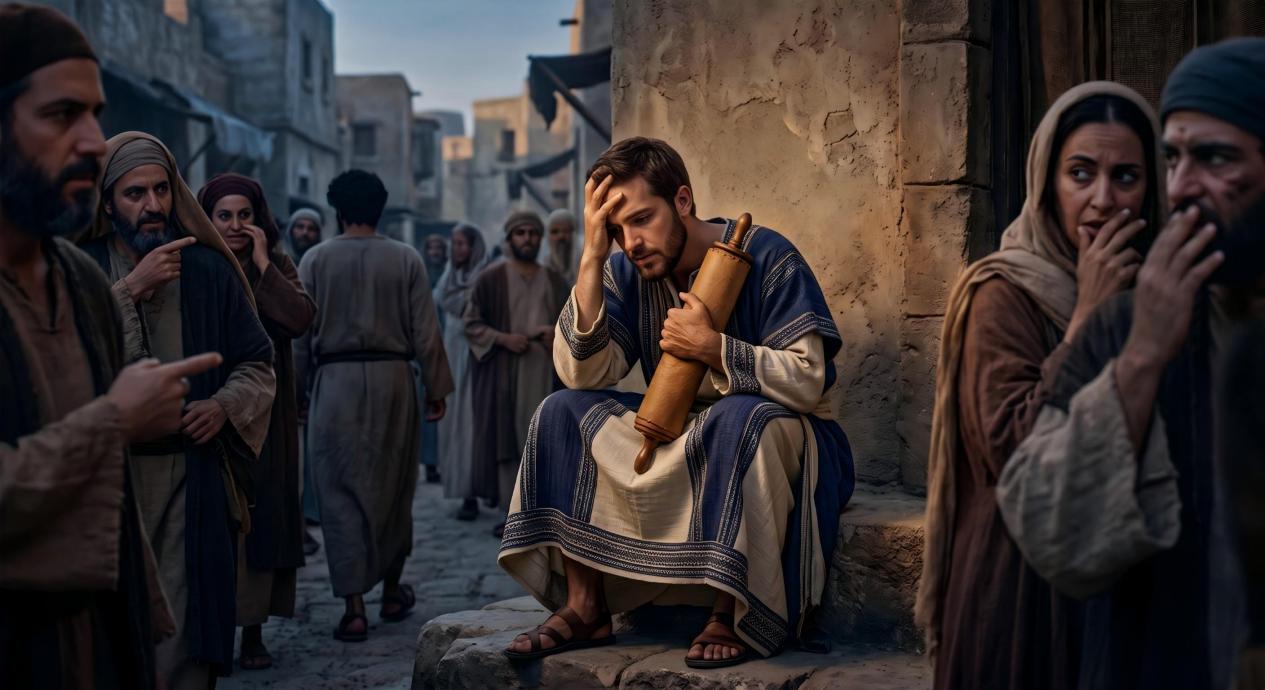
Jeremiah’s piercing confession reveals the shattering reality of his prophetic vocation. “O Lord, you have deceived me, and I was deceived; you are stronger than I, and you have prevailed” (Jeremiah 20:7). The Hebrew verb pathah—often rendered as seduced, enticed, or persuaded—implies a divine overpowering, a wooing that strips the prophet of his own defences from God. God’s grace is not merely a gentle invitation; it is a profound invasion of love.
For Teresa in the Book of her Life 14, she posits that here, “the will is occupied, in such a way that, without knowing how, it becomes captive. It allows itself to be imprisoned by God.” This resonates intimately with the experience of the infused action of the Word in the soul. The Word of God is a living flame that touches and transforms us at our deepest reality. Yielding requires a surrender where the cost is uniquely indeterminate. One cannot negotiate the terms of this divine encounter. The Spirit blows where it wills, and to enter its current is to forfeit control over life’s unfolding. For Jeremiah, this brings public reproach and the derision of his peers, yet the ‘burning fire shut up in my bones’ is stronger than the human instinct for self-preservation.
How does the soul endure this divine compulsion without being annihilated by it? The response lies in the Psalm: “O God, you are my God; for you my soul is thirsting… like a dry, weary land without water” (Psalm 63). Here, the soul longs for an immediate and direct encounter with life itself, while rejecting everything else that is less than this. In the ascetical tradition, particularly through the lens of St. John of the Cross, this surrender to aridity is not a sign of God’s absence, but of His profound, purifying presence. The soul recognises that complete surrender to the divine wooing is the most rational response in the face of deep longing.
Out of this contemplative thirst flows the apostolic action that St. Paul demands in our second reading. To present our bodies as a ‘living sacrifice’ is the true logike latreia—our spiritual, or ‘logical’, worship. Christ abolishes this divide. True discipleship is an act of yielding to the Logos, allowing His logic of self-gift to replace the human logic of self-preservation. Pope Benedict XVI returned frequently to this Pauline concept, seeing in it the blueprint for the ‘Eucharistic form of life’.
The liturgy of the sanctuary flows out to become the liturgy of the world. There can be no bifurcation between the faith professed at worship and the life lived outside it; authentic Eucharistic worship demands absolute coherence of life, drawing every human action into Christ’s perfect, embodied obedience to the Father. This reality is brought into sharp historical focus in the Gospel. The juxtaposition of Peter’s majestic confession at Caesarea Philippi and his subsequent rebuke is striking. Peter confesses Christ, but he desires a Messiah stripped of the cross—a revelation utterly devoid of commitment.
Jesus’s rebuke of this kind of self-serving religion—“Get behind me, Satan! You are a hindrance to me”—is a forceful correction of the human tendency to domesticate divine revelation. Peter is thinking in merely human terms, attempting to shield the Lord from the very act that will redeem the world. As Pope Benedict XVI so often elucidated, the cross is not a failure of God’s plan, nor is it merely a mechanism of penal substitution; it is the supreme wooing of love.
To deny oneself and take up one’s cross is the requirement for this union of love; it is the necessary means of kenosis (self-emptying) so as to be filled entirely with the life of the divine lover. St. Thérèse of Lisieux grasped this perfectly in her science of love: the smallest daily sacrifices, when united to the cross of Christ, possess a universal, redemptive freedom. Thus true freedom is found only in the total oblation of the self. Pope St. John Paul II describes it as the capacity for unreserved self-surrender. Like Jeremiah’s fire and the Psalmist’s thirst, the cross is embraced not with despair, but with a willing and joyful compulsion, knowing that the cost of discipleship is nothing less than the surrender of everything for the sake of the All.
Therefore, we are left with a stark choice. Do we, like Peter in his moment of weakness, shy away from the demands of love and seek a self-determined discipline? Or do we allow the Word of God to seduce us, yielding entirely to the Logos, and offering our very lives as a living, Eucharistic sacrifice for the life of our world and immediate community?
Prayer
O Lord, grant me the grace to yield entirely to your living Word. May I embrace my daily cross not as a burden, but as the pilgrim staff that leads me to union with you. Transform my life into a living, Eucharistic sacrifice of praise, that I may seek no other freedom than the total oblation of myself to your love. Through Christ our Lord. Amen.
Ponder Questions
- Where in my life am I resisting the “divine seduction”, attempting to retain control over my own path rather than yielding to the Holy Spirit?
- Like Peter, do I subtly desire to domesticate God’s will to fit my human logic of self-preservation?
- In what specific ways can I begin to unite my daily labours and hidden sufferings to my logike latreia (spiritual worship)?
Practice Exercise for the Week
Choose one small, unsolicited inconvenience or irritation each day this week. Instead of immediately seeking to alleviate it, practice Teresa’s recollection by seeking divine logic; uniting this fleeting moment of discomfort to a logike latreia. Let this small, hidden kenosis be a deliberate gift of self for the spiritual nourishment of your immediate community.
Phrase to remember
Offer your very body as a living sacrifice