
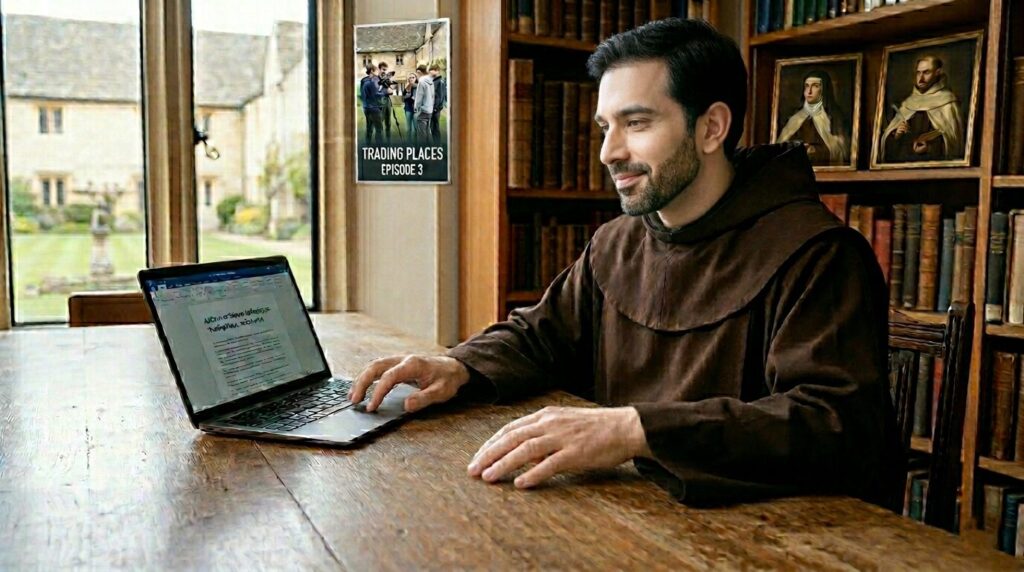
When a proposal to shoot an episode of a new show Trading Places at the Carmelite Priory, Boars Hill, Oxford, landed on our prior’s desk last autumn, the initial reaction in our community was predictable: polite bemusement.
A television crew? Party-loving young people swapping £800 nights out for our life of prayer and service? Film cameras in our cloisters? Yet as our community gathered for discernment, what first seemed absurd began revealing itself as a possibility. Perhaps even a calling!
St Teresa of Ávila constantly faced the tension of the contemplative soul living in a very public world. She founded seventeen monasteries while maintaining profound interior prayer. She wrote intimate mystical theology while managing finances and navigating church politics.
For Teresa, contemplation and action weren’t opposites but two movements of the same breath: the inhale of silence with God, the exhale of love for neighbour.
And so, our discernment asked: Could hosting this film be an exhale?
The concerns were real. Our life is ancient, ordered, countercultural. We rise for morning prayer while most of the world sleeps. We practice silence when the culture screams. We have chosen poverty, chastity, obedience in an age that worships autonomy, accumulation, self-gratification. Could cameras capture any of this truthfully? Or would we become quaint relics performing for entertainment?
But then, another question surfaced: What if our discomfort was precisely the point? What if the very vulnerability required — opening our life to scrutiny, to misunderstanding, perhaps to mockery — was itself a kind of poverty, a stripping away of control that our vows already ask of us?
If our vocation is to witness to Christ, the Incarnate Word, who became vulnerable like the rest of us, could we do so only on our own comfortable terms? Or were we being invited to risk genuine encounter with people whose lives looked nothing like ours?
We said yes. Not because we were certain of the outcome but because we sensed the Spirit in the uncertainty itself.
The filming week was everything we anticipated and nothing we expected. Yes, there were cameras. Yes, there was awkwardness. Yes, our rhythm was disrupted, our privacy invaded, our routines explained and re-explained for the benefit of viewers who’d never heard of Lauds or Vespers.
But there was also something else. These young people arrived as strangers to everything we hold sacred. They knew nothing of contemplative prayer, religious vows, Eucharistic adoration — even, perhaps, nothing of Christ. Their world was nightclubs and parties, Instagram and excess, the pursuit of pleasure and the numbing of pain through noise.
And yet, beneath the bravado, beneath the shock of 5:30am wake-up calls and the confusion over why we’d choose celibacy, there was hunger. Real hunger. For meaning, for peace, for something more than the hamster wheel of work-party-hangover-repeat that left them exhausted and empty.
When we took the young men bowling on Friday night — seventy-year-old Fr Liam vying for the top spot on the scoreboard like everyone else — something beautiful emerged. Laughter without performance. Connection without pretence.
The simplicity our Rule calls us to became visible not as deprivation but as freedom.
Teresa insisted that “God walks among the pots and pans,” that holiness isn’t absence from the world but presence within it. Our week with these young people and the cameras was an immersion in pots and pans. Messy, inconvenient, imperfect.
We didn’t perform flawless monastic life. We showed them our actual life — including the occasional grumpiness at 5:30am, the fumbled explanations, the dozing off at evening meditation after a tiring day — moments when our own humanity showed through our religious habits. And perhaps that’s what made it real. Perhaps that’s what made it witness.
The episode airs this Sunday. We have no idea how it will be received. Yet, we surrendered control the moment we said yes, trusting that God works through our poverty, our limitations, our willingness to be seen rather than our ability to manage perception.
Even if a single soul watching recognises his/her own hunger in these young people’s disorientation and discovery, or glimpses that the life we’ve chosen isn’t escape from the world but engagement with what’s most real, then the vulnerability was worth it.
John’s Gospel records the first disciples asking Jesus, “Where do you live?” His answer: “Come and see.” Not “Let me explain my philosophy.” Not “Here’s my mission statement.” Just: Come. See for yourself. Experience what can’t be explained.
That’s what we offered these three lads. That’s what, through them, we offer anyone watching Sunday night. Come and see…
…that joy isn’t found in excess but in enough.
…that peace isn’t absence of struggle but presence of God.
…that love isn’t a transaction but a gift.
Come and see that an ancient way of life — prayer before dawn, work without complaint, community beyond preference, surrender of control — isn’t irrelevant to modern longing. It is a response to it.
The cameras have gone. The crew has left. Our rhythm has returned to its ancient pattern. But something remains: the memory of encounter, the evidence that barriers dissolve when we risk genuine presence, the renewed conviction that our life, however countercultural, however strange, speaks to something essential and universal.
This Sunday, the world gets a glimpse of that life. Not polished. Not perfect. But true.
And we? We return to what we’ve always done: rise in darkness to praise the Light, hold the world’s pain in prayer, trust that Love is working in ways we cannot see or control.
Perhaps the deepest lesson of this whole unlikely adventure is:
Witness isn’t about controlling the narrative. It’s about showing up, being present, trusting the Spirit to work through our poverty and vulnerability.
Just like Teresa did. Just like we’re still learning to do. Just like we hope you too will strive to do.
How to watch “Trading Places” Episode 3:
- Channel 5, Sunday, May 24 at 10pm
- Watch the promo video on YouTube: https://youtu.be/Ukd0LpjEwHI
- Stream online now: https://www.channel5.com/show/trading-places
- Channel 5 App on Apple: https://apple.co/2sHmfTx | or on Android: https://bit.ly/4dQMLL8
This broadcast is an extraordinary opportunity to share the beauty of Carmelite life with millions of people who may never have encountered it before. So, spread the word!