
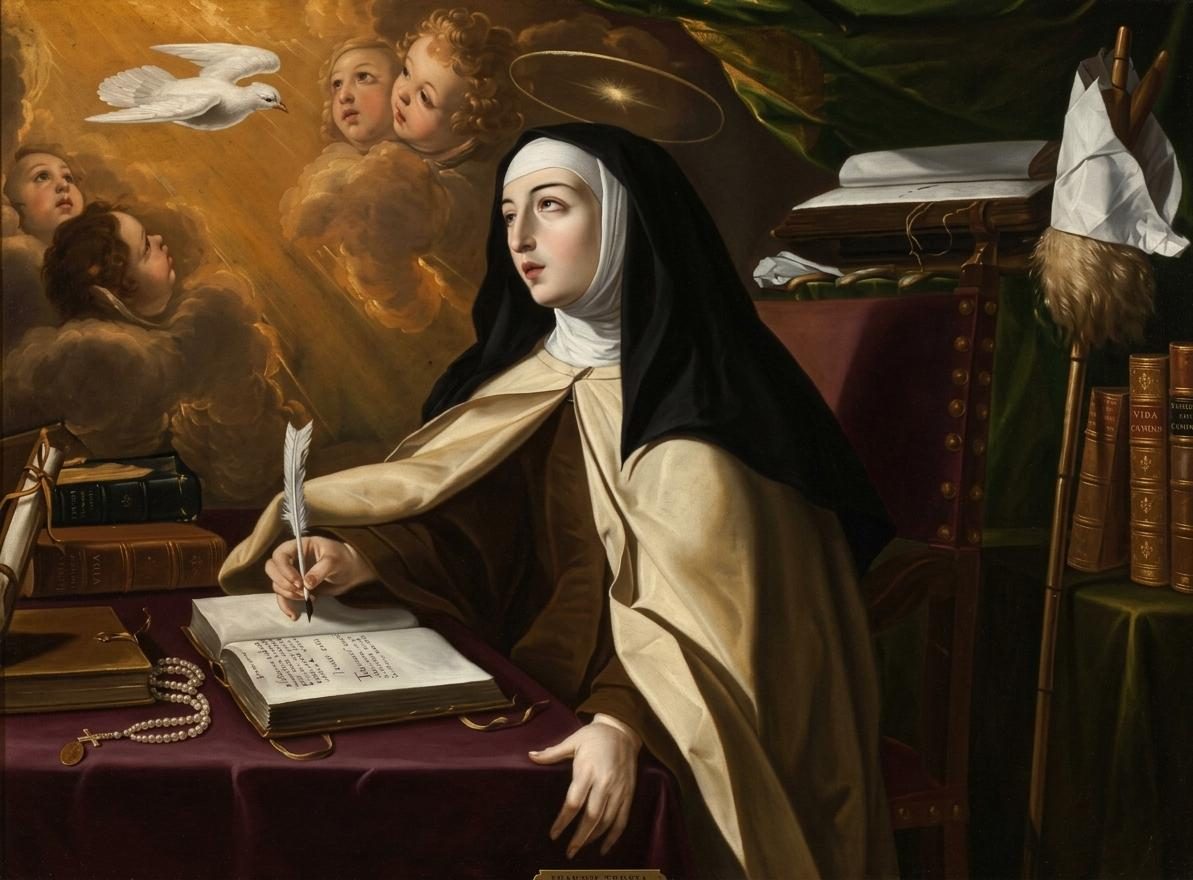
Celebrating the Mystic, Reformer, and Doctor of the Church
By Fr Rathan
The feast of St. Teresa of Avila, celebrated on 15 October, invites the Church to rediscover the beauty of prayer, the depth of friendship with God, and the transforming power of divine love. A woman of extraordinary courage, profound mystical experience, and remarkable practical wisdom, St. Teresa remains one of the most inspiring figures in the history of Christian spirituality. As a Carmelite reformer and Doctor of the Church, she continues to guide countless souls towards a deeper and more intimate relationship with God.
Born Teresa Sánchez de Cepeda y Ahumada in Avila, Spain, in 1515, she entered the Carmelite monastery of the Incarnation at Avila in 1535. Her spiritual journey was not without struggles. She experienced periods of spiritual dryness, physical suffering, interior conflict, and the challenges of balancing prayer with the demands of community life. Yet, through perseverance and a growing openness to God’s grace, she gradually discovered that prayer is not merely a religious duty but a loving relationship with the One who loves us.
One of Teresa’s most enduring contributions to Christian spirituality is her understanding of prayer as “…nothing else than an intimate sharing between friends; it means taking time frequently to be alone with Him who we know loves us” (The Book of Her Life, Chapter 8, Paragraph 5). For her, prayer is not primarily a matter of words, techniques, or extraordinary experiences. It is an encounter of love, a journey of friendship in which the human heart learns to listen, trust, surrender, and respond to God’s presence. Her spirituality reminds us that holiness begins not with extraordinary achievements but with an honest and persevering relationship with the Lord.
Teresa’s masterpiece, The Interior Castle, presents the soul as a magnificent castle made of a single diamond or crystal, with many dwelling places. At its centre dwells the King himself — God, who longs to draw the soul into intimate communion with Him. The spiritual journey involves moving through these interior mansions by prayer, humility, self-knowledge, and the grace of God. Teresa teaches that the goal of the spiritual life is not simply personal perfection or spiritual consolation, but loving union with God that transforms the way we live and relate to others.
Her mystical insights were inseparable from her missionary zeal and practical wisdom. At a time when religious life faced significant challenges, Teresa courageously undertook the reform of the Carmelite Order, seeking to restore a life marked by prayer, simplicity, fraternity, and fidelity to the Gospel. Despite opposition, ill health, and the hardships of travel, she founded several reformed Carmelite communities. Working alongside St. John of the Cross, she helped lay the foundations of the Discalced Carmelite reform. Her life demonstrates that genuine contemplation does not withdraw a person from the world; rather, it gives birth to renewed energy for service, mission, and the building up of the Church.
Teresa was proclaimed a Doctor of the Church by Pope St. Paul VI in 1970, becoming the first woman to receive this title. This recognition affirmed the universal significance of her spiritual teaching and her enduring contribution to the Church’s understanding of prayer and the mystical life. Her writings continue to speak to people of different cultures and generations, especially those searching for silence, meaning, and authenticity amid the distractions and anxieties of modern life.
Her famous words, “Let nothing disturb you, let nothing frighten you; all things are passing; God never changes… God alone suffices,” (Spanish – Nada te turbe) offer a message of hope in a world marked by uncertainty, conflict, and rapid change. This little poem was found written in the margins of her breviary in her own handwriting. Teresa does not promise a life free from suffering. Instead, she points towards the steadfast presence of God, who remains faithful even when circumstances change and human strength fails.
For the Carmelite family, St. Teresa is much more than a historical figure or a celebrated mystic. She is a spiritual mother who continually calls her sons and daughters to deeper prayer, authentic community, and generous apostolic commitment. Her teaching insists that prayer and service belong together. The authenticity of our encounter with God is revealed in the charity, patience, humility, and compassion with which we treat others.
As we celebrate her feast, St. Teresa challenges us to ask ourselves: Is prayer truly the heart of our lives? Do our communities, our families, create space for silence, friendship, and spiritual growth? Does our relationship with God make us more loving, courageous, and available to those who need us?
Her message remains simple yet demanding: allow God to lead you into the depths of your own heart, remain faithful in prayer, and let divine love transform your life. The journey towards holiness may involve struggles and uncertainties, but the God who calls us is also the God who sustains us.
St. Teresa of Avila reminds us that the ultimate purpose of prayer is not merely to experience God, but to become so united with Him in love that our entire lives become a gift to others. May her example inspire us to become contemplatives in prayer, courageous in mission, joyful in community, and steadfast in our journey towards union with God.
Our Holy Mother St. Teresa of Avila, pray for us…!