
V/ My eyes are turned to You, O Lord.
R/ You are the joy and gladness of my youth.
V/ Grant me the Wisdom that sits by Your throne.
R/ That I may dwell as a child in Your presence.
Let us pray:
Lord, in Your all-providential plan, You have led me to this moment to rediscover myself in Your Word and Wisdom. Aid me to make this time of meditation and prayer enriching, transforming, and liberating for my well-being and others.
UNAMBIGUOUS LOYALTY
By Clement Obiorah, OCD
29th SUNDAY IN ORDINARY TIME, YR A
Isaiah 45:1, 4-6; Psalm 96; 1 Thessalonians 1:1-5b; Matthew 22:15-21
There is a question that most of us live with, even if we seldom speak it aloud: where does my loyalty really lie? We owe allegiance to our families, employers, communities, country, and the Church. Usually, these coexist comfortably enough. Sometimes they do not, and we feel the painful pull of a divided heart.
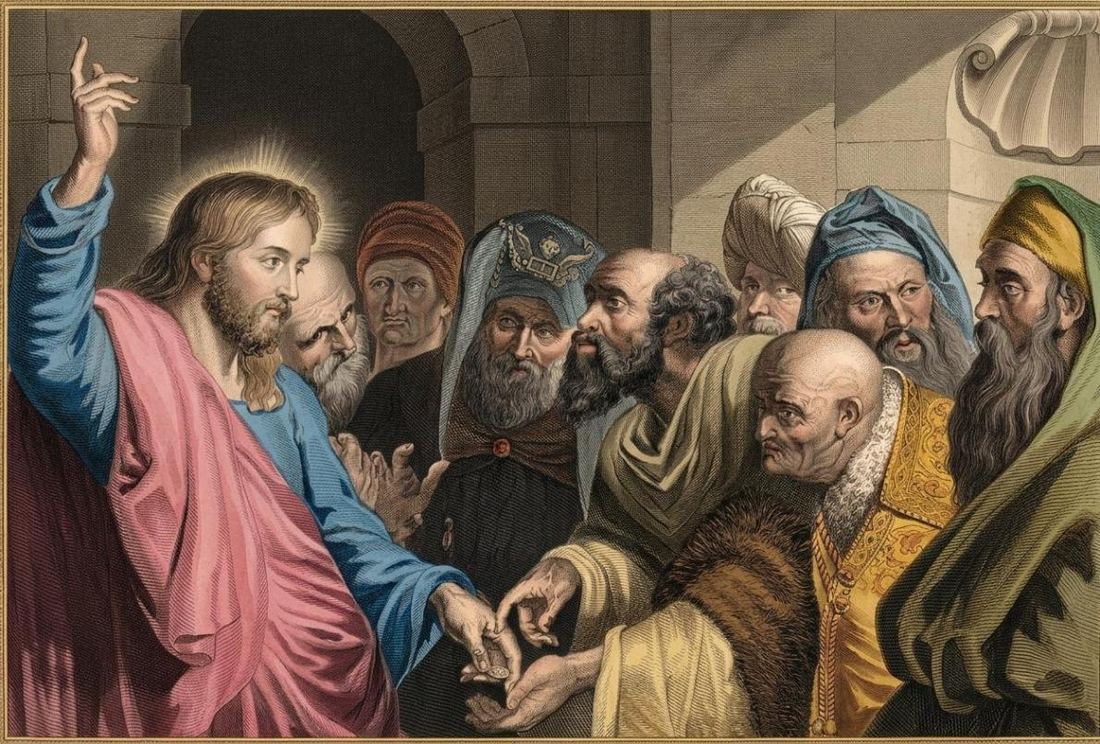
The Pharisees and Herodians knew this tension well, and they built a trap out of it. These two groups had very little in common; they united only to put a single question to Jesus: ‘Is it lawful to pay taxes to Caesar, or not?’ If he says yes, he appears a collaborator with Rome. If he says no, he is a dangerous rebel. Either way, he loses. They seek to force a choice between loyalty to God and loyalty to the empire, as if the two were rivals competing on the same level for the same territory.
The first reading undermines their premises long before the Gospel begins. Through Isaiah, God speaks to Cyrus, king of Persia—a foreign ruler who worshipped pagan deities and had no knowledge of the covenant. Yet God calls him ‘my anointed’, the very word that translates as Messiah and Christ. ‘I have grasped your right hand… I call you by your name… I equip you, though you do not know me.’
This is startling. The liberation of God’s exiled people does not come from a prophet, a priest, or a descendant of David. It comes from a pagan emperor who has no idea he is serving anyone’s purpose but his own. Nothing lies outside the reach of God’s sovereignty. No throne, no empire, and no unlikely person escapes his plan: ‘I am the LORD, and there is no other.’
The Carmelite tradition has always cherished this truth, for our saints learned it in the darkest corners of their lives. St Teresa of Ávila, recalling her confessor’s counsel during a period of intense fear, noted that ‘out of the harm which [the devil] was trying to do my soul, the Lord would bring good’ (Life, ch. 28). If God can raise up Cyrus, he can work through the person we least expect, the situation we would never choose, and the place we thought godforsaken. He can work through us, even when we do not know him as well as we ought.
Returning to the Gospel, Jesus does not engage in political debate. Instead, he asks for a coin. ‘Whose likeness and inscription is this?’ ‘Caesar’s.’ ‘Then render to Caesar the things that are Caesar’s, and to God the things that are God’s.’
The coin carries Caesar’s image, so give it back to him. It is merely metal, and Caesar is welcome to it. But the underlying question for his listeners was far deeper: what bears God’s image? Every Jew knew the answer from Genesis. We do. The human person is the coin stamped with the divine likeness. St John of the Cross draws this out beautifully, showing how through the Incarnation, God elevated humanity: ‘With this image of his Son alone, he clothed them in beauty by imparting to them supernatural being. This he did when he took on our human nature and elevated it in the beauty of God…’ (Spiritual Canticle, stanza 5, 4)
Rendering to God what belongs to God is not a demand to compartmentalise our lives. It means surrendering the whole self, because the whole self bears his image. Caesar may claim the coin; God asks for the person.
Christ lived this reality to the full. He stood in an occupied land, held a Roman coin, and was condemned under a Roman governor. He experienced the pressure of earthly powers demanding allegiance, yet his loyalty to the Father remained total and unambiguous—a clarity of heart that led him directly to the Cross. As St Teresa observed: ‘True dominion consists in possessing nothing’ (Life, ch. 40). Caesar’s power depends on what he can grasp; Christ’s lordship is revealed in what he gives away.
What does unambiguous loyalty look like for us? It is not a withdrawal from the world. We are called to be conscientious citizens, honest workers, and faithful members of society. The key is proper order. When God is first, everything else finds its rightful place. When anything else takes primary place, our loyalties inevitably tear us apart. St Paul commends the Thessalonians for their ‘work of faith and labour of love and steadfastness of hope’—the quiet, daily fidelity of those who have settled the question of to whom they belong.
Prayer
Lord God, you hold all creation in your hand, and nothing escapes your loving plan. Stamp your image ever more deeply on our hearts, that we may render to you our whole selves, and serve you in sincerity of heart. Through Christ our Lord. Amen.
Ponder Questions
- Where do my loyalties feel pulled in different directions? What would it look like to put God first there, ordering my duties rightly?
- Is there a ‘Cyrus’ in my life—a person, event, or place through which God may be working unexpectedly?
- Bearing God’s image, what part of myself am I still holding back from him?
Practice for the Week
At the end of each day, spend five minutes identifying one area where your loyalties felt divided. Consciously pray to surrender that duty, person, or concern back to God, ordering it under his divine sovereignty rather than your own anxiety.
Phrase to Remember
Caesar may claim the coin; God asks for the person.