
“At the evening of life you will be examined on love.”
St John of the Cross, Sayings of Light and Love
This examen asks a single question: how have I loved, and how have I allowed myself to be loved? Love given and love received.
Before You Begin
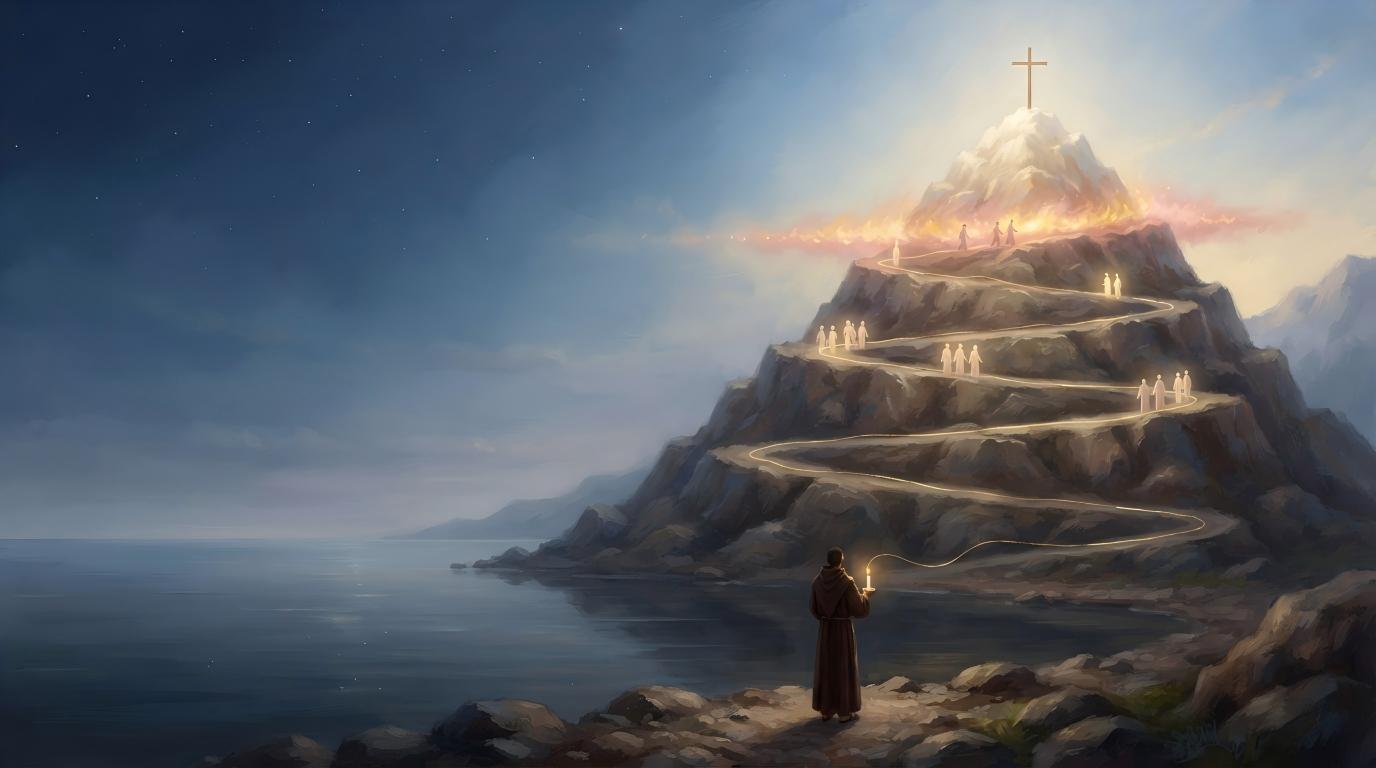
Our dead have already reached that evening. They can no longer speak, make amends, or express any gesture of love on earth. Yet the desire for love still burns in them, purifying them until their love is drawn wholly into Love in God. We are still in the day, and this examen asks what we are doing with it. It climbs Dante’s mountain in five terraces and rests on Spe Salvi 48: love crosses the threshold of death, and “it is never too late to touch the heart of another, nor is it ever in vain.”
In November, the Church on earth and the Church being purified walk one road toward God, bound by memory, love, and intercession. Carmel knows this road. Dante’s climb up Mount Purgatory mirrors John of the Cross’s Ascent of Mount Carmel, where the way up is love being made pure.
Pray it the Carmelite way: with few words and long silences. When a name or a face comes to you, stay with it in God and stop reflecting but love.
Allow 20 to 30 minutes. Keep the names of your dead before you, written down, or held in mind. Pray it alone, in choir after Vespers, or with a group. In a group or family setting, one person reads, and there are two or three minutes of real silence wherever you see Pause.
At the Foot of the Mountain
Dante’s Purgatorio begins on a shore at dawn. The pilgrim has climbed out of darkness and can see the stars again. Our dead are not far away. We meet them where God lives, in the depths of the heart.
- Settle your body and let your breathing slow.
- Turn inward to God the Almighty Father who lives in you, in whom your dead now live.
- Remember that you belong to one family “in heaven and on earth” (Eph 3:15).
- Ask for the grace of this prayer: Lord, let me remember my dead with your love, and let my love reach them.
Pause.
First Terrace: Remembering With Gratitude
Gratitude is the first gift we can still give the dead. For Dante, the souls ask to be remembered. They do not want fame. They want the prayers of the living. Manfred sends word to his daughter because “here, through those beyond, much is gained” (Purg. 3.145).
Carmel knows this attitude. Teresa wrote her Life to praise God’s mercies. In it she remembers her own people by name, above all her father, whose death she was present for (Life 7). For her, memory is a form of friendship: we hold our dead in the One who holds them.
- Slowly name the people you have lost.
- For each one, recall a single gift they gave you, or expectations not met for lack of time, such as a word, a habit of faith, or a kindness, and give thanks for it.
- Which of the dead has no one left to remember them? Take them into your prayer as well.
Pause.
Second Terrace: No One Is an Island
Our lives were bound up with theirs, and they still are. On the terrace of envy, Virgil teaches that heaven’s joy grows the more souls call it “ours” (Purg. 15.55–57).
Carmel lives this exchange in both directions. As a girl tormented by scruples, Thérèse turned to her four elder brothers and sisters who had died as infants, and she found peace (Story of a Soul, Manuscript A). Before her own death she promised to spend her heaven doing good on earth. The dead do not stop loving us.
- Where did their lives spill over into mine for good? And where does that result in harm?
- Is anything unfinished between us, such as words not said, a hurt not forgiven, or thanks never given?
- Can I let mercy give me the courage to remember and look forward?
Pause. Tell them, or tell Christ about them, whatever remains unsaid.
Third Terrace: The Fire That Heals
Purgatory is not a torture chamber. It is the encounter with Christ himself. “Before his gaze all falsehood melts away” (Spe Salvi 47). The pain is “a blessed pain”; his love burns through us until we become fully ourselves and fully God’s. Pearson says the light of God is the same for every soul, and only our readiness to receive it differs. We are ready for heaven’s shared life only when we can love wholly.
John of the Cross knew this fire from the inside. John even teaches that people purified by love in this life do not need purgatory (Dark Night II.20.5). Our nights of grief and dryness are that fire wall already at work.
At the wall of fire Dante cannot bring himself to move. He steps forward only when Virgil tells him, “between Beatrice and you is this wall” (Purg. 27.35–36).
- What “straw” in my life would not survive that gaze (1 Cor 3:12–15)?
- Where is Christ already purifying me now, through suffering, loss or grief?
- Whose love draws me through the fire, as Beatrice drew Dante?
Pause. Then ask for the grace of contrition without fear.
Fourth Terrace: Love That Crosses the Threshold
Intercession is charity that will not stop at the grave. Because our lives are joined, “my prayer for him can play a small part in his purification.” Dante shows this charity at work. Forese Donati has climbed high in only five years, carried by the hidden tears and prayers of his wife Nella (Purg. 23.85–90). Hidden intercession is Carmel’s own vocation. Teresa founded her houses on prayer (Way of Perfection 1). Thérèse trusted that “the fire of love is more sanctifying than the fire of purgatory” (Story of a Soul, Manuscript A). When we pray for the dead, we share in that hidden work.
- Whom will I carry to the Eucharist this month?
- What can I offer for them: a Mass, a prayer, a fast, alms? (Spe Salvi 48)
- Do I believe that my small love, joined to Christ’s, matters to them?
Pause. Commend each name to God.
Fifth Terrace: The Heart of the Examen — One Beloved
We have come to the heart of this exercise. Now choose one person who kept surfacing for you and hold them before God. Examine your disposition toward them in the light of John’s question. Take one movement at a time, and stay with whichever one stirs you.
Love given. What love did I give them while they lived? Where did I hold back time, patience, tenderness, or a visit I kept putting off? What love do I give them now: prayer, the Eucharist and faithful remembrance, or only nostalgia?
Love received. What love did they give me that I received only in part, or noticed too late? Can I receive it fully now, with gratitude rather than regret? Is there love from them that I still refuse, because receiving it would mean forgiving them?
Love that can no longer be spoken. They can no longer speak to me, make amends or show me tenderness. Can I trust that love’s fire is finishing in God whatever they left unsaid? What have I left unsaid to them, and will I say it now to Christ, in whom they live?
Love still burning. Is my grief turned toward them in God, or back toward myself in pity? Is my bond with them possessive, wanting them back, or offered, wanting them wholly in God? Do I hold on to anger, guilt, or an idealised picture that stops me loving them as they truly were?
To release them into the fire of love is not to lose them. Dante went into the flames because Beatrice was on the other side. We love our dead best when we love them where they now are: on the way to God.
Pause. Speak to Christ about them, then rest with them in silence.
The Summit: Saved by Love
The summit of this examen is a decision, not a feeling. “Our hope is always essentially also hope for others,” (Spe Salvi 48). Devotion alone does not save us; a commitment to love does. The love we offer the dead must reach the living too. Hope is a “disposition to act”; when we hope, we start building God’s future today.
- What one act of love will I do for someone living, in memory of my dead?
- Who near me is grieving and needs me to be with them?
- How can I live now so that my own passage through the fire is quicker?
Pause. Make one concrete resolution.
Closing Prayer
Lord Jesus Christ, our Judge and Saviour,
living flame of love, you wound only to heal.
Take into your gaze everyone we have named,
and those whose names you alone know.
Where any stain remains, let your love burn it away.
Where they wait, let our prayer bring them refreshment, light and peace.
Keep us bound to them in the communion of your Body.
Teach us to love the living as we now love the dead,
until we come together to the mountain which is Christ,
and to the table of the eternal feast. Amen.
Mary, Star of Hope, pray for us.
Eternal rest grant unto them, O Lord, and let perpetual light shine upon them. May they rest in peace. Amen.
May their souls, and the souls of all the faithful departed, through the mercy of God, rest in peace. Amen.