
V/ My eyes are turned to you, O Lord.
R/ You are the joy and gladness of my youth.
V/ Grant me the Wisdom that sits by your throne.
R/ That I may dwell as a child in your presence.
Let us pray
Lord, in Your all-providential plan, You have led me to this moment to rediscover myself in Your Word and Wisdom. Aid me to make this time of meditation and prayer enriching, transforming, and liberating for my well-being and others.
GOD TRUSTS AND HE ENTRUSTS… WE USE OR LOSE
By Dr Rathan N. Almeida, OCD
33rd SUNDAY IN ORDINARY TIME, YR A
Proverbs 31:10-13, 19-20, 30-31; Psalm 128:1-5; 1 Thessalonians 5:1-6; Matthew 25:14-30
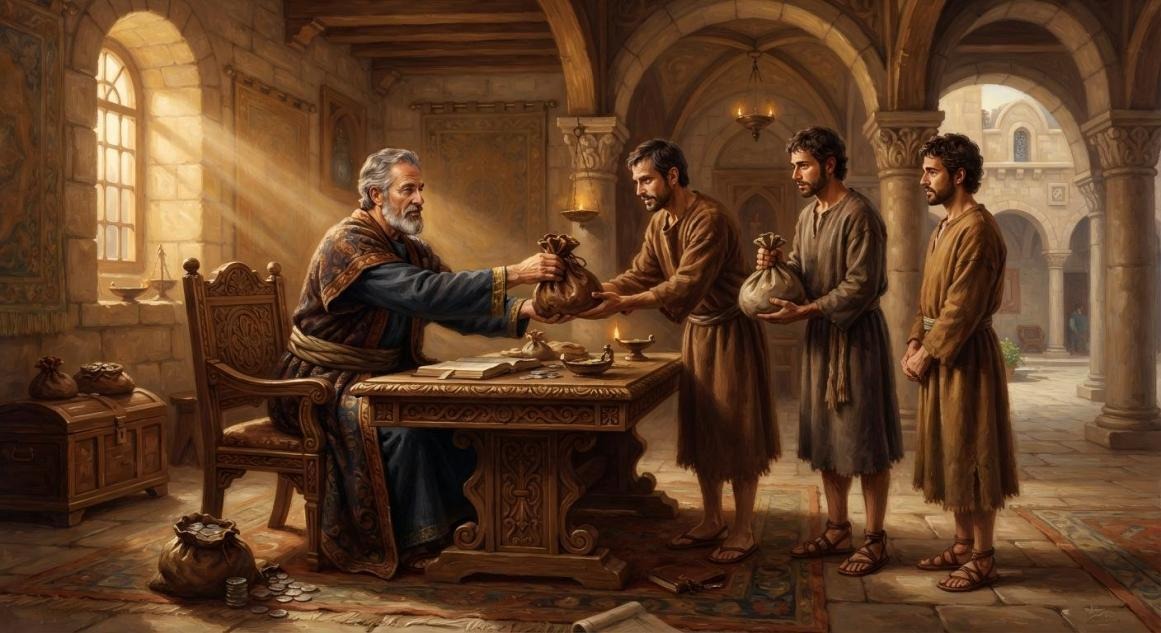
In today’s parable, only two servants made it to the end; the third servant was happy being inactive and passive, and took things easy. In the first century, a talent was the largest unit of currency available, worth about 6,000 denarii. A denarius was the usual payment for a day’s labour. At one denarius per day, a single talent was therefore worth sixteen years of labour.
The third servant, who received one talent, simply waits for the master to come back, so that he can return what he was entrusted with, perhaps saying, “Here you go — it’s all there, just as you left it with me.” His passivity makes one ask: “What’s so wrong with being cautious? Discretion and deliberateness are virtues, not vices.” Yet in the case of this third servant, these virtues become vices. Prudence and wariness easily become self-protectiveness and restraint. Inhibition turns to fear, and the servant ends up refusing the risk of trading in the marketplace. And yet, when the master returns, the prudent decision of the servant is not rewarded.
It is a hard story to swallow. It is not as if the third servant squandered these funds on sumptuous dinners and fine wines. He did not buy an iPhone 12 or go on an all-night shopping spree on Black Friday. He simply maintained what was there, in what he thought to be a reasonable and safe venture. And that seems to be the heart of one significant issue Jesus is trying to teach. The point here is not really about doubling your money and accumulating wealth. It is about living. It is about investing. It is about taking risks.
The greatest risk of all is not to risk anything: not to care deeply and profoundly enough about the things entrusted to us, not to give our heart and soul to the things that matter most in our life. The greatest risk of all is to play it safe, to live cautiously and prudently, without even giving it a try.
The German pastor and theologian Dietrich Bonhoeffer, who struggled with his own calling and who witnessed such struggles in his society during those serious and testing times, boldly wrote: “The sin of respectable people is running away from responsibility.”
There are five valuable lessons that this Parable of the Talents teaches us.
1. Success is a product of our work. Work has never been alien to human beings, because right from Genesis we see God placing Adam and Eve in the garden to work it and take care of it. As Christians, we have a mission in the garden where God has placed us today, a mission that our Lord expects us to accomplish here and now. We are to work, using our talents to glorify God and serve the common good, and thus extend God’s kingdom.
2. God always gives us everything we need to do what he has called us to do. We might feel sorry for the third servant who received only one talent, but we are reminded that, in reality, even that one talent was a huge amount. He was given more than enough to meet the master’s expectations. God has blessed all of us with gifts and talents, and he expects us to do more than just passively preserve what has been entrusted to us.
3. We are not all created equal. The master gives each servant talents, “to each according to his ability”, explains the parable. It is clear that the master understood that the one-talent servant was not capable of producing as much as the five-talent servant. We need to accept the reality that we are not all equal. Diversity is woven into the fabric of creation. We need to thank God for the talents he has blessed us with and, instead of wasting time comparing our talents with others’, get going, using our talents and being productive.
4. We work for the Master, not for our own selfish purposes. The talents given to the servants are not their own, and the money these servants earn with the capital is not their own either. The servants are only stewards of the master’s investment and will finally be rewarded for their efforts and commitment. Care should be taken that we make the most of our talents not for our own selfish purposes but for the glory of God.
5. We will be held accountable. This parable is all about how we use our talents and work to fulfil our earthly calling. The unfaithful steward did not so much waste the master’s money — it was kept intact — but he wasted a great opportunity. This made the master call him wicked and lazy. We are all called to be responsible for what we do with what God has entrusted to us, and one day we will be held accountable. Let us not waste time postponing such opportunities, because we do not know when the master will return and start settling accounts.
The life of St Thérèse of Lisieux particularly consoles us, because she clearly communicates that not everyone receives five talents, not everyone receives two, but everyone receives something. All of us have been given money, possessions and position, and God wants us to use them while we await the return of our Master. Pope Francis teaches us that this Parable of the Talents reminds us of personal responsibility and of faithfulness to what God has entrusted to us. This will always enable us to set out anew, walking new paths, without burying our talents, and always being accountable.
Prayer
Lord, you trust us and have entrusted us with talents, gifts and blessings. Help us to use them for your greater glory and for the good of humanity. Amen.
Ponder Questions
Sometimes we bury the gifts God has given us because of fear, insecurity, excessive attachment or lack of trust. St John of the Cross would invite us to ask ourselves:I
- What attachments prevent us from becoming fruitful?
- Are we afraid of surrendering ourselves completely to God?
- Are we using our gifts for God’s glory, or merely protecting what we have?
Practice for the Week
Learn to free yourself from everything that hinders your friendship with God. Place your life in his hands, and he will hold you close to his heart. Find joy in giving and sharing, and God will certainly refill you with more.
Phrase to Quote
“The greatest risk of all is not to risk anything.”