
V/ My eyes are turned to You, O Lord.
R/ You are the joy and gladness of my youth.
V/ Grant me the Wisdom that sits by Your throne.
R/ That I may dwell as a child in Your presence.
Let us pray:
Lord, in Your all-providential plan, You have led me to this moment to rediscover myself in Your Word and Wisdom. Aid me to make this time of meditation and prayer enriching, transforming, and liberating for my well-being and others.
THE IRREVOCABLE GIFT IN CHRIST
By Clement Obiorah
21st SUNDAY IN ORDINARY TIME, YEAR A
Isaiah 22:15, 19-23; Psalm 138(137):1-6, 8; Romans 11:33-36; Matthew 16:13-20
The liturgy for this Twenty-First Sunday in Ordinary Time presents a profound convergence of divine providence and the deepest realities of the spiritual life. To understand this profound reality, we must first look to the historical and institutional security of God’s design. The first reading from Isaiah forms a perfect, classical typological pair with the Gospel of Matthew. Through the figures of Eliakim and Peter, we are confronted with the unfathomable outlook to grace.
In Isaiah, Eliakim is granted total administrative authority, symbolised by the placing of the key of the House of David upon his shoulder. To the ancient Hebrew mind, the pairing of opposites—opening and closing—is a “merism” signifying absolute control; no one may interfere with his stewardship. In addition, God promises to fasten Eliakim “like a peg in a secure place,” establishing him as an unshakeable point of stability for his people.
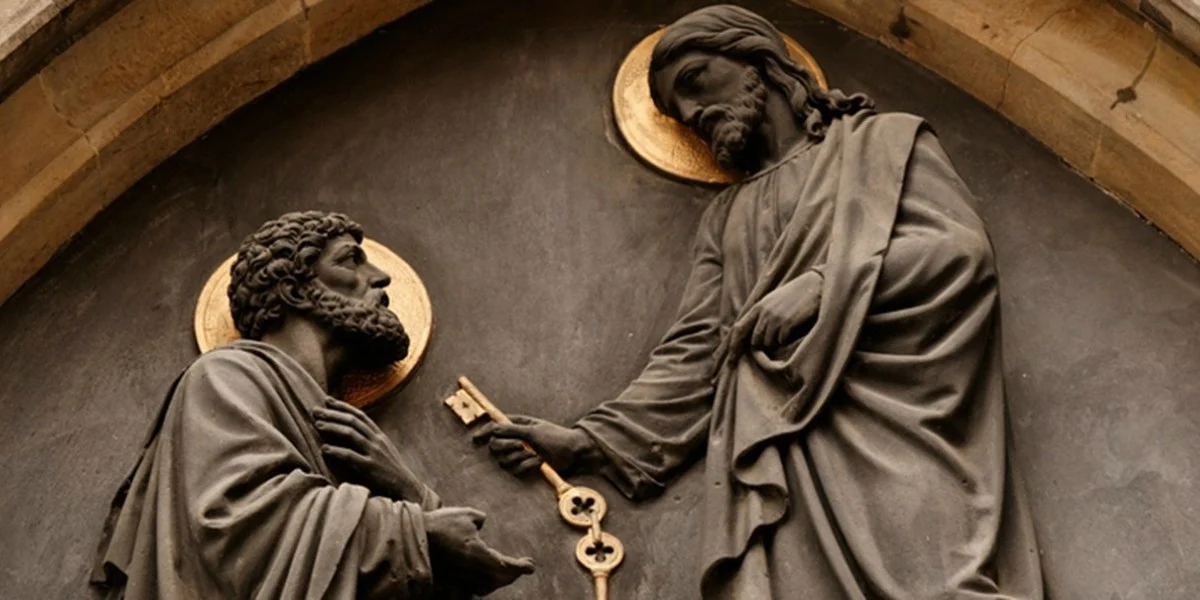
In Caesarea Philippi, Jesus elevates and fulfills this. Peter is appointed as the foundational Rock of the new people of God. Using an equivalent pairing of opposites—“binding” and “loosing”—Christ grants Peter total, delegated authority over the Church. He is handed the “keys of the kingdom of heaven,” a kingdom that represents the fullness of God’s sovereignty established on earth, gathering all creation into the worship and glory of the Father. Peter’s confession of faith is explicitly identified by Christ not as a deduction of human intellect—not of “flesh and blood”—but as a pure gift from our participation in the Son’s relationship with the Father. Such that the institutional permanence of the Church rests entirely upon this unshakeable divine invitation: “God so loved the world that he gave His only begotten…” Here St. John of the Cross reveals the more absolute totality, finality, and irrevocable nature of the Father’s gift to humanity: His only begotten Son. He says in his Sayings of Light and Love (Maxim 26):
“You will not take from me, my God, what you once gave me in your only Son, Jesus Christ, in whom you gave me all I desire.”
Highlighting the primacy of the Father’s initiative, Paul in his Letter to the Romans asks, “Who has given a gift to him that he might be repaid?” The resounding answer is no one. Recognising this sheer grace, St Paul yields to awe. He bursts into a doxology praising God’s inscrutable wisdom: “How unsearchable are his judgements and how inscrutable his ways!” The entire edifice of the Christian life is freely given. The Psalmist echoes this supreme confidence in eternal, merciful love, pleading, “discard not the work of your hands.” The Church—and indeed, every individual soul—is precisely this work, sustained not by its own merit, but by the faithfulness of the Divine Craftsman.
What the Father establishes macrocosmically in the visible Church (the secure peg, the unshakeable rock, the keys that bind and loose), He also establishes microcosmically within the depths of each soul through the Word Incarnate. St Paul tells us that all things are from, through, and for God. St John of the Cross intimately personalises this: by giving us Christ, the Father has spoken His definitive, eternal Word, holding nothing back. The “keys” given to Peter exist precisely to unlock this spiritual edifice for the faithful, guarding the purity of the Word and the life-giving grace of the seven Sacraments.
Just as Christ promised that the gates of hell will not prevail against the Church, St John of the Cross gives voice to the mystical certainty that God will never revoke His ultimate gift of Christ as the life of the soul who remains in communion. Our interior peace is secured exactly as the Church’s foundation is secured: by resting entirely upon the objective reality of what the Father has already given.
When Peter recognises that Jesus is the Christ, the veil of human uncertainty is lifted by a shaft of divine light; it is an encounter with the living God acting intimately among them. Christ responds with staggering generosity: He gives Simon a new name. To name something is to claim it, to draw it into one’s own domain. Simon becomes Peter—Petros, the Rock. Jesus, the “Rock of Ages,” takes Simon to Himself, transforming his very identity and destiny for an eternal good.
This dynamic of naming and claiming is the reality of our Baptism. Baptised in Christ, His name has been irrevocably invoked over us. We have been claimed by Him and drawn into the very life and mission of the blessed Trinity, which the Church continues until the end of the age. Like Peter, our faith is a gift of the Father. Like Paul, we must bow before the unsearchable riches of a God who gives so lavishly. Grounded in this truth, we can stand firmly amidst the trials of life. The gates of hell cannot prevail, for we possess an unshakeable confidence in the depths of our souls: God will never take back the gift of His Son, in whom we already possess everything we could ever desire.
Prayer
Lord God, source of all grace, as the name of Jesus has been called over us in Baptism, claim our entire lives and draw us deeper into the life of the Trinity. May we know no other desire than Christ, who lives and reigns with you for ever and ever. Amen.
Ponder Questions
- How does seeing your faith—as a pure gift from the Father rather than a human achievement—change the way you approach prayer and spiritual life?
- In what specific areas of your life are you tempted to seek security outside of the irrevocable gift of the Father?
- How would being “named and claimed” by God shape your daily responsibilities and witness to the world?
Practice for the Week
Set aside ten minutes each day to sit quietly with St John of the Cross’s maxim: “You will not take from me, my God, what you once gave me in your only Son, Jesus Christ, in whom you gave me all I desire.” Whenever a worry, anxiety, or sense of lack arises during the week, gently bring this maxim to mind, consciously surrendering that anxiety into the absolute finality and sufficiency of Christ.
Phrase to Remember
LORD, discard not the work of your hands in me